
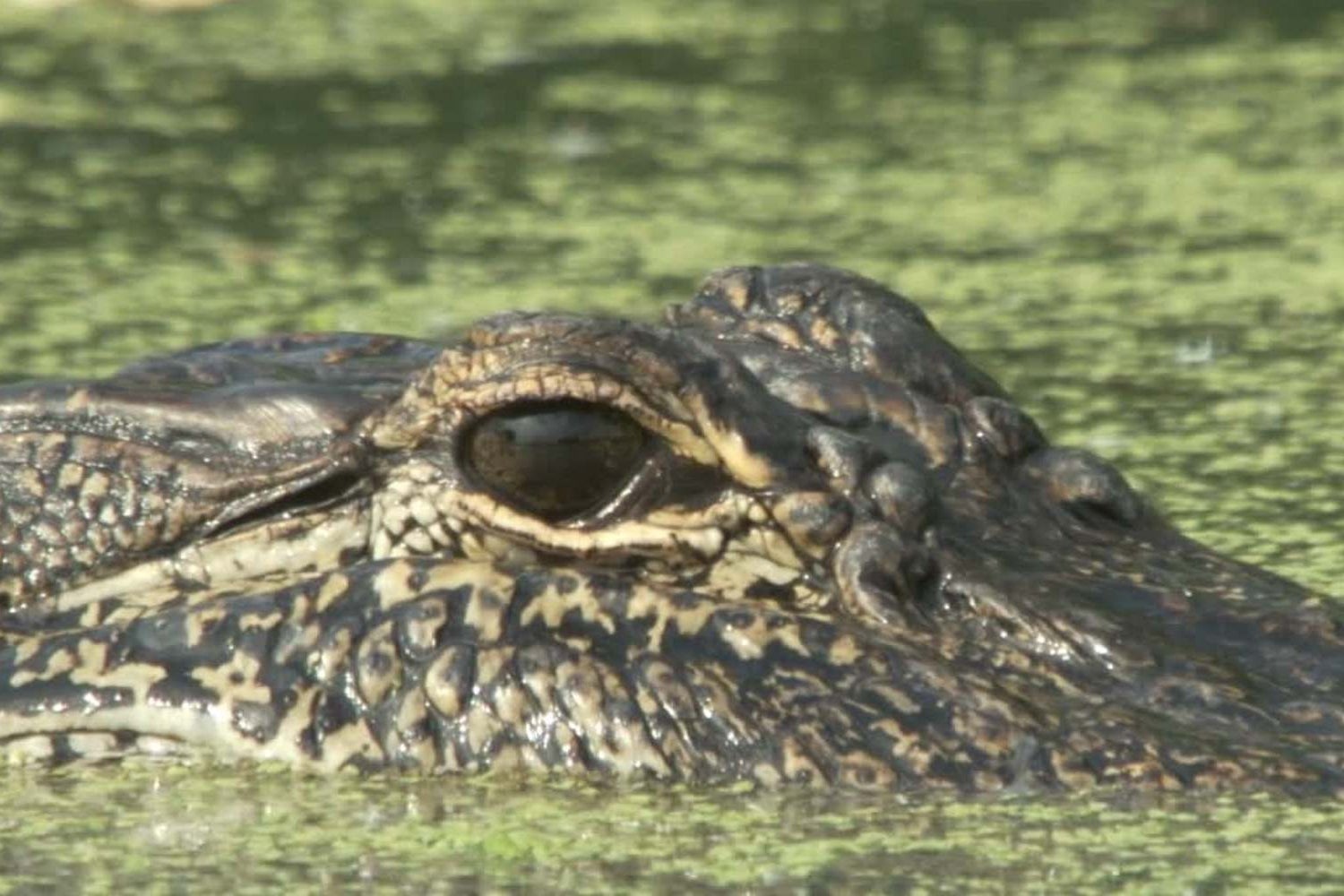
In the luxe suburbs of northern Tampa, schoolchildren zip down empty streets on candy-colored scooters. Grills crackle to life on lacquered wooden decks. Young mothers, all Pilates-trim, gossip in lush backyards; dads unload child seats from enormous slate-gray SUVs. Cloistered between all of these million-dollar homes is a stately retention pond, burbling in the reddening late-afternoon sunlight. I am standing on its muddy shores, watching, with some apprehension, a 6-and-a-half-foot alligator. Its pewter eyes blend in with the reedy shallows. The only thing betraying its camouflage is a silent V-shaped ripple it leaves on the water’s surface. It appears to be swimming right toward me.
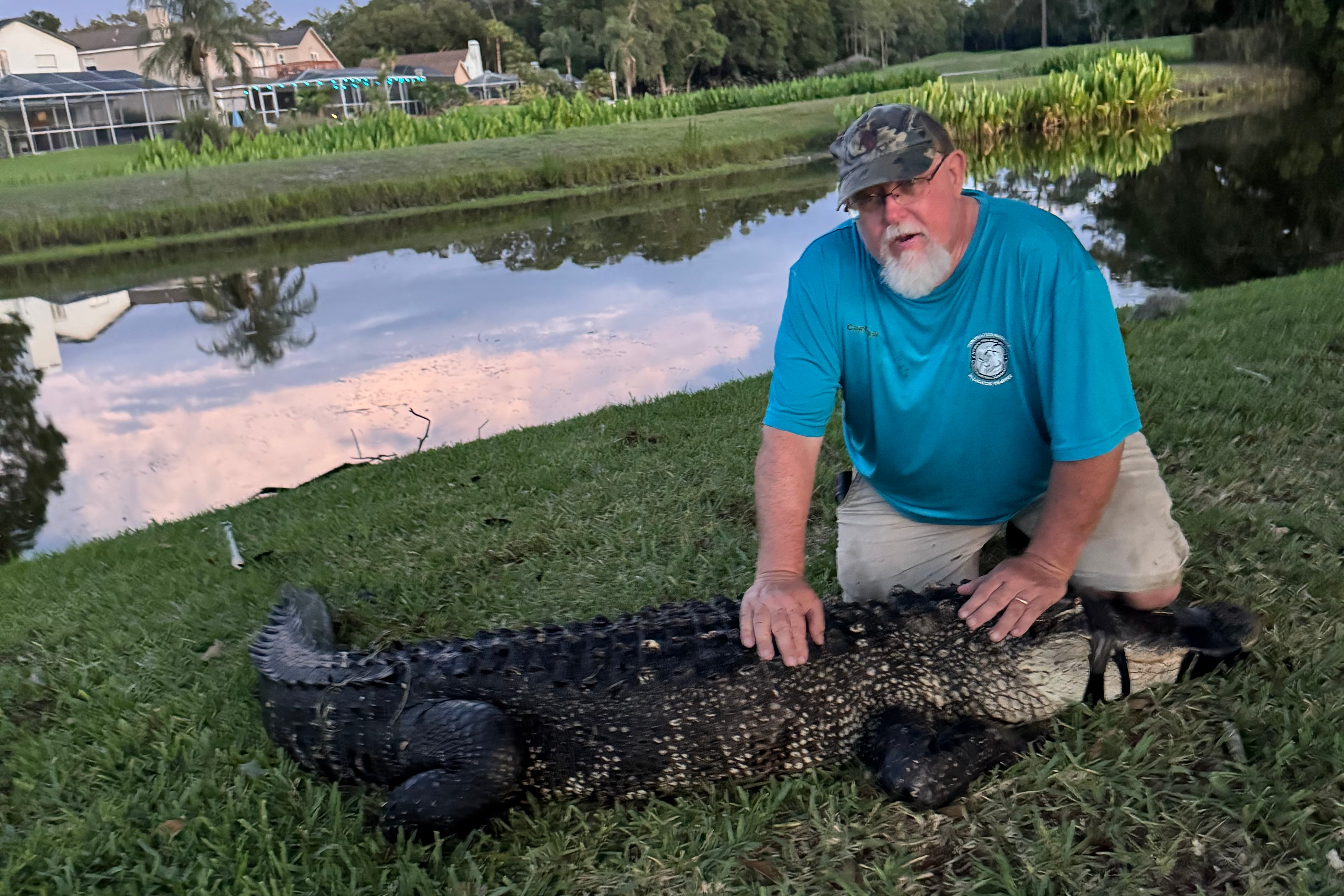
A few paces to my right, brandishing a fishing rod fastened with a triple-pronged hook, is 66-year-old Phil Walters. He is what the state of Florida designates as a “nuisance alligator trapper,” and he’s been summoned here because someone in the neighborhood wants this particular gator dead. Walters whizzes the fishing line, almost translucent in the heavy sun, through the air, dropping the hook a few inches away from the creature. He holds up a palm in my direction, admonishing me to remember what we talked about a few moments ago: Stay quiet until the line is set, no sudden movements, and, for God’s sake, remain calm. Walters carefully reels his line inward, tracking the gator’s drift, until suddenly it goes taut.
The hook has plunged deep into the animal’s scaly flank, piercing its armor. The gator tows the line farther out into the pond, bending the rod concave with incredible torque. Then, realizing how much trouble it’s in, it starts to panic. It flails its tail and gnashes its teeth, tumbling over itself to expose its smooth white underbelly to the sky, drawing on all of its instincts to defeat the infernal machine that has snagged it. Walters hands me the rod and tells me to hold the gator in place, as close to the shoreline as possible. He picks up a coil of rope tipped with a cruel-looking iron hook and lassos it out into the pond, across the gator’s back, pulling it through the water until it buries deep into one of the gator’s moss-green shoulders. Walters says there are three steps in catching an alligator: hooking it, beaching it, and dominating it. “We’re about 99 percent of the way there,” he tells me.
An audience is gathering now. Families pour out onto mesh-screened patios, children press their noses against windows, mothers crane their necks from marble kitchen islands. With the rod and the rope as leverage, we heave the alligator onto the shore, where it becomes slack, worn down from the resistance of the line. “Sit on it,” Walters commands. I plop down on its shingled ridges, which are glossy with swamp muck. Walters places two slits of black duct tape over its eyes, wheeling the spool in a mummifying pattern around its snout, neutralizing the immense power in its jaws. Finally, he jackknifes a metal pole, studded with a scythelike spike, under the gator’s chin, where blood is spilled for the first time—a dark, watery trickle. With both hands on the pole, I drag the gator away from the retention pond in the same way you might pull a wagon, its limp claws dragging on the grass until we get to asphalt. Walters rummages under its tail. It’s a girl.
This gator has not committed a crime. She hasn’t eaten a dog or devoured a child. Instead, she is one of the 10,000 or so gators that are reported as “nuisances” to Florida officials each year. The Statewide Nuisance Alligator Program was chartered in 1978 in response to the “public safety problem” created by an “increasing incidence of alligator attacks on humans,” according to a paper published by Florida Fish and Wildlife Conservation Commission leadership in 1989. A nuisance alligator, according to the FWC, is any gator that is “believed to pose a threat to people, pets or property.” If a Florida resident has decided that an alligator fits that criterion, they can call the Nuisance Alligator Hotline—its digits spell out the word GATOR—and someone like Walters, who is one of the 100 or so nuisance trappers contracted by the state, will be dispatched to “resolve the situation.” What happens afterward depends on the size of the animal. If the offending alligator is under 4 feet, it will be relocated to another pond. Any animal above that threshold, meanwhile, will almost certainly be “harvested”—killed and disposed of—according to the commission’s mandate.
For the past week, I have driven the width of Florida, from Jacksonville to Miami, to get a better understanding of this program. Throughout the journey, I have honed the basic strategies of the gator hunt: its tools, techniques, taboos, and best practices. I have sat in tiny boats, floating on green lagoons whose murky depths teem with 12-foot leviathans. I have locked eyes with the terrifying alphas of the swamp, and I’ve cradled freshly hatched younglings in search of a sweaty fen to call their own. I’m now savvy enough to know what a midsized adult male gator could fetch on the open market. What remains a mystery to me, however, is why this particular alligator—floating peacefully in a retention pond—was deemed to be a threat. The more time I’ve spent around these animals, the less sure I’ve become that anyone could ever make such a determination.
Most native Floridians maintain a blithe attitude toward their reptilian neighbors. Living alongside alligators is, as one friend from Orlando, who was annoyed I was writing about this at all, told me, “a nonissue.” (“They’re in every suburban retention pond, and they’re very easy to avoid,” he scoffed.) But the Florida government keeps the program around for when one of the animals shows up in a swimming pool or community lake or, really, anywhere else a human being might not want one. Headlines about horrific attacks, however rare and isolated, surely do not help. The hotline is in easy reach to assuage those fears. In total, trappers killed 184,047 nuisance gators between the years of 1997 and 2021.
I never did learn exactly why the suburban Tampa alligator had been reported as a nuisance. There were indeed rumors of dogs getting too close to the water and macabre fantasies of toddlers getting swallowed whole. Mostly, though, it seemed that someone in the neighborhood simply wanted this alligator gone, because alligators make them uncomfortable.
Walters and I lift the alligator up onto the tailgate of his Dodge, its cabin glinting with miscellaneous gator-trapping equipment, most of which is necessary only if you’re taking down a monster twice the size of the one in our hands. The neighborhood children lope down the sidewalk from all angles, their parents a few paces behind. Word has spread quickly of our bounty. The kids want a picture with the gator, which is motionless and defeated but not yet dead. Walters produces a waxy, burnt-orange wallet indented with scales, teasing the crowd about the fate that may someday befall this unfortunate animal.
A woman walks up to the crown of the creature, its scales drying out. “Poor thing,” she says, resting a hand on its back. It blinks its eyes against the black tape. Walters hauls the gator into the cargo bed and closes the tailgate. It thrashes around for a while, thumping the truck with tectonic force as we merge onto the highway. A few minutes later, it crawls to the darkest corner it can find and goes quiet.
Had something gone wrong with this capture, there is a chance I’d be down a finger. The alligator is an apex predator, after all. But what I went on to see in Florida made it clear which animal had a more rational fear of the other.
The story of the American alligator doubles as one of the greatest conservation successes in history. The earliest known alligatoroidea appeared 87 million years ago and are differentiated from their cousins in the broader crocodilian milieu for their U-shaped snout, their aversion to salt water, and a unique skeletal formation that allows the bottom of their jaw to slip neatly inside its upper half. (This is why an alligator’s top teeth protrude with carnivore menace when its mouth is closed.) There is some debate about when the American alligator came into its evolutionary prime, but fossils with a modern physiological structure are at least 7 million years old. Some of those remnants have been found as far north as western Canada, suggesting that during warmer epochs, alligators—or something like them—could be found across the continent, before cooling temperatures restricted them to its muggy southeastern reaches. The animal’s name was coined by the French zoologist Georges Cuvier, who formalized the genus Alligator. The term is likely a corruption of the Spanish word for “the lizard,” el lagarto, a term that early Floridian colonists used to identify the dinosaurian beasts in their waterways when the state was still a possession of Spain.
The Alligator genus contains only two species: the American alligator and the critically endangered Chinese alligator, the latter of which suffered apocalyptic habitat destruction as the marshlands of the Yangtze River were woven into rice paddies and today maintains a population of fewer than 200 in the wild. For a time, it seemed as if the American alligator were destined for a similar fate. The reptile’s native biome, a wide band of wetlands ranging from South Carolina to Texas, steadily eroded with settler expansion. By the late 19th century, as alligator leather became a luxury textile, poachers hunted the animal to the brink of extinction. According to one estimate, 3.5 million alligators were killed in Louisiana alone between 1890 and 1930. By the 1950s, some conservationists feared that only 100,000 alligators still existed in North America.
This trend line reversed completely with the passage of the Endangered Species Act, signed into law by Richard Nixon in 1973. The measure granted the American alligator protected status, and the government heavily restricted gator hunting, prohibited the sale of wild hides, and enforced environmental safeguards on wetlands. The population flourished afterward. Today there are some 5 million alligators in the United States, with 1.3 million just in Florida. In fact, the scale of the rebound is so strong that some zoologists—like Frank Mazzotti, a professor involved in Croc Docs, a crocodilian-centric research program at the University of Florida—theorize that those midcentury conservationists, who did not have access to satellite imagery or fancy-schmancy tracking data, may have overestimated just how endangered the American alligator was in the first place.
“I’ve read the journals of the hunters of that era, and they only hunted alligators in the areas they had access to,” Mazzotti tells me. “Those alligators maintained a strong population in wetlands that those hunters couldn’t get to. That’s one of the reasons for why they responded to the conservation efforts so quickly.”
Whatever the case, by 1987 the American alligator had demonstrated enough staying power that the animal was taken off the endangered species list. The Florida Fish and Wildlife Conservation Commission—better known as FWC—formally decriminalized alligator hunting a year later, allowing adventurers to once again prowl the state’s public swamps, albeit under institutional scrutiny. Hunting licenses are scarce and monstrously expensive, running $271.50 for Florida residents and in the low four figures for anyone outside the state, and are all awarded via raffle.
The FWC had already created the Statewide Nuisance Alligator Program almost a decade earlier, owing to that reputed “increasing incidence of alligator attacks on humans.” When I reached out to the commission for further context, a representative told me that between Florida’s increasing population and expanding tourism sector in the 1970s, the agency was “receiving more alligator-related complaints,” which made “case-by-case relocation increasingly impractical.” Therefore, the nuisance system was established to “provide a consistent, regulated way to address alligators” while conserving their density in the wild.
But that representative also conceded that alligator bites are “relatively rare,” and that the program doesn’t specifically exist to euthanize the animals after they have deliberately attacked a human being. This point is reflected in the commission’s own records. The FWC has tabulated the number of statewide unprovoked alligator bites—as in, conflict with an alligator that can’t be chalked up to harassment or mishandling—consecutively every year since 1971. During that time, just 342 of those incidents have been classified as “major,” meaning that the injuries sustained required serious medical intervention. (Of those attacks, 32 were fatal.) Minor attacks, a term that refers to injuries that can be patched up without a trip to the hospital, are rarer; the FWC counts only 153 across the same period. Add up those figures, and Florida has witnessed 495 unprovoked bites in 55 years—averaging out to about nine annually. For what it’s worth, 1977 was a relatively high-water mark for gator carnage, with 14 incidents, which may further explain why the FWC moved to intervene.
All of this is to say that alligators are typically shy, defensive, and preternaturally uninterested in human conflict, a reality internalized by longtime Floridians. The FWC seems to agree: In all its published material about alligator safety, it reiterates that as long as state residents maintain a deferential distance from the creatures, a peaceful détente will reign in the swamp. In fact, the No. 1 thing you don’t want to do, according to the FWC, is feed your local alligators, because that will allow them to “overcome their natural wariness” and “learn to associate people with food.”
These conclusions are echoed in a study conducted by Mazzotti’s team that found that 96 percent of gator bites, going back as far as the 18th century, are the result of “risky behavior” by the victim rather than overt aggressiveness from the animal. Mazzotti judges that risky behavior on a gradient: The high end constitutes something like night swimming in gator-infested waters after a few glasses of wine; the low end is closer to playing fetch with a small dog along the edge of a silty lake. And, really, when you consider the diverse fauna of the crocodilian kingdom, the only conclusion to draw is that Americans lucked out. If the lowlands of Florida were instead swollen with, say, the much larger Nile crocodile—which is native to sub-Saharan Africa, doesn’t discriminate about the warm-blooded mammals it feasts upon, and therefore gorges on hundreds of human bodies a year—we’d be in a lot more trouble.
Still, the nightmare of being minced to death by a hungry reptile, jaws packing the punch of a shotgun, does happen, and it can happen to you. There are stories of grandmothers getting engulfed by a toothy maw while walking their dog or strolling the grounds of a sedate golf course. In 2023, a panicked man in Largo called the police after spotting an alligator lounging in a canal with the masticated remains of a woman’s body. (“I just couldn’t believe it was real,” he told CBS.) And then there was last May, when the world was transfixed by the tragedy of Cynthia Diekema, who was canoeing with her husband Dave on Tiger Creek, an outlying watercourse connected to Lake Kissimmee, which happens to be the home of Florida’s second-highest concentration of alligators. According to a widely covered FWC report, their canoe rolled over an 11-footer lying flat in the waters. The gator thrashed, tipping over the vessel. The next thing Dave saw was his wife’s torso crushed in the animal’s mouth. He recalled her having a “puzzled” look on her face. Dave attempted to pry her body free of the gator’s grip to no avail, and it swam away. When authorities tracked down the creature, it still hadn’t let go of Diekema.
“Our hearts are shattered!” wrote Dave in the caption of the only Instagram post he’s made since. Attached is a photo of Diekema, looking game for adventure in hiking shoes and a pink blouse, sitting on a trailside rock. “My beautiful angel has flown home to be with her savior.”
Before going out on patrol with Walters, I needed to purchase what the state of Florida calls an alligator trapping agent license. The paperwork would effectively grant me the legal authority to handle gators so long as I was working with someone deputized as a nuisance trapper. I expected a lengthy vetting process, complete with a monthslong waiting period and multiple-choice competency quizzes about gator biomechanics, fail-safes, and emergency protocols, in the same way one would demonstrate the ability to parallel park before being allowed to drive a car. But no, I did the whole thing on my phone in about five minutes. The license cost $54.83, and all the form really asked for was my name and Social Security number. Upon checkout, I clicked through pop-up ads attempting to upsell me on other wildlife accoutrements—long-sleeved T-shirts stamped with the FWC logo, a plastic card embossed with my name and newly attained credentials, and so on. I declined all options and texted Walters that I had my license. “Hired,” he responded.
The home that Walters lives in, nestled in a serene stretch of suburbs in Tampa’s northwestern corridor, is quiet, roomy, and rich with the scent of alligator leather. It is also absolutely covered with Confederate memorabilia. A map of the seceding states, excising everything north of the Mason-Dixon line, hangs on the wall of the small alcove he uses as an office. Next to it is an ornate, sepia-toned certificate that christens the recipient a member of the Sons of Confederate Veterans. Throughout our long day of gator wrangling, he gripes about PETA, communists, Northerners, Nancy Pelosi, Hillary Clinton, Michelle Obama, and his own liberal-leaning brother.
Walters whips out his phone and proudly shows me a photo of himself bundled in a parka, standing in the frigid Washington air on Jan. 6, 2021. (Walters assures me that he did not enter the Capitol, but, nevertheless, the “guys with three letters” still came “banging at his door.”) For the rest of the day, as we drive across town, he pelts me with hardcore MAGA invective, covering terrain that is genuinely avant-garde. For instance: Walters is of the opinion that manatees aren’t endangered, that the whole thing is a liberal conspiracy. Among the constellation of reactionary bumper stickers on the back of his truck, one features a cartoon alligator coiled around seven blocky words: Florida Is Where Woke Goes to Die.
Walters has with him a clipboard pinned with a thick stack of nuisance gator ransoms, each printed with an address, the estimated size of the creature, and a brief description of the complaint (“alligators are in HOA community pond behind address”). Together, those bounties are our itinerary for the afternoon. We roll into yet another gleaming arm in the upper-crust Florida exurbs, the sun glittering on the surface of a tropical-blue basin encircled by gorgeous waterfront homes, and set up shop on the supersaturated green lawn of a lavish estate. We are told that there is a 7-footer somewhere underneath the freckled shimmer of the water. Walters has already been out here several times to try to catch it. He connects his phone to a Bluetooth speaker, which plays a gurgling warble on a loop. It’s a YouTube video titled “Baby Alligator Call Sounds.”
Luke Winkie
The creature never appears. I’m not surprised—the lake is huge, and we’re covering only one small corner of it. I suggest traversing the circumference to see if any obvious ridges materialize on the horizon, but Walters says that such a tactic runs afoul of the strict dictums of nuisance trapping. The contract we are on is restricted to the address of the resident who has filed it, and no others. “That person over there might like the alligator,” says Walters, gesturing across the waterway. “But this one doesn’t.”
We return to the truck, where Walters receives an emergency phone call. Someone in his jurisdiction has discovered a 2-foot-long alligator in their backyard and they want it removed immediately. Sure enough, upon arrival, a family of four is standing vigil around the puny animal, petrified in the tall, dewy grass. No hooks or harpoons are necessary for this case; Walters casually jabs at the gator with a metal pike. It jolts to life, snapping haplessly at the much larger man disturbing it. Walters circles behind the gator’s eyeline and scoops it up with one hand, holding its head perpendicular to his chest. In another world, had this family not called the hotline, the alligator would have likely moved along—slipping out of the yard and down a storm drain, savoring the rejuvenating water, because with time, all alligators eventually return to water. But we do not live in this world, so Walters tapes the reptile’s mouth shut and places the animal in a burlap sack. He twists the top tight. It will sit below the truck console for the rest of the day.
That gator, like every other one that Walters catches, will earn him a $50 stipend from the state of Florida. That doesn’t sound like much, and it isn’t, but it actually constitutes a raise from the $30 the FWC was paying up until 2023. (This is why Walters, like many others in the field, has a number of side hustles around the alligator industry, including airboat tours, hunting guides, and equipment sales.) Still, the bulk of the profit in nuisance trapping has always been derived from the alligator itself, which, from the moment it’s captured, is considered to be the trapper’s property. Historically, this meant a drive to the local tannery. The gator’s skin would be cured into leather and sent overseas to the bigwig European fashion houses—Gucci and Hermès in particular—for wallets, luggage, and handbags. But that market isn’t what it used to be. These days, those same fashion brands prefer to purchase from boutique alligator and crocodile farms, where the animals are hatched from eggs and raised in pens, then produce a pristine, unvarnished hide. Wild gators, on the other hand, are blemished from the scars of the swamp, and manufacturers are now less inclined to turn their patchy, mottled leather into shoes.
“Those farmed alligators give you a perfect skin, and it crushed the wild market,” says Dave Travers, owner of Sebring Custom Tanning, a store that has been churning out alligator leather since 1959. “There was a time back in the early ’90s where it was $65 a foot for wild skins. Now you can get them for $10.”
Instead, the big money for nuisance trappers is to sell their alligators to a different kind of alligator farm—one that essentially functions as an enclosed hunting ground, where trophy chasers pay exorbitant fees to claim an alligator carcass in a controlled environment, with a 100-percent-guaranteed success rate, without interfacing with the various legal tendrils regulating public land. The procedure has been derided by many hunters as a “canned hunt,” in that it forcibly eliminates a gator’s chance to elude the sportsman. Nonetheless, these hunts have proved extremely popular, and dozens of farms across Florida offer them. This has begotten a counterintuitive ecosystem in which wild alligators, basking in lakes and ponds, are ambushed by nuisance trappers, packed into trucks, and driven miles away from home—only to be dumped in another swamp, this one cordoned off by wire fencing, where someone will purchase the opportunity to hunt them all over again.
Participating in these hunts costs a pretty penny. Gator farms charge customers on a sliding scale depending on the length of the animal they want to kill, to say nothing of the commission for harvesting its leather and meat. (Unlike Gucci, people who want to cosplay as alligator hunters for the day care little about the intrinsic qualities of the skin—it is just a trophy, after all.) Central Florida Gator Hunts, one of the industry’s leaders, will help you bag a 12-footer for an eyepopping $6,500. Five-footers, the smallest gators on the menu, are more economical, but they’ll still run you $750. Bill George, a veteran of the alligator business who runs the hunting emporium G&B Gator Gear, tells me that the enclosures themselves can range from wide-open pastures with considerable acreage to “a little pond that someone has put an alligator in.” George also says that these alligator farms often attract out-of-towners seeking a swampland experience that has been exoticized to the max, so some farms are known to accentuate the drama of the hunt, satiating the macho fantasies of their clientele with Disney-style artifice.
“I’ve heard of people putting a gator in a walk-in cooler, getting it all lethargic, and then, when a customer comes by, they say, ‘Oh, look! That’s the one that’s been eating the cows!’ ” George says.
Bullgator Bayou, one of those gator farms, is located conspicuously close to a McDonald’s on a nondescript residential street in St. Augustine, Florida. The property is owned and operated by a licensed FWC nuisance trapper named Adam Burch, who loads me into a golf cart fitted with huge cross-country wheels. The two of us drive down the dirt road—crossing wooden bridges that teeter over muddy gullies—until we arrive at a reservoir about the size of a football field. Burch and I pass through the fence that surrounds the enclosure, which feels a little bit like wandering into Jurassic Park, and we climb a watchtower that looms over the bayou. It is there where you can see the dozens of portentous bubble trails fizzing along the water’s surface. There are more than 150 gators here in total, and every one of them is available to be caught.
Burch has been trapping alligators since 2009, and, like everyone else in the trade, he suffered from the collapse of the wild skin market. (“I used to get $40 a foot. That’s never coming back,” he tells me.) So, these days, when Burch seizes an alligator over 6 feet, he brings it to his farm, buttressing Bullgator’s inventory. The goal is to vertically integrate his share in the nuisance trade, squeezing out the maximum value of his gators without interference from middlemen. “Before, when I’d catch a gator, people would ask me what was going to happen to it, and I’d say, ‘It’s getting harvested,’ which is a nice way of saying it’s getting killed,” says Burch. “Now I say, ‘It’s going to my farm, which is really a hunting preserve.’ The gator may die, but it’s not going to die today.”
Unsurprisingly, Burch says that the majority of his customers come from outside the gator belt and are tacking on a boys’ excursion to a family-friendly Florida vacation. But Burch also maintains that Bullgator’s lagoon—with its coves, inlets, and opaque layer of pond scum obscuring the creatures below—could never be considered the venue of a canned hunt. (“We aren’t going out there and shooting gators with a gun,” he says.) Burch intends to prove this point to me directly. The two of us pile into an aluminum duck boat and shove off from the lichened shores with a couple of fishing rods in tow. It is feeding time: A pile of meat collected from local grocery stores is strewn on the opposite coast, summoning the reptiles from their aqueous depths. The only thing Burch is mindful of are the two 12-footers here, because, in his words, angering them can get a little spooky.
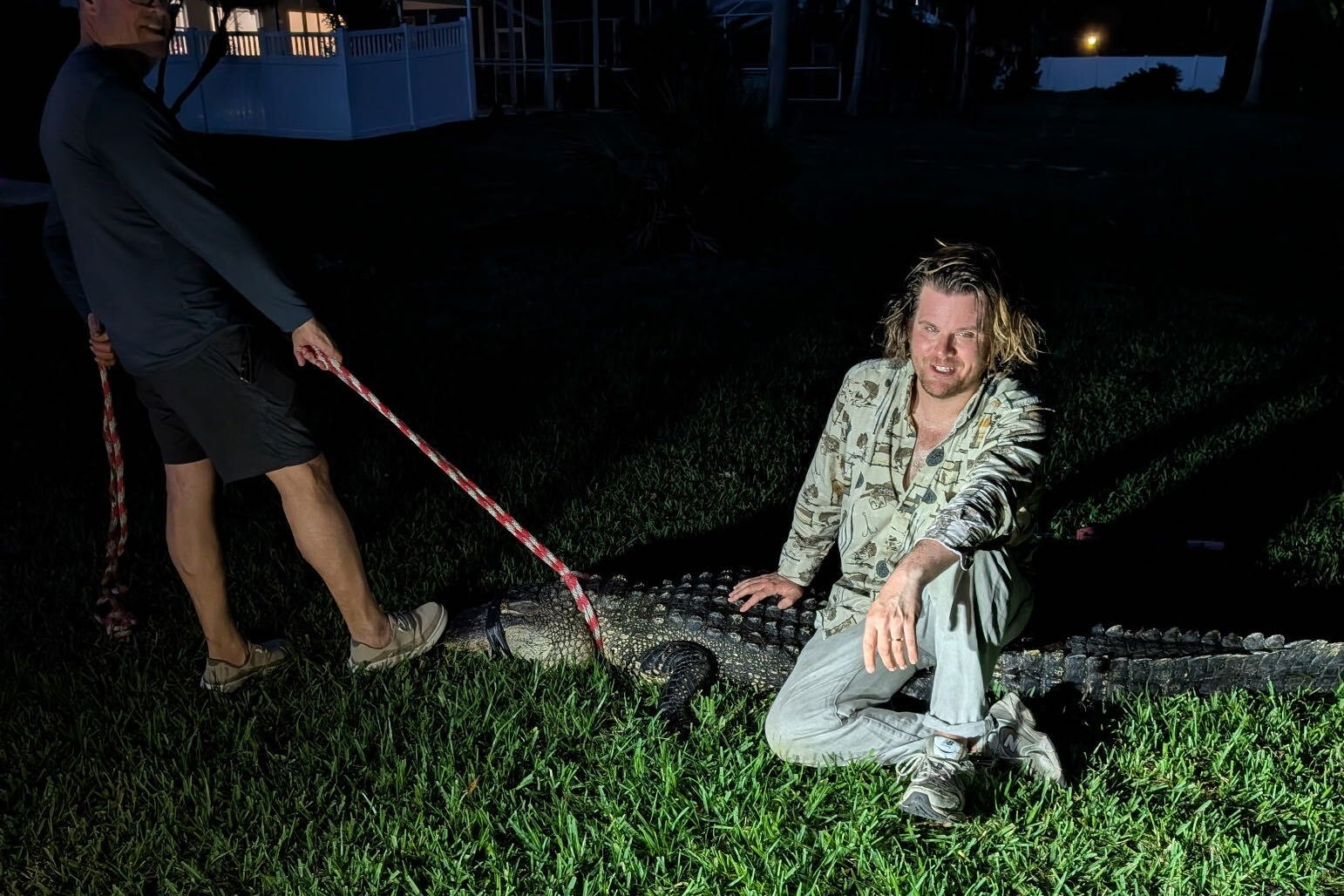
The author posing with an alligator.
Luke Winkie
It doesn’t take long for Burch to hook a gator. Unlike in the wild, where deft tracking techniques are necessary to snag alligators, if you cast in any direction for long enough at Bullgator Bayou, with its mass abundance of the animals, you will eventually have your bounty on the line. He hands the rod to me, and I fight against the gator’s ripping strength, our boat jerking along with its kinetic power. A few minutes later, the alligator yields. I reel in enough slack to lift its body above the waterline. We had hooked it on the bottom of its hind leg. It never stood a chance.
Burch asks me if I want to bring the alligator back to the dock. I could crawl onto its back, wrestle my arms around its neck, and bind its mouth shut. Burch would take photos, consecrating my mastery of the beast for Instagram or elsewhere. I politely decline. The helpless creature hangs uncomfortably portside, submitted to its fate, one claw suspended unnaturally on the line. The same gator that evokes shrieks of terror from the pebbled beaches of HOA ponds can just as easily be the centerpiece of a bachelor party, fraternity brothers in wraparound shades and mud-stained Ralph Lauren button-downs taking pictures with the carcass dangling from the gallows. The alligator doesn’t change in either context—it is simply there, awaiting execution in the muck.
We grant clemency with a heavy pair of pliers, yanking the hook free. The gator splashes into the umbral water, where it will survive for at least one more day, because Burch has two more hunts booked tomorrow.
Contrary to what I expected, the kayak launch at Lake Kissimmee State Park is not wreathed with a memorial for Cynthia Diekema, the woman killed last May. There are no lily bouquets or driftwood crucifixes blessing the shoreline. The only evidence of what happened here is a large warning sign that was posted by the county sheriff shortly after the incident. (“Due to alligator attacks the public is advised to exercise extreme caution,” it reads.) The tragedy also hasn’t altered the vibes at the small camping ground dotting the entrance to the park, where sunburned men load up airboats with Styrofoam coolers and jingling tackle boxes, preparing for a long day on the water. Walk into the gift shop, and the first thing you’ll see is a massive taxidermied alligator crowned with a straw fishing hat. It lies on top of a wide rack of touristy T-shirts, which are illustrated with yet more gator-themed graphics.
“It was just an accident,” says a woman working at the campground’s administrative building, who responds to my question—how has this community reckoned with the fact that somebody got devoured on this lake, making tabloid headlines far and wide?—with a broad smile and total serenity.
“I used to tell my husband that we have lived here for 18 years without an incident with an alligator,” she continues. “Well, now we can say there’s been one.”
The two of us are speaking toward the end of my journey across the wetlands of Florida, and after getting to know so many sons and daughters of this state, I’m not surprised by her breeziness about the matter. If there’s one thing I’ve learned during my time here, it is that native Floridians by and large do not think about alligators the same way the rest of the country does. I imagine that if one were to scurry up the nearby riverbed while we were talking, she would react with cautious bemusement, similar to the way outsiders might to a raccoon. In fact, by far the easiest way to mark oneself as an outsider here—uncultured in the way of the still waters—is to be scandalized by these creatures enough to want them destroyed.
And, really, that is what makes the question that’s been eating at me all trip more difficult to answer: What, exactly, is being tarnished when a nuisance alligator is killed? What is the loss? The state’s gator population numbers have been steady for decades, and there does not exist an organized social opposition to the program’s operation. (People for the Ethical Treatment of Animals’ gator activism is centered on the general leather trade, while the Animal Rights Foundation of Florida focuses on the yearly recreational alligator hunt.) It is unimpeachably true that an apex predator basking in a swimming pool does constitute a problem—to put it lightly—requiring professional intervention. But still, the anxieties here aren’t material. What lingers is this feeling that removing an alligator from its chosen swamp without just cause is violation of an unspoken code of honor. You could call it un-Floridian.
At least so I gleaned from an 87,000-member-strong Facebook group called “Florida Alligators,” which mostly features photos of dewy-eyed hatchlings and impressive behemoths, all studded with fawning heart-eye emojis. Occasionally, though, some members of the group froth with outrage when an FWC trapper comes to their neighborhood looking to harvest a beast in their backyard. “What can I do to advocate for the gator?” one woman posted, attaching a gallery of grainy surveillance photos she had taken of the marshes behind her apartment building, all rigged up with snares that will surely, someday, entangle the local 7-footer she has come to adore. “We have been watching him for two years,” she continued. “He’s never bothered anyone!”
Her anger is slightly misdirected. Those trappers don’t have much of a choice about the contracts they take on. When the state mandates that an alligator be removed, they are expected to deliver results. But the precise criteria the FWC uses to determine nuisance status eluded me. So I called the hotline myself and asked the woman who picked up the phone how the process worked. She told me that if I were complaining about an alligator, an operator would ask a couple of basic questions—if the alligator had approached anyone’s driveway, if someone in the neighborhood had been feeding it—and that any gator on private land is subject to such an interrogation. From there, the agency would make a decision about whether to issue a nuisance bounty. (To put that in perspective, in 2017 the FWC received 13,210 nuisance complaints, leading to the removal of 8,455 gators—a conversion rate of almost 65 percent.)
Still, there are trappers who think this system off-loads much of its judgment to the hotline’s callers and their interpretation of how dangerous an alligator really is. And as I gleaned from the 2-footer in the backyard, frivolous nuisance requests do happen—and that bothers some people in the business.
Consider the case of 67-year-old Allen Register, who refers to himself as a “recovering trapper,” rather than a “former trapper,” because of the stress he endured in the field. Unlike his peers in the nuisance trade, Register never harvested any of the alligators he caught. Instead, he used them to stock the waters of Gatorama, a roadside zoo that he purchased with his wife in 2004.
Register remembers the exact case that made him ready to quit the job: He was assigned to a juvenile alligator 30 miles away from his home that a woman wanted taken out of a pond on her property. There was just one problem: The pond was completely overgrown with lily pads and cattails. He couldn’t see the water, much less the alligator. “I looked and looked and found nothing,” Register says. “There could have been three or four gators in there, for all I knew.”
Register eventually decided to set a trap—something he doesn’t like to do, because traps can kill alligators—and returned the following morning. The gator hadn’t taken the bait, but a turtle had. All told, he made 30 trips to the property, baiting and rebaiting the snare. Register would go on to kill a total of five turtles, all inadvertently. He never did find that alligator.
The nuisance contract expired, which was some relief, but the woman refiled her request a year later, for the same alligator. Register’s son took the charge this time around and managed to catch the creature on his first trip. It measured 3 feet from nose to tail. Register reflected on the time and money he had spent on this bounty—leaving aside his localized turtle extermination campaign—all in pursuit of a gator that represented little threat to anyone. Shortly afterward, he hung up his trapping boots for good.
“It just wasn’t worth it,” he tells me. “The nuisance program is a good program. But with the influx of people coming into Florida, they freak out when they see an alligator anywhere close to them—and they call FWC and say, ‘You’ve got to come get it.’ ”
This is why Chris Gillette, a 37-year-old conservationist better known as @GatorChris to his 1.6 million Instagram followers, envisions a world where anyone moving to Florida is required to take a crash course in the fundamental tenets of alligator management, equipping them with the basic framework for when—and when not—to call the nuisance hotline. The class would instill into these newcomers that many of the state’s freshwater reservoirs are home to at least one or two of the creatures, a fact he thinks ought to be honored rather than feared.
“It’d be a video that said, ‘There are alligators here, here’s how to be safe,’ and I think that would solve 90 percent of the problems,” says Gillette. He suspects that some prospective Floridian homesteaders might be taken aback by such a thesis. Are they meant to simply make peace with the alligators living in their backyard? To this, Gillette would respond: “I mean, kind of. If you want to live in Florida, this is part of living in Florida.”
Luke Winkie
I am speaking to Gillette at his animal rescue sanctuary Bellowing Acres, located in the dank, peaty center of the state—about as far as anyone can get from civilization in Florida. The campus towers with huge wooden corrals, and inside many of the exhibits are alligators that in a past life were deemed to be nuisances by the FWC. Gillette has purchased most of these gators directly from trappers, thus saving them from the hunting grounds. He brings me up close to a gargantuan specimen named Big Mac. He was found on a highway after getting hit by a truck, which had mangled one of his front legs.
“He was blocking traffic,” Gillette says. “That was enough to make him a nuisance gator.”
Gillette has worked with alligators his whole life, including a stint on the 2010s Animal Planet reality series Gator Boys, which followed a team of naturalists in the Everglades who attempted to rescue and rehabilitate problem alligators. All of the money he’s made has been reinvested here, into Bellowing Acres, which he hopes to open to the public later this year. The idea is to commute the sentences of as many nuisance gators as possible, spiriting them off to his sanctuary, where they may live out their days in generous captivity. Gillette is aware of the limitations of this plan. Even if there were 100 more facilities like his, there still wouldn’t be nearly enough room to house the thousands of gators processed by the state every year. A certain percentage of the population is always going to be euthanized—that has been the status quo in Florida for centuries. But at the very least, he hopes to provide refuge for the truly ancient creatures of the swamp, who, in his mind, are entitled to a nobler fate than the nuisance program has afforded them. Those alligators must have done something right in their lives to survive for as long as they have, Gillette says, and to him that is worthy of preservation.
“When you see an alligator that’s 13 feet long, that’s probably older than any person making a decision about whether it gets to live or die,” he says. “Doesn’t an animal that impressive deserve your respect, instead of having some guy fly down from New York for the day to shoot it?”
Gillette is of the opinion that alligators are smarter than we realize, that they can be trained and even remember their names when called. He wants people to know that they do have the capacity for sweetness. “They’re dangerous, but they’re not mindless killing machines,” he says. “They’re not as bad as people think.” He unlocks the gate of the enclosure and slips inside. Big Mac trudges over to greet him, wobbling on his bad leg. One of his consorts—svelter and more agile—emerges from the water to join them. She stops a few feet away from Gillette, looks up at him with her marble eyes, and cracks open her jaw. When the treat doesn’t come, she turns toward Big Mac and rests her head on his back, the two of them glistening in one of the few sunbeams piercing the canopy overhead. I find myself thinking about how much Gillette loves these creatures, and how this expansive pen communicates that love through raw physical space, the only language he could ever hope they understand.
Still, I naturally wonder how Gillette would respond if something went wrong and, in a flash of violence, Big Mac, the miracle rescue gator, latched on to his leg and twisted into a death roll, severing arteries and snapping bones. But I think I already know the answer to that question. Toward the end of my conversation with Register, I had asked him about an incident last year, when he became one of the very few people on Earth to have been bitten by an alligator. He was hosting what Gatorama calls a feeding show—he holds a chicken leg quarter over the water, and an alligator crests through the waves and crushes the bird with its jaws. It is a routine that Register has performed thousands of times across his career, but on this fateful afternoon, he misjudged the height of the gator’s leap. Its teeth closed around the chicken and the tip of his index finger. It wasn’t a clean bite. Register described the sensation, with the vise grip of the mandibles and extreme gravitational inversion, of having his finger “popped” off his hand.
“If he had gotten my middle finger too, I don’t think I would’ve been able to hold on. He would have taken me into the water, where a dozen other gators were in the middle of a feeding frenzy,” Register says. “I would have been dead in 30 seconds.”
Blood squirted. People screamed. Register adjourned the show and headed off to the hospital. He tried to keep his wits about himself, projecting an air of confidence. Because in that moment—staring down at the jagged nub that had been, just moments before, his second-most-important digit—the one thing he was focused on were the kids in the audience. Register would be heartbroken if they grew up to fear alligators, all because he had held a piece of chicken an inch too low.
On the last stop of our night together, Walters and I travel to an upscale gated residential community organized around a golf course, where lavish off-white houses line the rolling fairways—a mixed-use infrastructural endeavor that seems to me uniquely Floridian. We are tracking a tenacious 9-footer that has proved very difficult to catch. The last time Walters was out here, the gator snapped his fishing line without much effort. All day, I’ve wondered why Walters has allowed a reporter to join him on the job. It dawns on me that, more than anything else, he needs the backup.
We set up shop on a verdant patch of tall grass, and keep our eyes on the mellow lagoons where the alligator is known to make its home. Almost on cue, the target emerges from the reedy bulrush. Walters wasn’t kidding about its size. This gator puts the 6-footer we bagged earlier to shame. Its shoulders bulge with hulking, fibrous muscles; its armor looks downright indestructible with its perfect scales. Hooking this beast would be like hooking a block of granite. This is the heavyweight among the welterweights, the true king of the swamp. And now it’s about to be ambushed on its evening swim.
Alexander Sammon
It Was on Your Table Every Morning Growing Up. It’s Dying Before Our Eyes. No One Wants to Face It.
Read More
We lash two fishing lines on the gator and reel it in slowly, gently coaxing it into striking distance. Oddly enough, the creature seems unfazed by the pressure and doesn’t put up much resistance. Walters tosses out the grappling hook and punctures its hide. This rouses the alligator more, but it still keeps the bulk of its power hidden, almost as if it hasn’t perceived us as a worthy threat. Then Walters reaches for a tool I haven’t seen him use before, a hollow pole filled with razor-thin wire that spools out into a loop at the end. He lowers the pole into the water and collars the gator’s neck. The wire extends, feeding out slack like a leash. A crowd amasses to witness the theater from their porches, and Walters plucks a reluctant volunteer from the bystanders for more help. With the wire and the rope as leverage, this volunteer and I are instructed to heave the gator out of the water and onto the sloping bank of the pond, holding it in place so Walters can apply the finishing touches of his capture: wrestling the animal to the ground, binding its mouth, blacking out its eyes.
And then, at long last, the alligator comes to life. We hoist the creature onto the shore, where the gravity of its terrible predicament crystallizes in its cold reptilian mind. More importantly, it realizes that it is much, much stronger than the three men trying to detain it. The beast musters a hasty retreat, straining against our hooks with all of its might toward the refuge of the pond, and I finally experience the wrath of a desperate alligator. The thrum it puts on my rope is unreal. It feels like trying to hold on to a 747 as it rounds the corner for takeoff. I lock my fists together, sweat beading on my forehead, feet slipping on the grass. I’m losing ground. If the gator makes it back to the waterline, it will surely break my grip, and who knows what that means for Walters. So I drop to a knee and wrap the rope over my shoulder, maximizing my meager anchor point. Walters, sensing the momentum shift, bellows at us to hold tight for just a few seconds longer.
Walters finishes binding up the alligator, and, exhausted and confused, the beast finally relents. All of us pull its enfeebled body onto the sidewalk. I sit on its back to prevent another escape attempt, steering clear of all the gnarly hooks pockmarking its flesh. The creature whips its head toward me, exhaling a primordial, snakelike hiss. If it sheds those shackles—if the pulverizing force of its jaws splinters the tape—it would kill me in an instant. You couldn’t say I didn’t have it coming.
Florida Has Sentenced Some Alligators to a Terrible Fate. No One Realizes Exactly How Horrifying It Is. I Went There to Find Out.
Please Don’t Ask Me About My European “Vacation”
The Idea of the Idyllic Italian Summer Is Over. Here’s What’s Really Going On—and How to Survive It.
This Content is Available for Slate Plus members only
My Brother Woke Up in the Hospital With a Strange Story. It Was Even Stranger When It Turned Out to Be True.
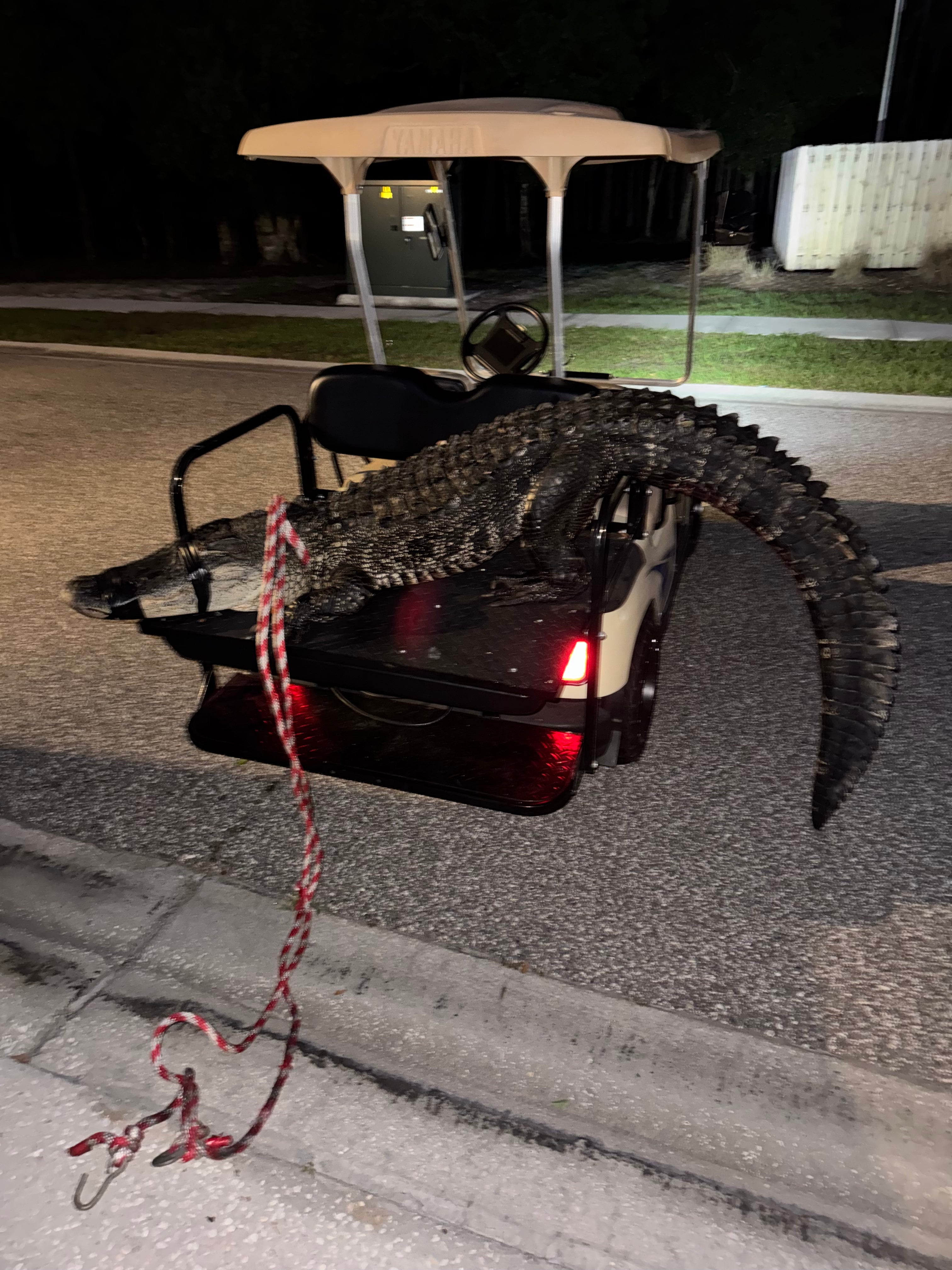
We manage to load the alligator onto the back of a golf cart. An acrid, earthy scent wafts through the air. I realize that the gator has peed on me, petty revenge in its moment of ultimate subjugation. Walters and I drive the bounty to his truck. The first gator—the 6-footer—is still in the cargo hold, its head curled meekly to its tail. Walters will sell these animals to a farm tomorrow afternoon, making $600 in total. He invites me to tag along, but I decline. I’m not sure I want to see a gator in bondage ever again.
But there is one order of business left before the shift is over. Walters parks the truck at the edge of a pond a block away from his house. He picks up the burlap sack between his feet, the one containing the baby alligator he caught earlier this afternoon. With one hand under its belly, Walters peels the tape off its mouth. The gator yawns wide open—out of fury or gratitude, or some combination of the two—its stony claws kneading the air. Walters steps outside and drops the gator into the pond, where it will embrace its newfound haven, feeding on insects, snails, and tadpoles, absorbing the life-giving warmth of the Florida sun. It will grow big and strong, until its proud speckled ridges are large enough to break the surface of the water, which will of course be enough to make it a nuisance. Perhaps someday, Walters will be summoned back out here to finish the job for good. I guess you could call that the circle of life.