
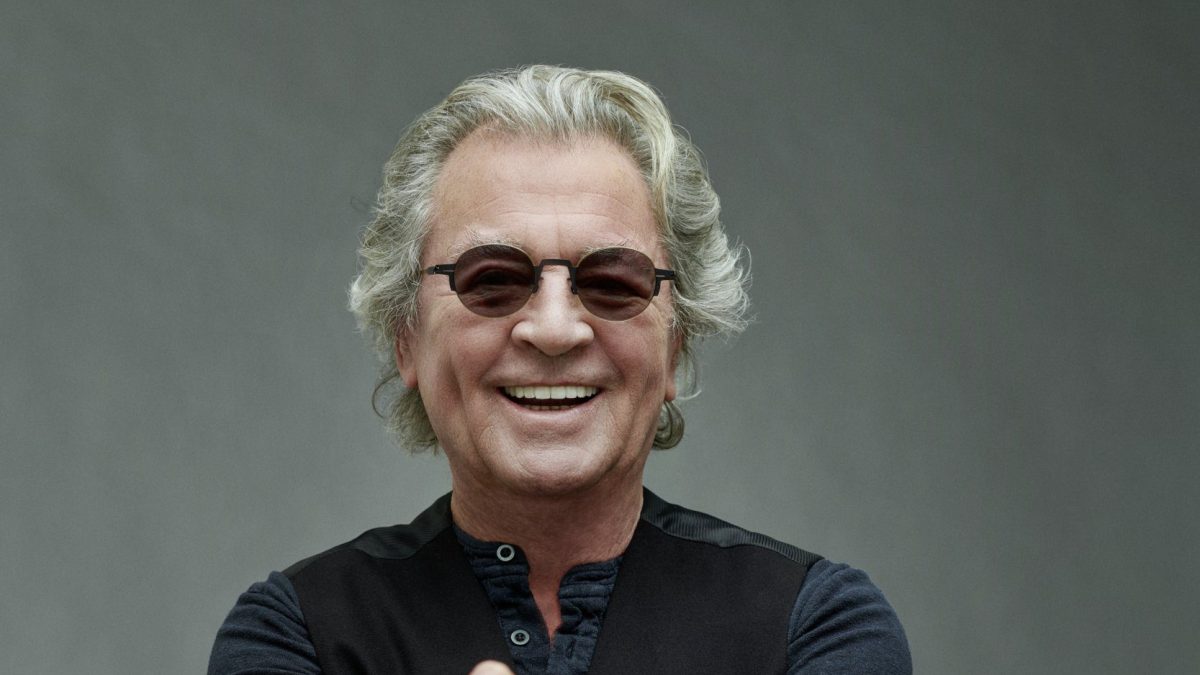
Deep Purple’s biggest song nearly went unheard. “It was a filler track,” says frontman Ian Gillan of the rock classic “Smoke on the Water”. “We were seven minutes short of a record and we only had a few hours left to finish it.” It was December 1971 and Deep Purple were recording in Montreux using The Rolling Stones’ mobile studio. “So we dug out this jam we used for soundcheck. It was called ‘The Dan Dan Song’.”
Up against it, Gillan wrote the real-life story of the night before, when the band watched on from their hotel as a fire broke out at a Frank Zappa concert at the nearby casino, the smoke drifting over Lake Geneva. “We just thought it was nice and part of the album,” drummer Ian Paice says. But an American executive saw the potential, and made a radio edit of the track. “Bob’s your uncle,” Gillan says. “It stuck.”
That’s one way of putting it: “Smoke on the Water” went on to become the most famous guitar riff in rock history. “It’s also the most annoying riff for people who work in music stores,” Paice smiles.
Even all these years later, they still love to play it live. “And we don’t just go through the motions,” Gillan says, admitting they often subtly change its style and tempo. “When I was working with Pavarotti, he said, ‘Ian, I’m so jealous. I’ve heard you sing ‘Smoke on the Water’ six times, and every time, it’s different. If I was to do that in the world of opera, they’d crucify me’.”
With more than 100 million records sold, Deep Purple are, alongside Black Sabbath and Led Zeppelin, among the holy – or maybe that should be unholy – trinity of British hard rock. Formed in 1968 in London, their commercial and creative peak between 1969 and 1973 with their MKII line up – Gillan, Paice, bassist Roger Glover, keyboardist Jon Lord and mercurial guitar hero Ritchie Blackmore – merged huge, fast riffs, progressive, complex arrangements, and musical virtuosity (the band had classical and jazz backgrounds). It set a template for heavy rock with classic albums like 1970’s Deep Purple in Rock and 1972’s Machine Head.
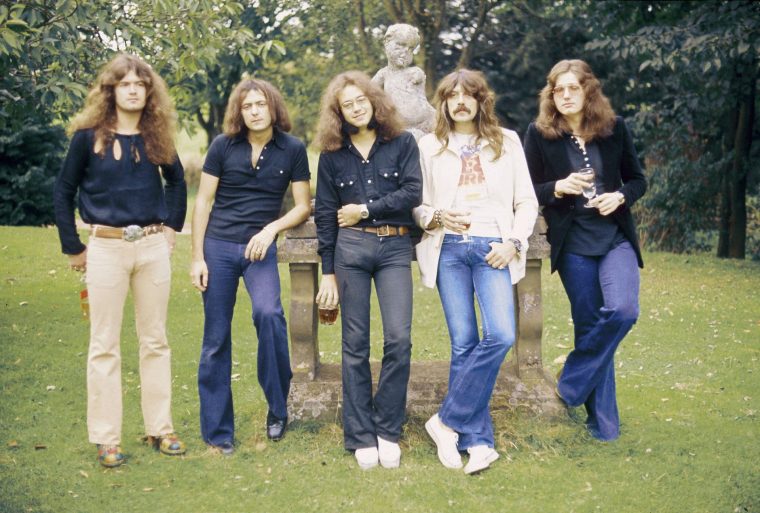 The early 70s line-up of Deep Purple, during one of Gillan’s breaks from the band, then featuring legendary guitarist Ritichie Blackmore (second from left) (Photo: Fin Costello/ Redferns)
Even with key members leaving, changes in style and the usual rock ’n’ roll pitfalls – “You’ve seen This Is Spinal Tap, right?” Gillan says – the band continued to have a huge impact, with Top 10 albums and mammoth gigs. In 1975, Deep Purple were placed into The Guinness Book of Records as the loudest live band ever. “If you’re the first one measured, you’re the loudest,” Paice smiles. “Compared to today, it was probably slightly louder than a couple of trucks going by on the motorway.”
Such is the band’s longevity and cross-generational, cross-cultural appeal that last year the band met Japanese Prime Minister Sanae Takaichi, who once played in a Deep Purple covers band. “She’s a very smart lady,” Gillan says. “She realised there was no future in drumming, so she became prime minister.”
Despite all this success and influence, financial issues persisted. “Let’s not go too much into that, but I didn’t get paid for 40 years,” Gillan says. I find that pretty amazing. “I found it amazing, too.”
I meet Gillan, now 80 and Paice, 78, in separate rooms in a central London hotel. They are both buoyant about their new record: coming shortly after 2022’s reinvigorating album =1, their 24th album Splat! sees Deep Purple in vibrant form in their twilight years. Again produced by Bob Ezrin, who has steered the band’s late-career renaissance since 2013’s Now What?!, Splat! is forceful and intense yet loose and playful.
Both Gillan and Paice agree that Northern Irish guitarist Simon McBride, who joined in 2022, has been a catalyst, replacing Steve Morse’s southern Americana blues style with back-to-basics British rock. The music sounds both familiar and fresh, not an easy trick to pull off for a veteran band. “I think Simon has helped us get our mojo back,” Gillan says. “It’s like a unit again. It’s a fantastic feeling.”
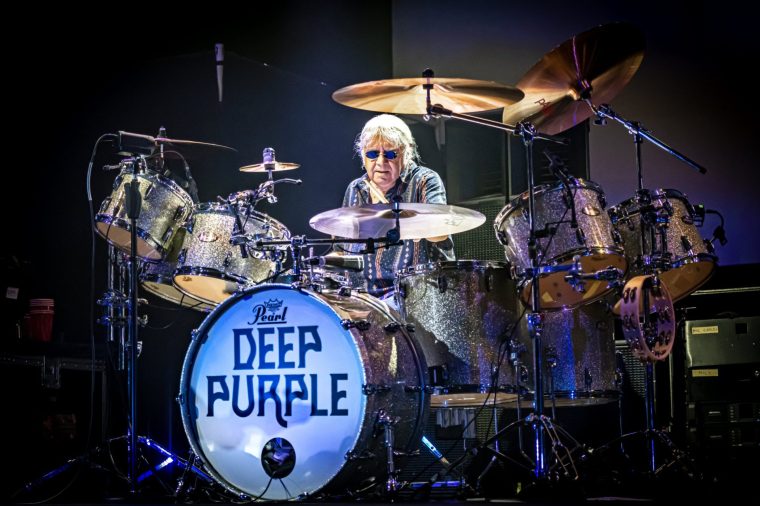 Drummer Ian Paice on stage with Deep Purple in Japan earlier this year (Photo: Robert Lio / DABOSS)
While there are some silly outliers – “Jessica’s Bra” is actually about a bar and their younger days; “The Rider” pokes fun at rock star ego – Splat! has an elaborate semi-concept: what comes after the apocalypse, and how humanity’s consciousness might transform in a metaphysical future. “It’s about hope and light and the future,” Gillan says. While it’s a shift from some of Gillan’s early lyrics of fast living and band turmoil, it’s an update on his old Cold War fears.
“Well, the world’s changed,” Gillan says. “I’ve changed. You’ve climbed the hill of life. You see further, you interpret things in different ways.” But does it not hit differently given end times seem nearer than ever? “But that doesn’t mean you can’t write about it. Or even laugh at it.”
Deep Purple are settled now as they reach their 60th year, but it has been a career of upheaval. Paice is the only founding member; he and Lord were in the more psychedelic early version of the band that broke through with “Hush” in 1968, later a hit for Kula Shaker. But by 1969, original singer Rod Evans and bassist Nick Simper were out, replaced by Gillan and Glover. “God bless him, Nick didn’t like the way music was going, so he was just unhappy,” Paice says. “Rod had a really nice voice, but it wasn’t the voice that could go where we were automatically going. It had to go that way. It’s a hard business. But when there’s been a change, the change has always been quality for quality.”
Gillan, a former boy soprano who had just starred in Jesus Christ Superstar, had the vocal range and power for this new heavy direction. But there was tension with Blackmore almost immediately: starting a classic frontman-guitarist ego-clash from the get-go, the first thing Blackmore told Gillan upon him joining was: “I’m going to try and blow you off the stage every night.”
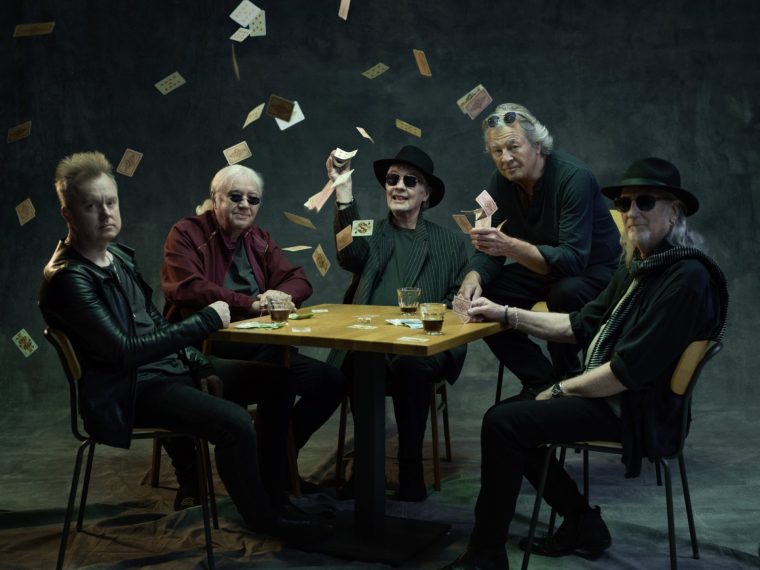 The band’s current line-up (left to right) Simon McBride, Ian Paice, Don Airey, Ian Gillan and Roger Glover (Photo: Olaf Heine)
“It didn’t bother me at all,” Gillan says. “I thought it was fun. We were kids at the time, and Ritchie was a great showman. But if things were going too well, he’d try and screw it up a little bit.”
Increasingly self-isolated, Blackmore took to onstage tantrums and sabotage: at one gig, Gillan requested not to sing “Child in Time” because he had a cold and couldn’t sing it properly; Blackmore played it anyway. Gillan is not of the mind that such tension is good for creativity. “It may be when the sparks are flying for a little bit,” Gillan says, “but it’s all too much for me. I don’t think you need that to produce your best necessarily. But then, I was just as bad as he was.”
Still, it’s fair to say they all enjoyed themselves: they were a rock band in the 70s after all. “Oh, yeah,” Paice says. “Crazy days. So much crazy. It just never ended. Every night was Saturday night, and sometimes you didn’t see your bed for two or three days.” But there were no substances other than alcohol. “We didn’t do drugs,” Gillan says. “We did beer and whiskey. We smoked cigarettes. I didn’t smoke my first joint until I was 38.”
Gillan left in 1973, saying he wanted a new creative challenge. “I think it ended up looking that way in public, but it was also personal,” Gillan says. “We weren’t getting on very well. All the outside things come into it. But the band was drifting more towards what Ritchie wanted – simpler tunes with a lot of the danger being smoothed out. And I like rough edges on the music.”
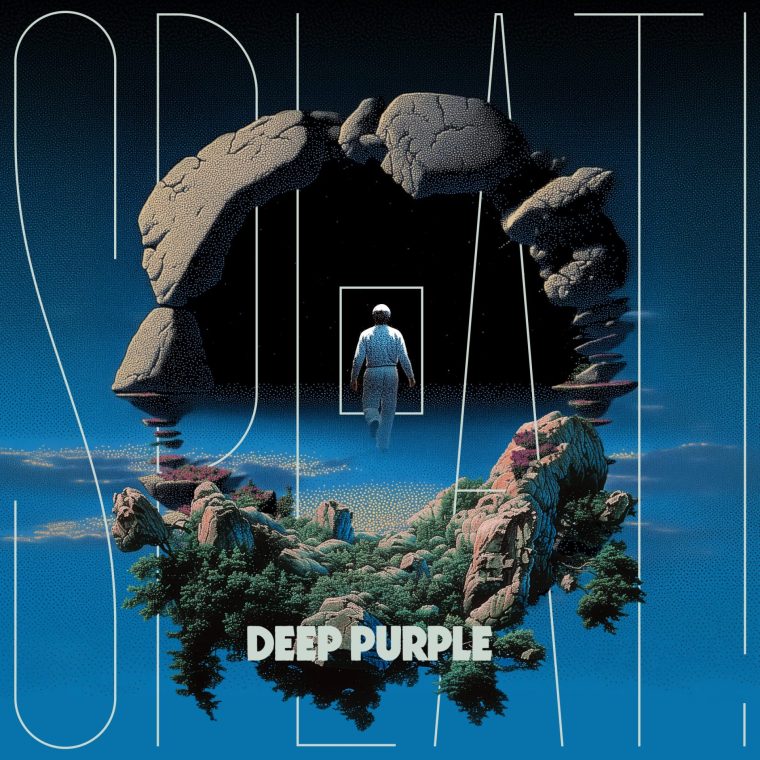 Deep Purple’s latest album Splat! is available now
Gillan was replaced by David Coverdale, but that version of the band lasted just two years: Blackmore left in 1975 to form Rainbow. “Ritchie’s a black and white character,” Paice says. “It’s either good or bad, I will or I won’t like you. You can deal with it to a point. But it becomes a problem for the band, because you can’t carry anybody.”
The band carried on, but eventually reunited with Gillan and Blackmore in 1984. It started well, but old issues soon resurfaced. “Sooner or later, those personality clashes started to become apparent again,” Paice says. The late 80s period into the mid-90s was a low for the band, who were out of vogue, with sparsely attended concerts and record sales on the floor. Gillan was sacked in 1989 and reinstated in 1992, while Blackmore’s behaviour was becoming more erratic: he once walked out of a Birmingham concert halfway through, and in 1993 threatened to get Gillan beaten up during an interview on Swedish television.
“It was obvious that Ritchie wasn’t happy,” Paice says. “It was affecting Gillan, and it was becoming difficult.” Ahead of a Japanese tour in 1993, Blackmore quit, replaced for the shows by Joe Satriani. “He’d drive me crazy, but he was so important to the halcyon days of the band,” Paice says of Blackmore. “He was that good.” Blackmore now plays medieval folk music and is all but uncontactable to his former bandmates. “I haven’t heard from him for a long time,” Paice says. “He’s wrapped up in a different sort of music and he’s happy with it. That’s all that really matters.”
It’s taken a while for Deep Purple to recalibrate, but both Gillan and Paice agree they are in the best place since their heyday. “As you get older, it becomes easier, because you understand people have different points of view on nearly everything,” Paice says. “Just play the music and stay on neutral.”
And Deep Purple aren’t finished yet. “I always think about the future,” Gillan says. “Positive aging. That’s me. I’m making long term plans.” The band are already talking about getting back in the studio in 2027. “Well, it’s a job for life,” Gillan smiles.
Splat! is out now. Deep Purple tour the UK from 18 November