
A new DNA study of two Renaissance members of the Medici family has confirmed malaria, not poison, killed Grand Duke Francesco I de’ Medici in 1587. The research also found a previously unknown strain of the parasite behind the deadliest form of malaria, giving scientists new clues about how the disease spread across Europe centuries ago.
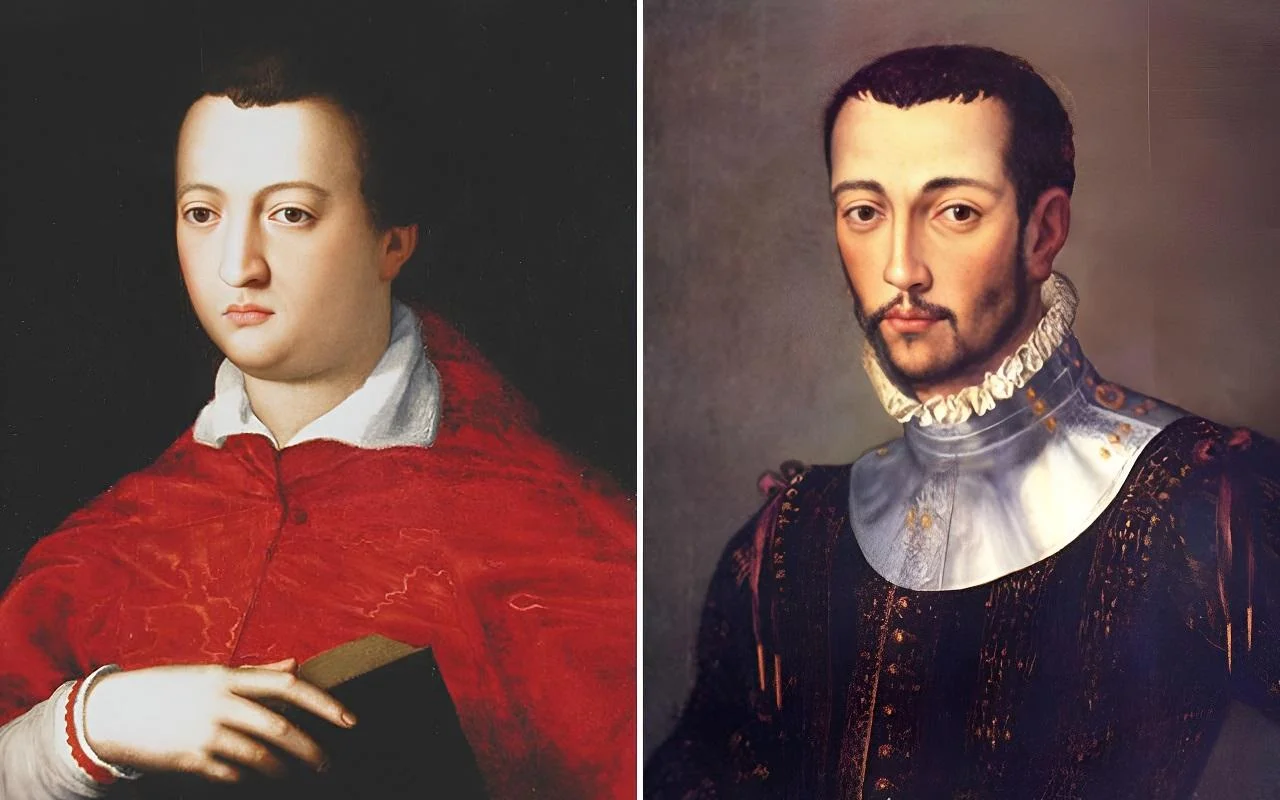 Cardinal Giovanni de Medici (left) and Grand Duke Francesco de Medici. Public domain
The study, published in iScience, examined the skeletal remains of Francesco and his younger brother, Cardinal Giovanni de’ Medici. Both men died after repeated fevers, a sign long linked with malaria in historical records. Giovanni’s cause of death had been widely accepted for years. Francesco’s death told a different story. For more than four centuries, many believed his brother and rival, Cardinal Ferdinando de’ Medici, poisoned him with arsenic.
Researchers from Yale University and the University of Pisa extracted ancient DNA from rib bones belonging to the two brothers. Their remains rest in the Medici Chapels inside the Basilica di San Lorenzo in Florence. The team searched for DNA from six species of Plasmodium, the parasites responsible for malaria.
The results found Plasmodium falciparum DNA in both brothers. Giovanni’s remains produced nearly 1,900 base pairs of genetic material, while Francesco’s remains contained a smaller amount. Scientists also found traces of Plasmodium malariae in Francesco. The finding points to the presence of two malaria species, though more DNA data is still needed to show whether both infected him at the same time.
Giovanni’s sample held another surprise. His P. falciparum DNA belonged to a genetic type never seen before. The sequence contained two unique mutations. When researchers compared the sample with other ancient malaria genomes dating from the Iron Age through the 1940s, they found close links with samples from Europe, Taiwan, and the Caribbean. Their results suggest this strain spread during a period of population growth in Europe.
The finding adds another chapter to the long history of malaria. Ancient DNA helps scientists trace how malaria parasites changed over time and how different strains moved across regions. Those genetic records fill gaps left by written history.
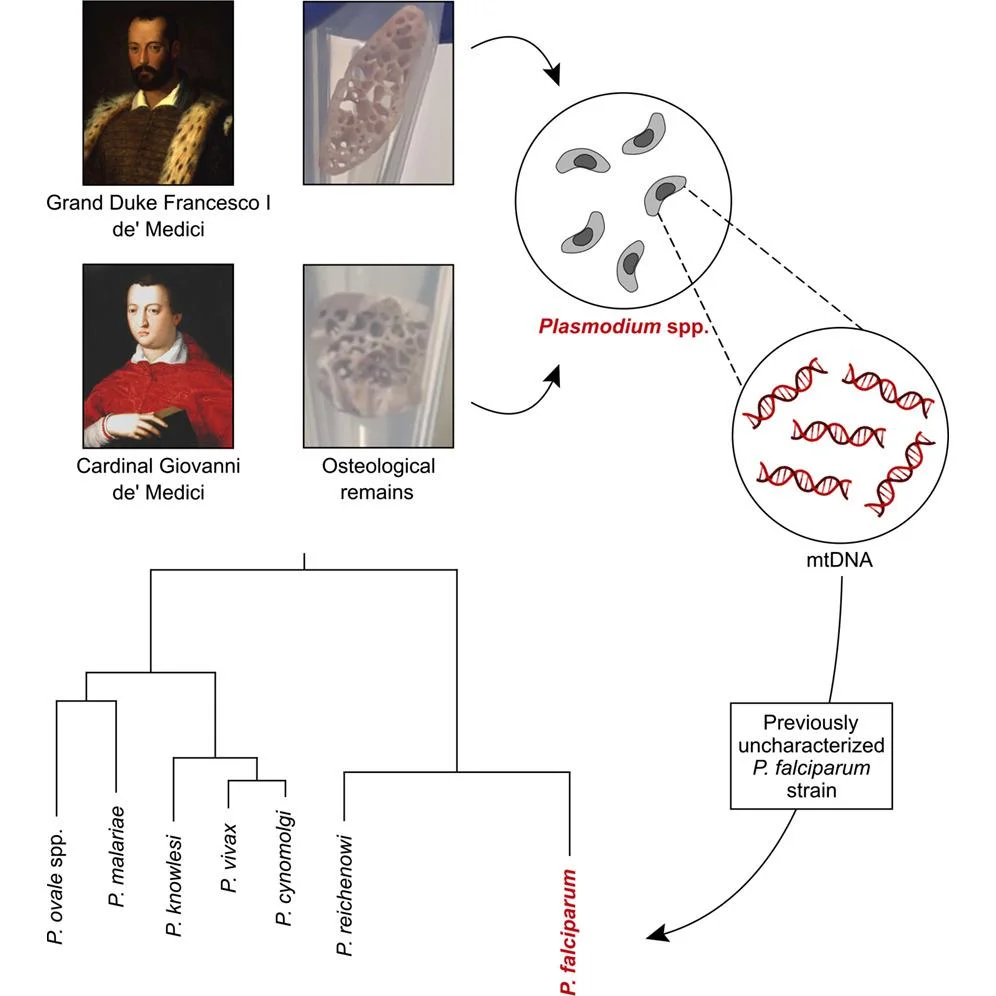 Ancient DNA reveals malaria killed the Medici brothers, not poison. Credit: Ochoa et al., iScience (2026)
Historical accounts match the DNA evidence. In 1562, Giovanni traveled to the Tuscan coast with his mother, Eleonora of Toledo, and his younger brother Garzia. Marshes in the area were full of mosquitoes carrying malaria. All three developed recurring fevers and died within a month. Giovanni was 19 years old.
Francesco fell ill 25 years later after visiting the Medici family’s villa in Poggio with his wife, Bianca Cappello. The estate stood near swampy rice fields where mosquitoes thrived. The couple died on back to back days after suffering repeated fevers. Their sudden deaths fueled stories of murder and poison.
The new DNA findings match reports written by court doctors at the time. They described recurring fevers known in central Italy as “febbre terzana,” the local name for malaria. The records also mention bloodletting, a common treatment during the Renaissance that likely made sick patients worse.
Earlier studies had found immune signs linked to P. falciparum in the brothers. This marks the first time scientists confirmed those findings with genetic evidence from their bones. The results settle one of the Renaissance’s longest-running medical debates while adding new data about the history of one of the world’s oldest diseases.
Malaria disappeared from central Italy during the 20th century after disease control campaigns. The illness still affects large parts of the world. The World Health Organization estimated about 282 million malaria cases and roughly 610,000 deaths in 2024. Researchers hope ancient DNA studies like this one help build a clearer picture of how the parasite changed through history.
Publication: Ochoa, A., Miller, S. L., Reilly, P. F., Fornaciari, G., Fornaciari, A., Riccomi, G., … Tucci, S. (2026). Ancient DNA analyses of remains of the Medici family (16th century) provide insights into the genetic variation of Plasmodium falciparum. iScience, 29(7), 116371. doi:10.1016/j.isci.2026.116371