
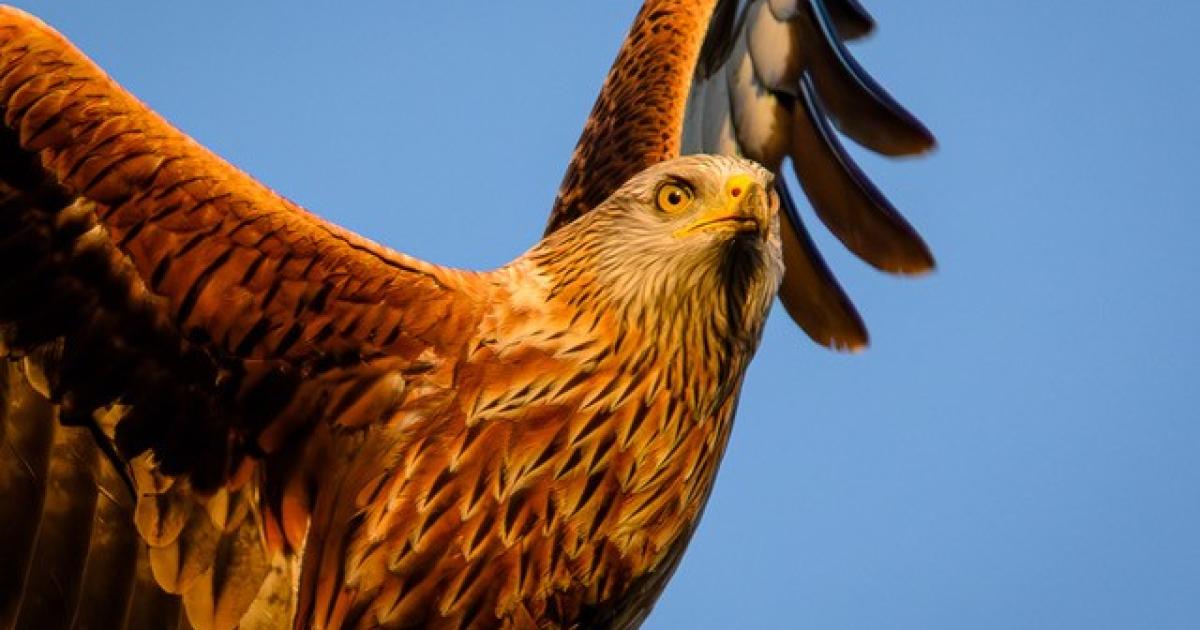
Suddenly there was a marked change in community energy. The Lapwings went to ‘red alert’! A Red Kite (Milvus milvus) was swirling in the distance. It was quite high, and covering ground with ease. The hot weather was probably helping – providing thermals that enabled it to soar with barely a wingbeat.
Approaching the Lapwing fields, it descended a little, now flying in smaller arcs, adjusting its turns to accommodate the breeze. It made progress over the fields, while apparently scanning the ground. Perhaps it was looking for its breakfast. Although, at this time of year, provisioning its own nest, might have been a priority.
Red Kites are native to the UK and, for many centuries, would have been a common sight in Yorkshire. But, as a result of persecution, by the late 19th C, they had been eradicated from England and Scotland – with just a small number remaining in Wales. Fortunately, in the early 20th C., the need for conservation was recognised and, subsequently, starting in 1989, an ambitious series of reintroductions was undertaken. This included the release of birds at Harewood, in Yorkshire. As a result, the BTO estimates there are 4,400 breeding pairs in the UK (as of 2016), and they are now a common sight in Wharfedale. The Yorkshire Red Kites website provides an array of fascinating information on Red Kites, including further details of the reintroduction program.
In an energetic defence of their breeding territory, the Lapwings ‘scrambled’ and mobbed the Red Kite. It was an interesting contrast. The languid movements of the Kite versus the agile acrobatics of the Lapwings. In some photographs I can count sixteen Lapwings in the air. This must be one of the big advantages of having several breeding pairs nesting in relatively close proximity.
Perhaps it was the attentions of the Lapwings, or perhaps the Kite already had other feeding opportunities in mind, but, before long, it was just a disappearing speck above the opposite horizon. As far as I could see, the Red Kite didn’t make any attempt to land in the Lapwing fields and, on subsequent days, I watched the same sequence of events play out again, with the same conclusion. So, was the threat to Lapwing chicks real or imagined?