
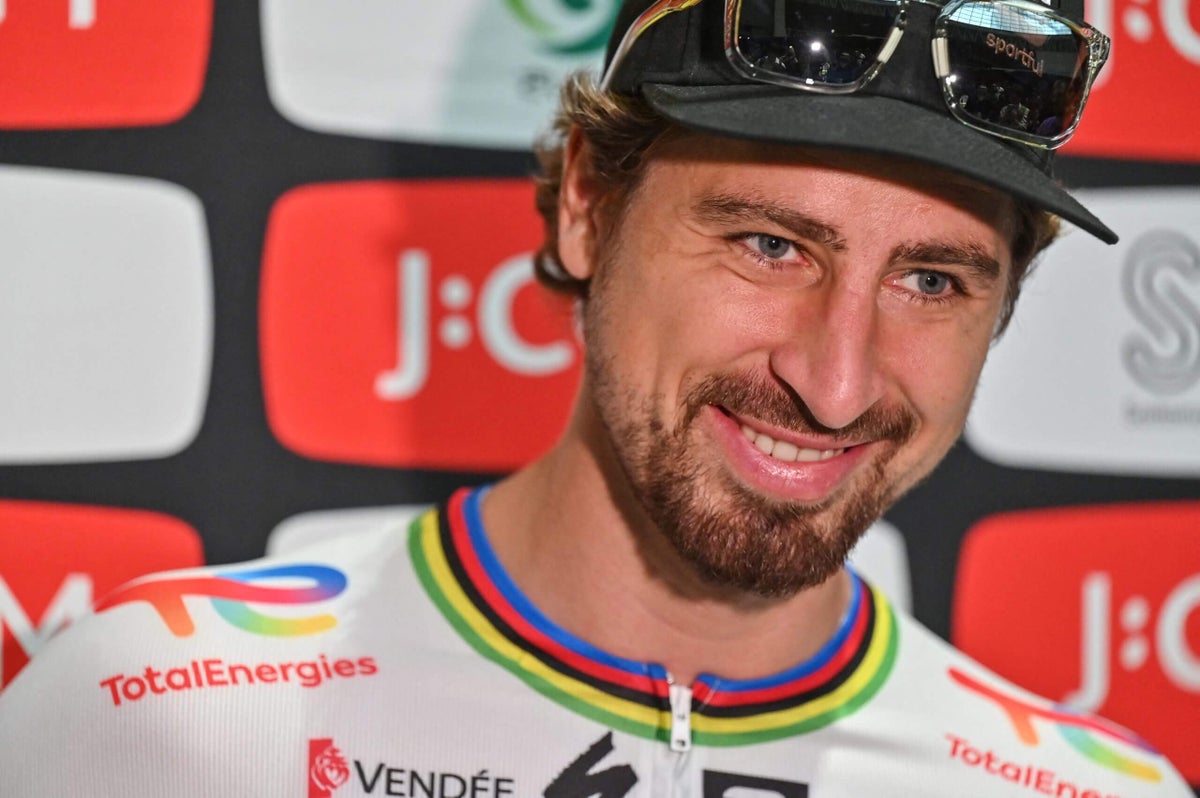
There are five riders older than Peter Sagan competing in the 2026 Tour de France. There’s even a 35-year-old debutant, New Zealander Aaron Gate, but Sagan, for a decade one of the Tour’s star attractions and headline names, is not racing. He quit the sport two years ago and has no regrets about his decision to retire at an age — 34 — that some perceived as early.
“People ask me a lot: ‘Why did you stop?’,” the Slovakian tells The Athletic three days out from the Tour, where he’s in Barcelona for an event with his longtime sponsor Sportful. “I say to them: ‘Living in this world for 14 years wasn’t enough?’ You can’t do it forever.
“When I saw the moment that I was going to be a domestique (helper) for someone, I said: ‘It’s my life. I don’t want to ride for someone and to pull the sprint for them. It’s not my style’. I said: ‘It’s enough’.”
What a sterling career Sagan drew the curtain on. A record seven green jerseys in the Tour, three successive road World Championships, and wins in Paris-Roubaix and the Tour of Flanders. There were 12 Tour stage victories, four in the Vuelta a España, and 18 in the Tour de Suisse. All in all, he was victorious as a pro 121 times. He is an eternal great.
He was much more than a bike rider. His long, wavy hair in his mid-20s was more reminiscent of a guitarist in a rock band, he tried his hand at acting in promo videos, while he would wheelie up Alpine climbs and bunny hop to avoid crashes — or simply because he was bored.
In a sport where media shyness is the norm, Sagan stood out for being different. He was an icon for many, a fan favourite to most, and Slovakia’s biggest representative on the international stage.
“I am proud of having the nickname ‘The Rockstar’ because nobody else was called that in cycling before,” he says.
But all of that attention came with its drawbacks. Pressure, fame and fatigue took its toll.
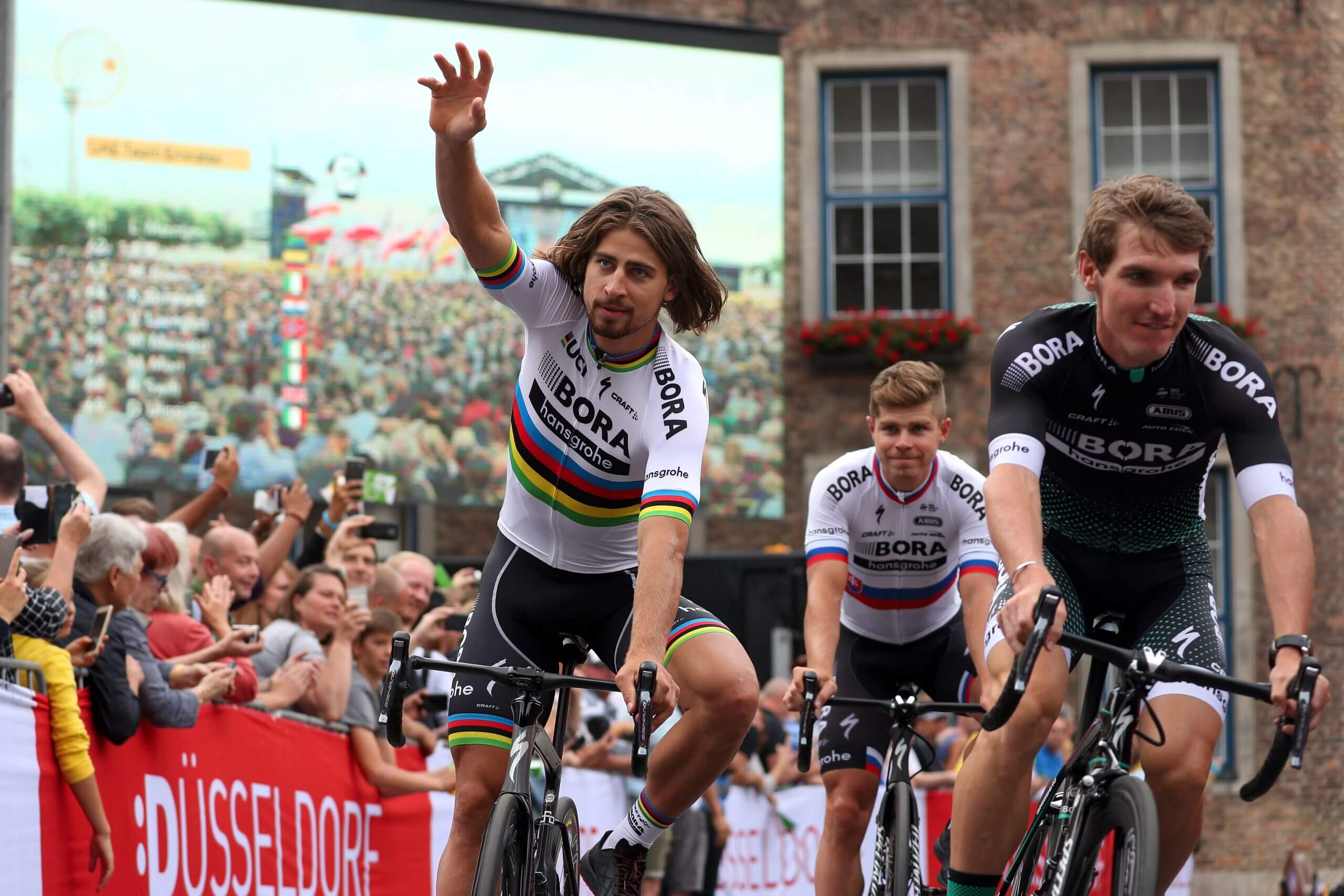
Sagan’s style in his 2010s heyday was different to most cyclists (Chris Graythen/Getty Images)
Hanging his racing wheels up wasn’t a hard decision for Sagan. The wins began to dry up post-Covid — though there were two stage victories and a points jersey at the Giro d’Italia — and a 2022 move to French team TotalEnergies from Bora-hansgrohe failed to reverse a (relative) late-career malaise.
He was just done with being a professional athlete. “I was tired of it and I wanted to stop. It was easy,” he states.
Unlike many of his peers, though, he didn’t find the transition to normal life difficult.
“A lot of professional athletes stop and they don’t know what to do. They find themselves in a black hole,” he says.
“It’s very hard because you’ve been doing a sport since you were seven or 15, and you’ve always been in a routine. And then afterwards, when you have nothing to do, it’s hard.
“But for me, it wasn’t like that because I had a plan of what to do and this reputation as the rockstar of the peloton has helped me with what I’m doing now with my sponsors. I’m even busier now than when I was a rider.”
Sagan has several ambassadorial roles: he has a long-time partnership with American bike brand Specialized, pops up during cycling coverage’s advert breaks riding an indoor bike for MyWhoosh, and recently, he launched his own non-alcoholic beer with Slovakia’s biggest brewery, Zlatý Bažant.
He’s found plenty of time for other activities, not least partaking in a primetime dance show in Slovakia last spring, eventually getting knocked out in the semi-finals with his dance partner Eliška Lenčešová.
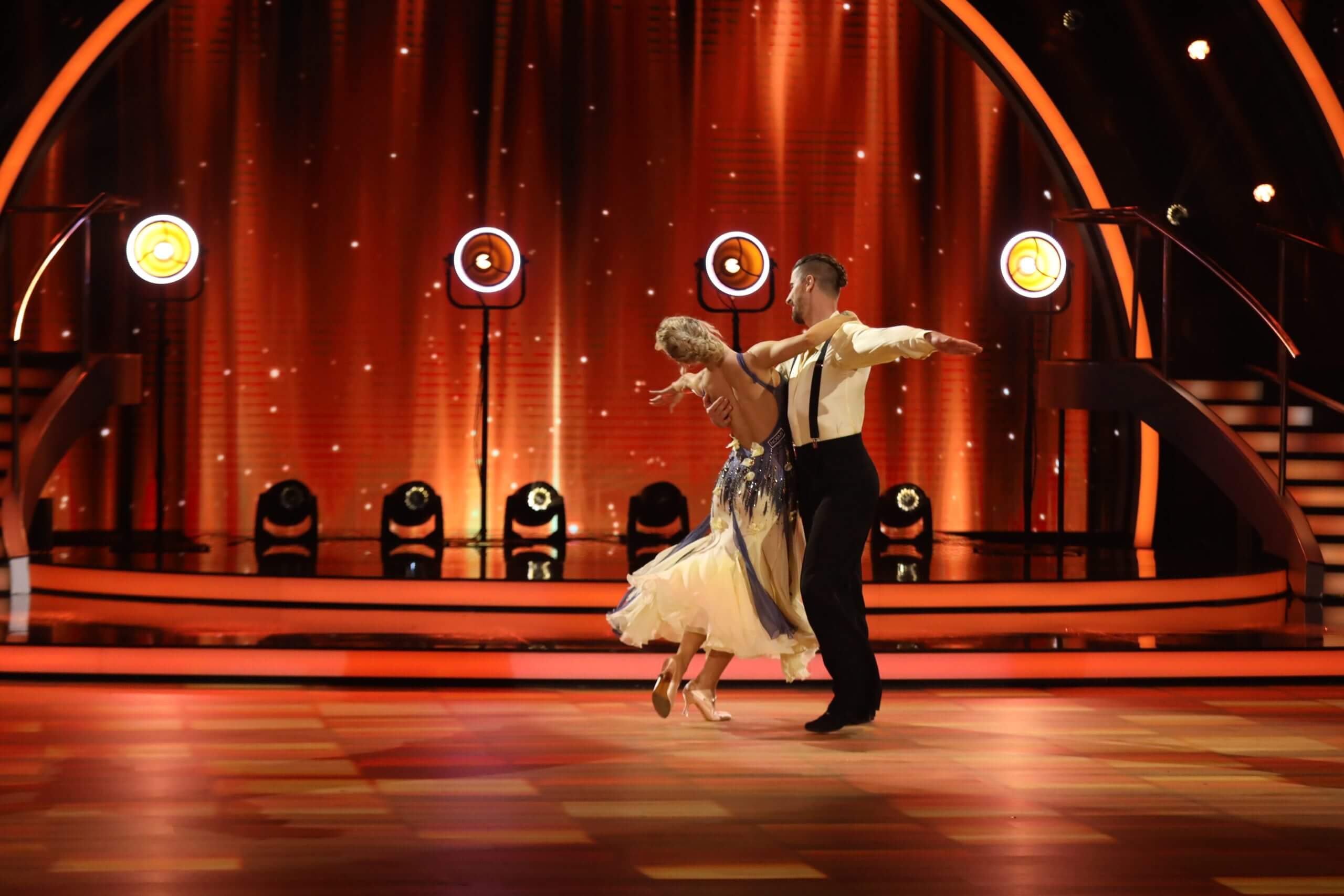
Sagan on ‘Let’s Dance’ in 2025 (Photo: Peter Sagan)
“It was a very nice experience,” he says of appearing on Let’s Dance. “I have to say thanks to my (dance) partner because my dancing maybe looked better on television than it was in real life. She saw how I was dancing at the start and tried different methods to make me better.
“We were training all kinds of dancing — classic, Latin American, cha-cha-cha — from January to March just to learn the basics. Then, during Let’s Dance, we had a week to learn a (specific) dance and the choreography, spending eight hours a day in the dance room.”
Did it give him a similar buzz to the one he had as a professional athlete? “Even more. I did cycling for years and I knew what to do, but dance was really something new.”
That Sagan took to dancing perhaps wasn’t a surprise. The most-watched video on his Facebook page is of him doing the splits in 2017, with his legs stretched out to the side and his bottom resting on the floor. It’s flexibility that is more associated with gymnasts, not cyclists.
“There was a lot of hard work behind that. I could do it now as I have some methods of stretching to do it, but I’d be f—ed up for two weeks!” he laughs.
His appearance on Let’s Dance reasserted him as Slovakia’s darling; the son they’re most proud of. But being his country’s most famous man is a burden he wears heavily — even if he’s spent most of his adult life living in Monaco, four countries and 700 miles from the Slovakian border.
💚A record 7-time winner of the Green Jersey, 3-time Road World Champion, but @petosagan is so much more than statistics. To the rockstar of our peloton, we say goodbye. Thank you for the memories across these years,
🙏 Ďakujem Peter
⁰
💚Recordman du nombre de maillots verts,… pic.twitter.com/BjfRQ1PZzF
— Tour de France™ (@LeTour) October 1, 2023
“When you go training, every amateur cyclist can see you, take your wheel and join your train. You can’t tell them to leave you alone,” he says.
It’s an issue Tadej Pogačar, Sagan’s successor as cycling’s rockstar and reigning world champion, has voiced, even turning to a black kit during training rides to make himself less recognisable.
“Even at races when you’re sleeping in a hotel, you have to go outside to eat in the kitchen truck and people are waiting for you. It’s intense,” Sagan says. “I don’t want to say it’s annoying but it’s part of the job.
“I could be an arsehole and say: ‘No, people’ but I’ve thought about it a lot and I know that they are fans, they are living for that, they are cheering for you, and they’re giving you something – energy. You have to give them something, some of your time.”
Escaping his adoring fans, though, became a matter of necessity. At the start of many seasons, he would often take himself to the U.S. on a training camp, favouring the Rockies over the Alps and Pyrenees.
“It really worked for me when I went to Park City, Aspen or Boulder on altitude camps,” he says. “Just me and a bunch of friends who prepared food. I’d go without the team, not under the control of anybody. I knew what to do and I just did it.
“That was where I found peace because nobody knew me. I left Europe, was in a different time zone so nobody called me, and it was peaceful. I was only thinking about what to eat and how to train. It was perfect for preparation.”
Most altitude camps are synonymous with riders experiencing crippling boredom, but not Sagan’s U.S. adventures.
“Every evening it was like, ‘What do we do tonight?’ Go to the cinema? Nice. Go to the shooting range and try all the guns they have? Nice. That was fun. Recovery day? Let’s go down to Salt Lake City and go shopping. We went there and nobody stopped me, nobody took a picture of me or asked for something. It was relaxing.
“These were the moments during my cycling career that I loved the most during the season.”
His close entourage, typically numbering six people, included his racing brother Juraj and Italian Daniel Oss, who with his long hair and love of bass guitar could pass off as a genuine rockstar.
“I created a good bunch of people and we had a good time in the races as well,” Sagan says. “It was necessary because if I didn’t have my group I was going to burnout and finish my career even earlier.”
Figuring out early on what he needed to be successful formed the backbone of his longevity in the sport. “It’s all about the individual mindset,” he says, once again speaking philosophically; it’s clear he’s a deeper thinker than his occasional comical antics and short race-interview answers often portrayed him.
“You’re not going to change the world, but you have to be somebody who is strong, who has self trust and self belief, and who doesn’t only want to be a sheep. You have to be the one navigating.
“If I’m going to do a job, I need this, this and this, and I believe that when I have that and when I’m relaxed and have fun I’m going to make it. If you’re under stress, you can make it for a year or two but afterwards, you’re going to be burned out.”
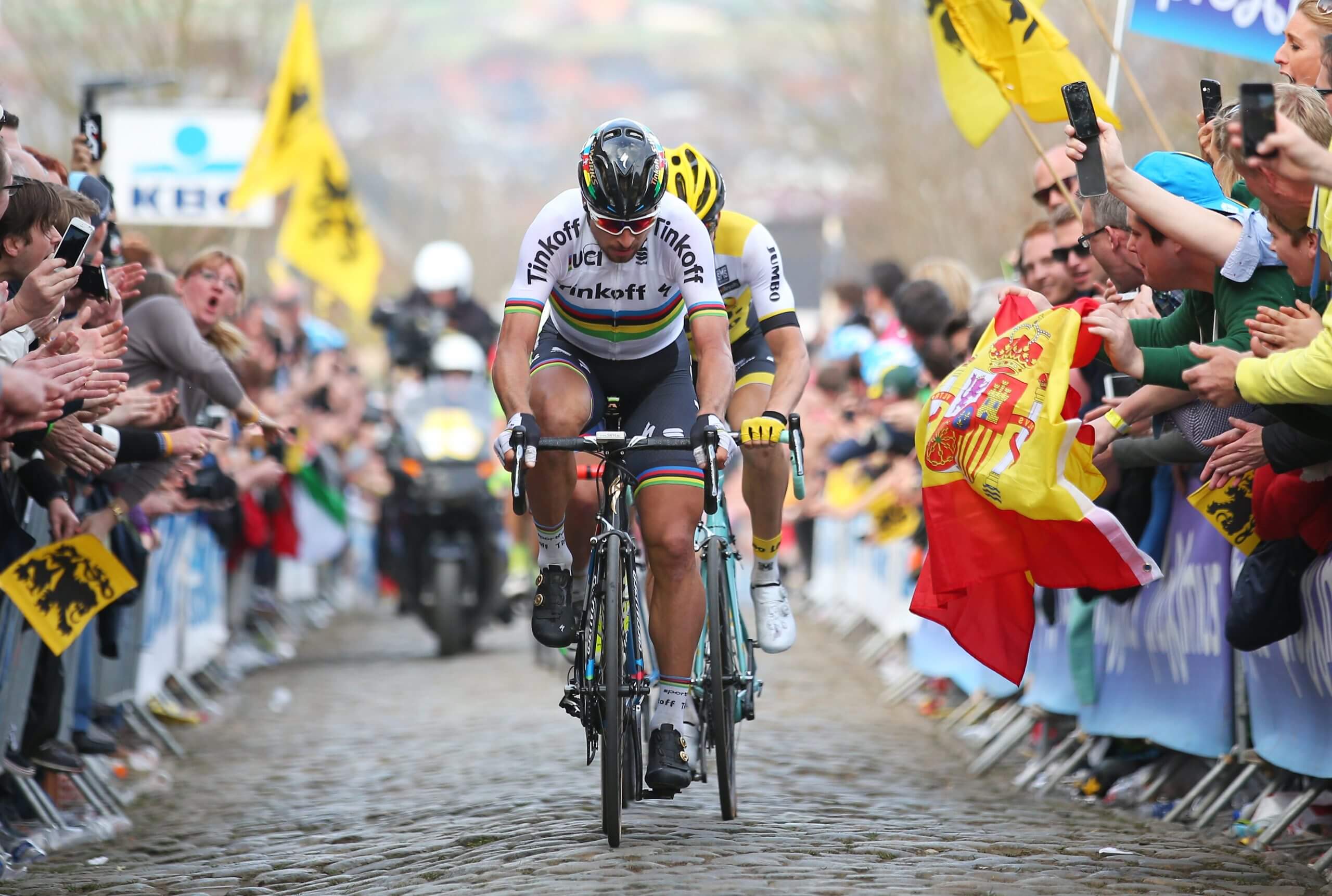
Sagan won the Tour of Flanders and Paris-Roubaix in his storied career (Bryn Lennon/Getty Images)
Sagan was at the start of this year’s Tour and will return later in the race for two sponsorship events. But he doesn’t really follow cycling too much — evidenced by picking the absent Jonathan Milan as his favourite for the green jersey.
He prefers to ride his electric mountain bike (he’s got faded cycling tan lines), go to the gym (his already broad shoulders are even broader) and hike in the mountains.
But when he was competing at the Tour, he was The Terminator. His repertoire of skills — a fast finish combined with an ability to get over even medium-sized climbs — meant he was a possible contender in roughly half of the stages. He was always in with a shot.
“The first Tour de France I did in (2012), I enjoyed the most because nobody had expectations of me and I didn’t have any either,” he says. “I was just happy to be in the Tour de France, the biggest race in the world that I’d always dreamed of riding, and it was great: three stage wins and the green jersey.
“But the second time I went, I was remembering what happened the first time, and it wasn’t the same. It’s always easy to win the first time but afterwards, it’s harder to keep going and win for a second, third, fourth, fifth, sixth, seventh time. Staying at the top for many years is hard.”
He managed it, though. From 2013 to 2019, he won the green jersey every year, except in 2017 when he was thrown out of the race for dangerous riding on stage four after crashing with Mark Cavendish. “If they didn’t exclude me, it could have been eight but who knows.”
Asked what the best 10 minutes of his career were, he laughs: “Maybe I have to say when I finished the Tour de France for the last time and I said no more.”
That’s the other side of life at the top. It becomes a chore.
His son Marlon, now aged eight, had seen his father battered and bruised too many times. “When he was five years old, I returned home from a race all broken and he was like: ‘What happened to you?’.
“I said I’d crashed in the race. ‘Do you want to do cycling?’ I asked him. ‘No, no, father, I don’t want to finish like you,’ he said.”
It’s not to say it was a bad life, though. Financially, Sagan is set for life. And his name is permanently etched in cycling’s history books.
But he reverts to a theme. “I stopped at the right moment.”
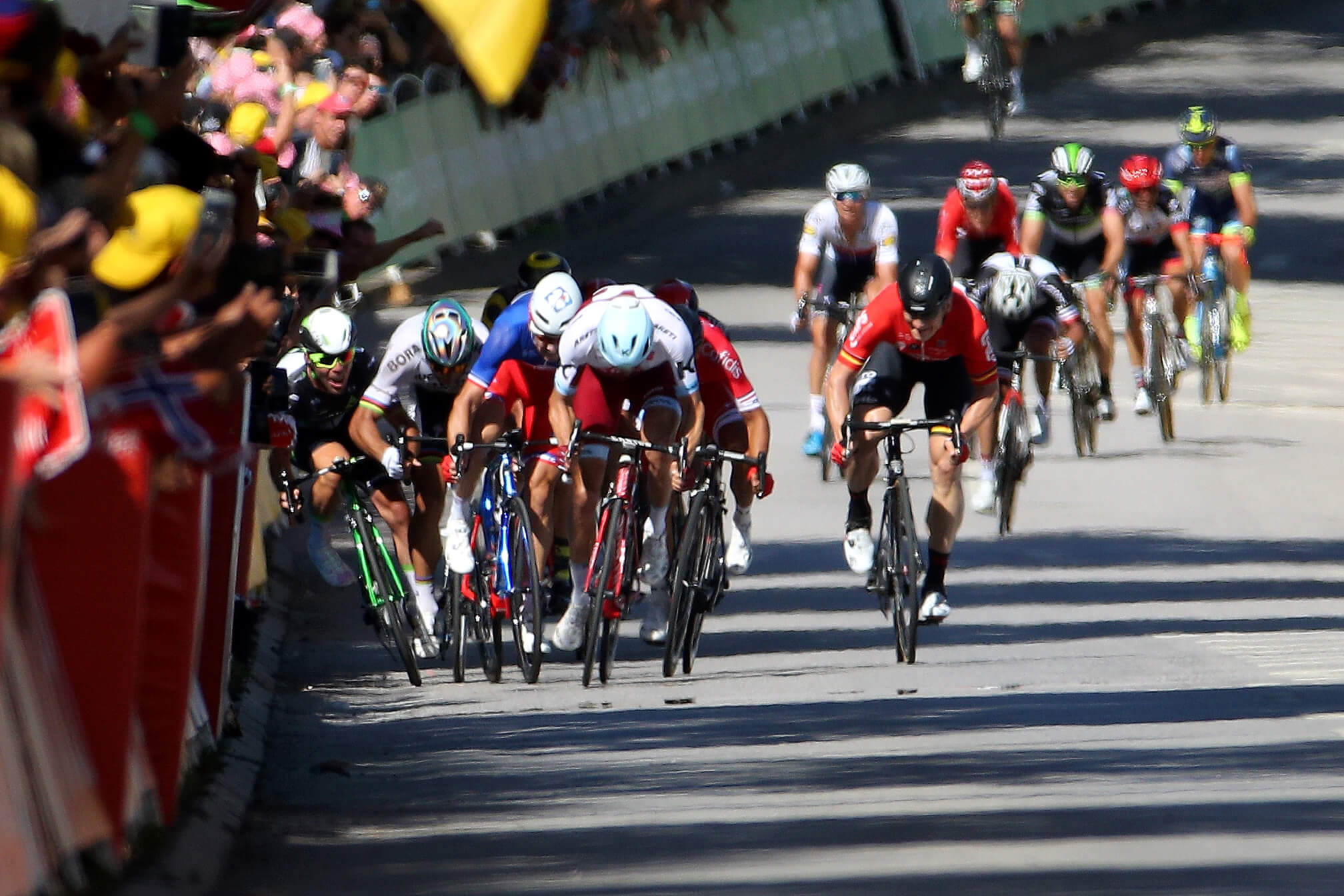
The incident with Mark Cavendish in the 2017 Tour which saw Sagan disqualified from the race (Chris Graythen/Getty Images)
When he allows himself to — and sponsorship events especially force reflection upon him — he can look back on a golden career. “Liquigas (his first team) was the first step for me, a good school, and when I left (in 2015, when it had been renamed Cannondale), it was a very nice opportunity to ride for Tinkoff-Saxo. I had my best years there,” he says.
“At Tinkoff, the diamonds were already created and we just had to sharpen them. After Tinkoff, I left for Bora-hansgrohe (in 2017) and we built a good base. They trusted me and I brought a lot of people from Tinkoff to Bora.
“It’s now Red Bull and I’m proud — it’s also a pleasure — that we were the step to developing and improving Bora-hangsrohe. They learned from us.
“My plan after Bora-hansgrohe was to do the same thing with TotalEnergies but after (two years), I said enough.”
His most cherished victories, he says, were his trio of World Championship titles. He’s the only male cyclist in the history of the sport to ever win three successive rainbow bands. “All three were different stories and all three were very special,” he says. “They were amazing for me.
“Also, to have the green jersey is a big deal, so to have it seven times in the race, holding it for three weeks, was amazing.
“Paris-Roubaix also. I won Flanders on its 100th anniversary with the World Championships jersey. To drop (Fabian) Cancellara, who was second, was amazing for me. They were all amazing moments, all of them.”
The many jerseys and trophies are at home, and the memories will never fade, but that chapter has been written. Sagan is now writing a new one, a more private one.
“I try to spend better time with my son than when I was a rider,” he says. “Because when I was home during my career, I’d be doing five or six hours on the bike and afterwards I was so tired that I couldn’t go out with him to play something because I had to recover.
“Now I can enjoy my time with him much more.”
As his sponsorship commitments regularly remind him, though, the rockstar who lit up the Tour de France every summer will never escape the spotlight entirely.