
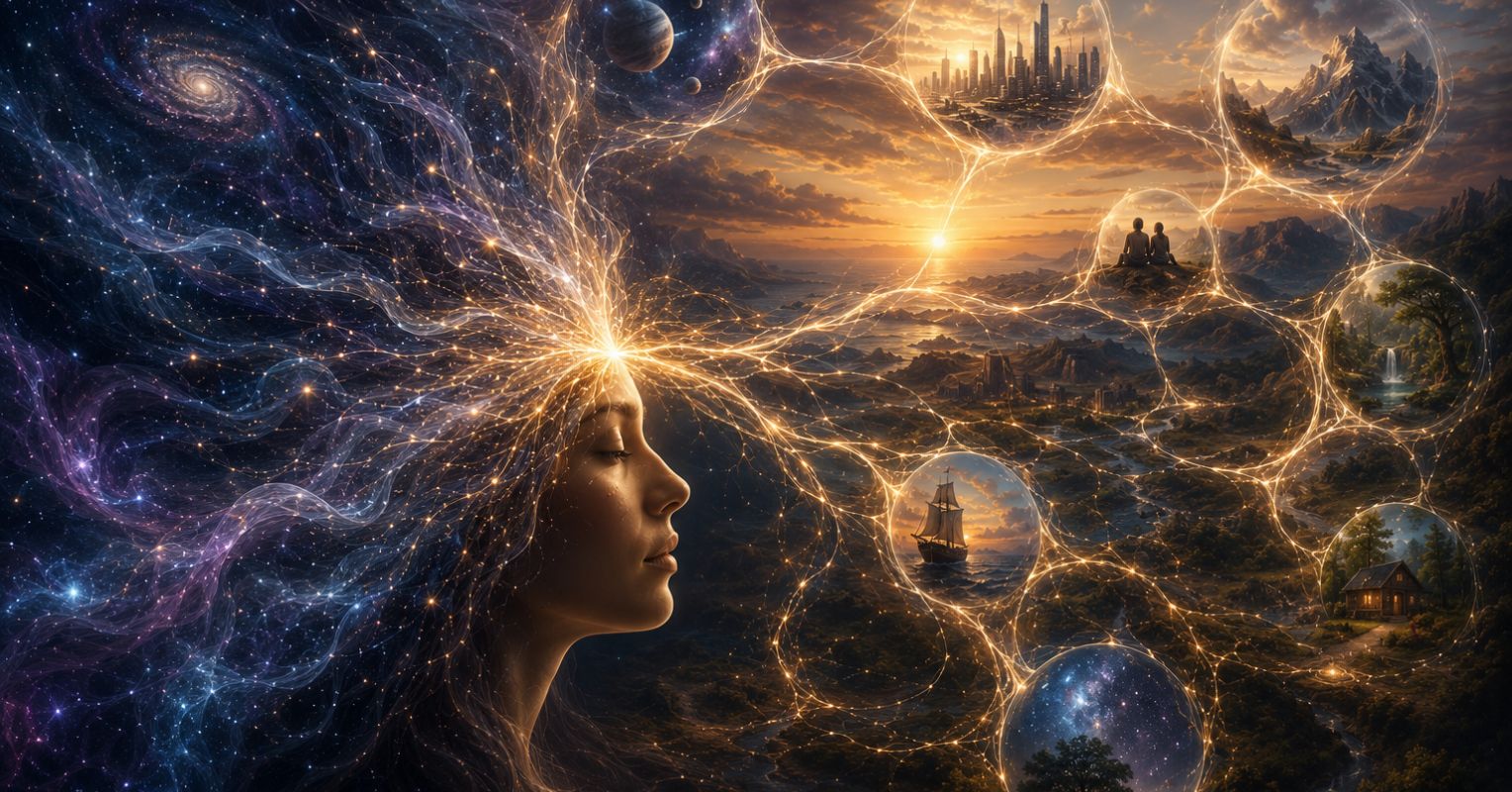
The idea that reality is fundamentally made of possibilities grew out of puzzles in modern physics that seem to point toward a radically different way of thinking about reality.
It’s now been a century since physics revealed deep flaws in our everyday conception of reality. If you measure one property of a particle first (such as its spin), and then another (say, its velocity), you can get a different outcome than if you measured these properties in the reverse order. The answer depends on the order in which you ask the questions. Moreover, in quantum mechanics, probabilities are used not because we lack information (such as when you calculate the probability that your opponent has the ace of spades), but because that information doesn’t yet exist! (These are actually two sides of the same coin; that is, if there is no fully specified underlying state before measurement, then both order effects and irreducible probabilities follow naturally.)
Interestingly, psychologists discovered something remarkably similar about the human mind. In a field known as quantum cognition, researchers found that people’s decisions often depend on the order in which different considerations are brought to mind. Ask someone first about one aspect of a political candidate and then another, and you may obtain a different judgment than if the order is reversed. Classical theories of decision-making struggle to explain such order effects, whereas the mathematical framework developed for quantum theory often predicts them surprisingly well. This doesn’t mean the brain is a quantum computer. But it suggests that both physical systems and human judgments may evolve from states of potential rather than reveal pre-existing answers. In other words, potential states are more fundamental than actual ones.
One attempt to make sense of this is physicist David Deutsch’s many-worlds interpretation of quantum mechanics. In this view, each possible outcome occurs, but in a different universe; i.e., every quantum event causes reality to branch. Somewhere, there’s another version of you who ate something else for breakfast, and another Earth where history unfolded along another path, and so forth. It’s a provocative solution, but there’s another possible solution that to my mind is more elegant. It’s arrived at, not by asking (as physicists do), “What do the equations actually describe?” but by asking (as a psychologist), “Why does the world appear to us as it does?”
Tendrils of Actuality in a Sea of Potentiality
In this view, instead of countless fully realized worlds—i.e., worlds of actuality consisting of objects that genuinely exist and events that really happen—there’s just one world, and its fundamental nature is not actuality but potentiality. Actual events continually crystallize out of this vast tapestry of potential like the delicate fractal ice crystals that spread across the edge of a half-frozen body of water.
The idea grew in part from early research carried out with my Ph.D. supervisor on context-driven actualization of potential (Gabora & Aerts, 2005): how entities change over time by actualizing states made possible by their context, situation, or environment. If all this sounds impossibly abstract, it may be because our minds evolved to hide from us the fact that what we perceive as reality isn’t real. Nervous systems evolved not to reveal the universe as it is but to help organisms survive long enough to reproduce. Each species perceives the sliver of reality that matters for its way of life, and assumes these perceptions to be reality itself. Bees see ultraviolet patterns on flowers that are invisible to us. Bats navigate using echoes. Increasingly, psychologists view human perception as less like a camera and more like a user interface. It presents us not with reality as it is, but a simplified representation that fosters successful action.
Our everyday experience of actuality may be part of that interface.
Minds Dwell in Actuality (but Now and Then Dip Into Potentiality)
The process of freezing potentiality into actuality occurs not only in perception but in thought. The moment we describe something, whether through language, music, painting, or even mathematics, we turn it into a narrative. We decide where the story begins, what details matter, how events connect, and what they mean. Even the most faithful account of an experience is still an interpretation. Our minds weave such narratives into what psychologists call a worldview—an integrated internal model of the world and our place within it. Each new experience is evaluated with respect to this ever-changing web of meanings. As we encounter new ideas and possibilities, we’re subconsciously wondering not so much, “Is this true?” but “Does this fit?” As I see it, coherence is our practical criterion for reality (Vieira & Gabora, 2026).
In this way, our worldviews generate streams of conscious experience by solidifying strands of actuality—objects, events, memories, explanations—from a sea of unrealized possibilities. These frozen trajectories of actuality successfully guide our actions and steer us into the future, but because they’re how we inhabit reality, we mistake them for reality itself.
Implications for Creativity
Seen this way, creativity acquires a new significance. Creativity consists of shepherding potentialities into actualities. Most of us spend our lives traveling well-established paths through actuality, but creative people linger longer in the surrounding realm of possibility. They tolerate ambiguity, entertain unlikely connections, and postpone certainty until patterns in their minds have had sufficient time to develop and mature. Society needs both; it needs people firmly anchored in actuality because coordinated action depends on shared understandings of what is real. But it also needs people who periodically drift into possibility, because tomorrow’s ideas do not yet exist as actualities. Every scientific theory or work of art, every technological invention or ritualistic behavior, begins as a possibility before becoming part of the actuality we collectively inhabit (Carbert et al., 2014; Gabora & Saab, 2011; Scotney et al, 2020).
Implications for Meaning-making
Thinking of reality as potentiality can also impact the meaning-making process by which we understand and make sense of our lives. We often experience the past as though it were a chain of hardened events leading inevitably to the present. Every mistake seems permanent. Every missed opportunity feels like a door forever closed. Every loss appears absolute. But perhaps this sense of inevitability is itself part of the user interface our minds construct. The actual path we travelled is only one crystallization through a rich landscape of possibilities. By traveling it, we may alter the shape of the realm of potentiality, pulling some possibilities closer, into the adjacent possible: the possibilities that are made newly reachable because of what has already become actual. Unrealized possibilities don’t really disappear; they can shape how we interpret the past, imagine the future, and find meaning. Even grief changes under this perspective. Death remains real, and loss remains painful, but a life need not be understood merely as a fixed sequence of completed events. It also consists of possibilities awakened in others, possibilities left unfinished, and possibilities still unfolding through the lives it touched.
All this may be wrong; reality may ultimately be nothing more than the relentless unfolding of actual events. But I suspect that actuality is what our survival-oriented minds extract from an inexhaustible sea of potentiality. In this view, our worldviews aren’t mirrors of reality, but living webs of meaning that crystallize coherent strands of actuality from that sea of potential. If so, reality itself is not those strands of actuality but the potentiality from which they continually emerge.