
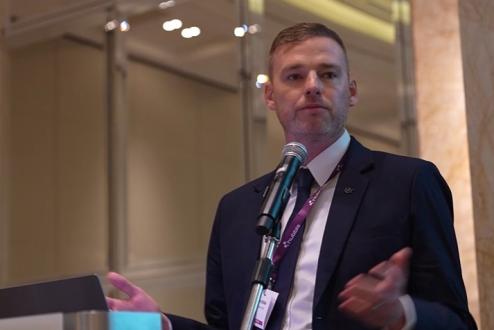
At the Hubbis Wealth Planning & Structuring Forum – Singapore 2026, Rory McDaid, Managing Director Private Clients at Henley & Partners, examined why residence and citizenship planning is becoming a more important part of the wealth planning conversation for high-net-worth families.
Rory’s presentation, titled The Optionality Premium, focused on the accelerating movement of private wealth across borders, the factors pushing families to reassess where they live and hold rights, and the role advisers can play in helping clients build flexibility before circumstances force action.
The central message was that residence and citizenship planning should no longer be treated as a reactive relocation issue. In a more fragmented world, where tax rules, political stability, education pathways, lifestyle preferences and succession needs can shift quickly, wealthy families need credible jurisdictional options. For advisers, the opportunity is to bring this conversation into the broader wealth planning framework before clients seek answers elsewhere.
Key Takeaways
Wealth Mobility Is Accelerating: Rory highlighted that more than 140,000 high-net-worth individuals relocated internationally in 2025, a record figure and around 300% higher than in 2013.
Optionality Is Becoming A Planning Priority: Families increasingly want residence and citizenship options that allow them to respond to geopolitical, fiscal, lifestyle and family pressures.
The UAE Remains A Major Wealth Magnet: The UAE attracted almost 10,000 high-net-worth individuals in 2025, ahead of the US, Italy and Switzerland.
The UK Has Become The Largest Outflow Market: Rory pointed to Brexit, political instability and recent tax changes, including the removal of the non-dom regime, as major factors behind the UK’s record wealth outflow.
Jurisdictional Exposure Needs Diversification: Rory argued that clients should think about residence and citizenship in the same way they think about investment portfolios: concentration creates risk.
Client Needs Are Multi-Dimensional: The key conversations are mobility, security, tax efficiency, education, lifestyle, and legacy and estate planning.
Planning Should Precede Crisis: Families with an alternative base already in place are better positioned than those trying to react when volatility has already escalated.
Advisers Can Own The Conversation: Henley & Partners works with advisers through referral, joint advisory or co-presented models, allowing residence and citizenship planning to complement existing client relationships.
A Personal Frame For Optionality
Rory began by linking the subject to his own recent experience of becoming a father. The need to put in place a will, life insurance and a trust had, he said, sharpened his understanding of what planning is ultimately meant to achieve: flexibility for a family if different scenarios unfold.
For high-net-worth families, that same principle increasingly applies at the jurisdictional level. The ability to live elsewhere, educate children in another country, obtain tax residency in a more suitable jurisdiction, or move quickly if conditions deteriorate can materially affect family resilience.
“Ultimately, that is what we are here to talk about today,” Rory said. “Ensuring that your clients, in this increasingly fragmented world, have that same optionality.”
In Rory’s view, the issue is no longer relevant only to clients already considering relocation. It applies to internationally exposed families whose assets, heirs, businesses, tax status or lifestyle are already spread across borders.
Wealth On The Move
Rory said global private wealth migration is now at record levels. In 2025, more than 140,000 high-net-worth individuals physically relocated, the highest figure recorded since Henley & Partners began collating the data. The 2026 projection suggests the trend is still increasing.
The drivers are both push and pull. Some families are responding to geopolitical risk, fiscal change, political uncertainty, safety concerns or economic pressure. Others are drawn to jurisdictions offering stronger lifestyle appeal, better education pathways, predictable tax regimes, healthcare access, security or business opportunity.
“High-net-worth individuals want to be based in jurisdictions where they are treated the best,” Rory said. “The best, of course, will mean different things to different families.”
That distinction is important. Residence and citizenship planning is not a generic mobility product. It must reflect the family’s priorities, risk profile, stage of life and longer-term wealth planning needs.
Where Wealth Is Moving
The UAE was the leading inflow destination in 2025, attracting almost 10,000 high-net-worth individuals. Rory said its appeal reflects a combination of business infrastructure, tax efficiency, connectivity, lifestyle and its growing role as a global wealth hub.
The US ranked second, while Italy and Switzerland followed in third and fourth place. Rory said both European jurisdictions had benefited from the outflow of wealth from the UK, particularly among families still seeking a European base but under a more attractive or predictable tax framework.
“Italy and Switzerland are both beautiful places to be based,” he said. “But it is also important to note that both have lump sum taxation policies.”
The UK, by contrast, recorded the largest net outflow of wealth. Rory traced the shift to a combination of Brexit, political instability and legislative change, with the scrapping of the UK non-dom tax regime having a particularly strong impact on internationally mobile wealthy families.
“In short, they are voting with their feet,” he said.
For advisers, the lesson is that even long-established wealth centres can lose appeal quickly when fiscal or political assumptions change.
Diversifying Jurisdictional Exposure
Rory then turned to the planning logic behind residence and citizenship optionality.
He cited an analogy used by Dominic Volek, Group Head of Private Clients at Henley & Partners: no adviser would recommend that a client hold their entire net worth in a single stock. The same principle, Rory argued, should apply to a client’s dependence on one country.
Citizenship and residence determine far more than travel convenience. They affect where a family can live, work, study, access healthcare, obtain tax residency and secure legal protection. If all of those rights are tied to one jurisdiction, the family remains exposed to that country’s political, fiscal and security environment.
“How does it make sense for that client to be inextricably linked to one individual country via citizenship and be at the mercy of any changes that might happen within that country?” Rory asked.
His point was not that every client should move. It was that clients should not be forced into action only after conditions have changed. Optionality allows them to choose, rather than react.
The Six Client Conversations
Rory identified six areas where residence and citizenship planning can enhance the broader advisory relationship: mobility, security, tax efficiency, education, lifestyle, and legacy and estate planning.
Mobility is the most visible benefit, giving families greater freedom to live, travel, work and educate children across jurisdictions. Security adds a more defensive dimension, particularly where families are exposed to political instability, sanctions risk, conflict or domestic uncertainty.
Tax efficiency remains a major driver, especially when policy change affects established structures or previously attractive jurisdictions. Education is also increasingly central, as families look for better pathways into schools, universities and future employment markets.
Lifestyle can be equally decisive. Climate, healthcare, community, culture and quality of life often determine whether a technically sound plan is attractive in practice. Legacy and estate planning then bring the discussion back to continuity, particularly where heirs, assets and structures sit across multiple jurisdictions.
These themes often overlap. A client considering tax residency may also be thinking about where their children will study. A family concerned about security may also need succession planning. The adviser’s role is to connect these issues into one coherent strategy.
Security, Tax And Education As Triggers
Rory used security, tax and education to show where advisers can begin the conversation.
On security, he suggested asking clients how geopolitical change is affecting their peace of mind, and how quickly they would want to act if volatility in their home country increased. Recent instability in the Middle East has shown that many families still start planning only once they feel exposed.
Rory said Henley & Partners’ Dubai office had recorded five consecutive record months this year. Commercially positive, he said, but also evidence that many clients are still reacting too late.
“Good for business, yes,” he said. “But it paints a very clear picture that clients are still reacting to a crisis.”
Tax is another trigger. Many wealthy families are based in efficient jurisdictions or operate through efficient structures, but those arrangements depend on rules remaining stable. Rory said advisers should ask whether clients have another base where they could obtain tax residency if their current position changed.
For families affected by developments such as the end of the UK non-dom regime, the value of a credible alternative becomes clear very quickly.
Education is often the most personal driver. Rory said residence and citizenship planning can support access to schools and universities, reduce tuition costs in some cases, and create pathways to longer-term residence or citizenship after graduation.
“As parents, we all want the best for our children,” he said.
For many families, this makes optionality a next-generation issue as much as a mobility or tax issue.
Working Alongside Advisers
Rory stressed that Henley & Partners is a specialist provider, not a competitor to advisers. Its role is to add a residence and citizenship planning layer to the adviser’s existing relationship.
“We are not here to compete, and we are not here to step on anyone’s toes,” he said. “We are here to be a value add to your core services.”
The engagement model is flexible. Some advisers make a confidential referral and allow Henley & Partners to run the process directly. Others prefer a joint advisory model, with Henley & Partners sitting alongside them and building the residence or citizenship strategy into the wider plan. A third approach allows the adviser to remain the point person, with Henley & Partners providing specialist input behind the scenes.
This flexibility is important because advisers manage client relationships differently. The common thread is that the primary adviser retains the relationship while adding a specialist planning capability.
Building Optionality Before It Is Needed
Rory concluded by arguing that advisers who raise the issue early can deepen trust, differentiate their platform and strengthen long-term client retention.
Residence and citizenship planning is rarely a one-off transaction. It often connects to tax, succession, education, real assets, philanthropy, governance and wider family strategy. For that reason, it can open up a broader and more durable advisory conversation.
The risk for advisers is that clients will have these discussions elsewhere if they are not introduced proactively. Rory’s message was that the conversation is already happening; the only question is who owns it.
“Your clients will be having these conversations,” he said. “The question is whether they are having them with you or not.”