
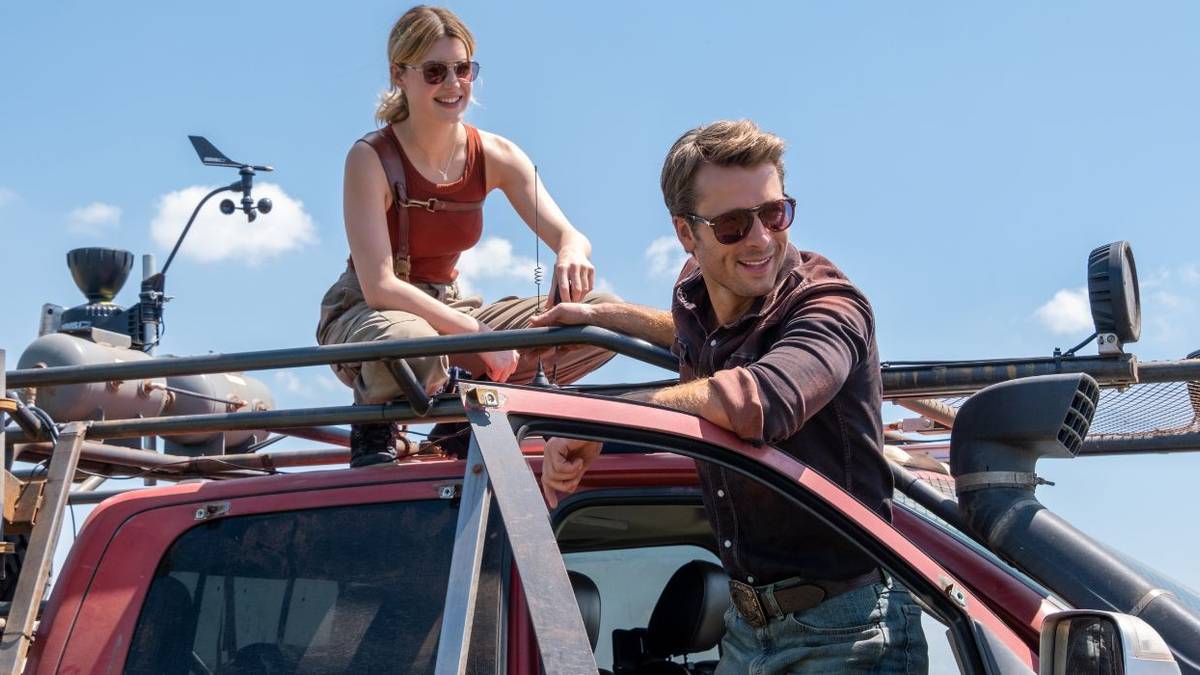
Disaster movies are surprisingly difficult to get right. They’re either some of the biggest productions Hollywood has to offer, or they’re completely ridiculous. Case in point: Sharknado (2013). Turns out that jaw-dropping visual effects can only carry a film so far. Once the novelty of collapsing skyscrapers and giant waves wears off, the audience still needs characters to root for and a meaningful story.
The most successful disaster movies understand that balance. They use the spectacle to raise the stakes, but don’t just rely on the shock value of it all. This is a list of six of the best disaster movies of the last 20 years that prove the genre is about more than just watching the world fall apart.
6
‘The Lost Bus’ (2025)
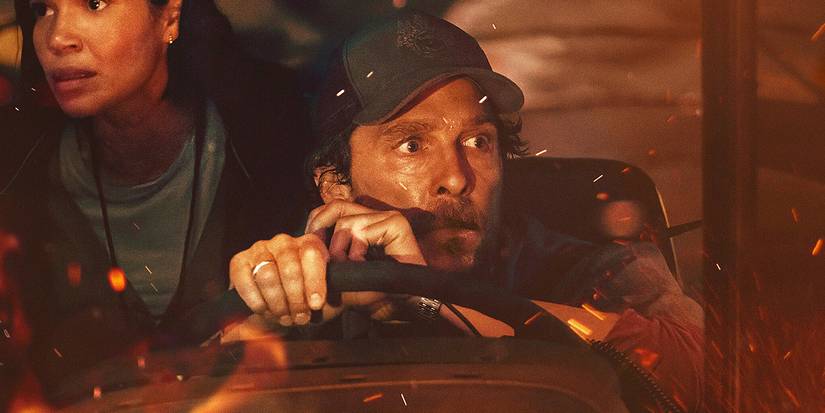
Matthew McConaughey on the poster for The Lost Bus.Image via Apple TV+
Unlike most disaster movies, The Lost Bus is not just about surviving the impossible. The film, directed by Paul Greengrass, is based on the true story of the 2018 Camp Fire, which adds a layer of emotional depth to the narrative from the start. The story follows school bus driver Kevin McKay (Matthew McConaughey) and teacher Mary Ludwig (America Ferrera), who find themselves responsible for getting 22 children out of Paradise, California, as the deadliest wildfire in the state’s history engulfs the town.
The routine evacuation quickly turns into a desperate fight for survival as roads disappear beneath flames, communication systems fail, and every decision swings between life and death. At the same time, The Lost Bus doesn’t sensationalize its subject matter, which might just be its greatest strength. The film focuses on the ordinary people trapped in this hellish nightmare. Kevin and Mary aren’t presented as larger-than-life heroes, but two people who simply refuse to give up on the children they are responsible for. The Lost Bus is a disaster movie that actually feels terrifying because it’s rooted in reality, and that is the genre at its best.
5
‘2012’ (2009)
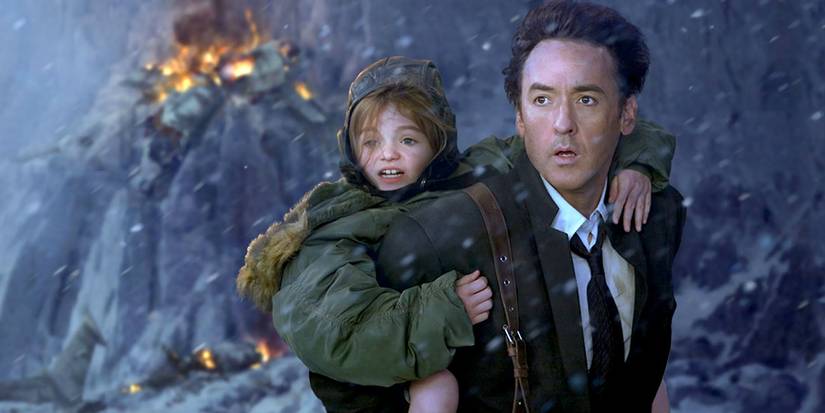
Jackson Curtis (John Cusack) holds his daughter Lilly (Morgan Lily) as the world ends in ‘2012’Image via Columbia Pictures
2012 is the movie that had the entire internet coming up with conspiracy theories about the Mayan calendar and the end of the world. In fact, Roland Emmerich’s blockbuster became the definitive image of what that apocalypse might look like. The film follows struggling writer Jackson Curtis (John Cusack), who discovers that the Earth’s crust is becoming unstable after unprecedented solar activity begins triggering catastrophic natural disasters across the globe. Jackson races to save his family as cities collapse and continents begin shifting, while governments secretly prepare a last-minute plan to preserve humanity aboard a fleet of enormous arks.
2012 is easily one of the most ambitious disaster movies of all time because the narrative isn’t contained to a single earthquake or tsunami. The film imagines the very collapse of civilization in the wake of several catastrophic events. All of that could have easily felt gimmicky and overwhelming, but 2012 has a strong plot that drives the spectacle forward with purpose. Jackson’s desperate determination to reunite and protect his family gives the relentless destruction real stakes and makes the audience care about more than just the visual effects. 2012 is an iconic pop culture moment at this point, and not many disaster movies can boast that kind of mainstream impact.
Collider Exclusive · Sci-Fi Survival Quiz
Which Sci-Fi World Would You Survive?
The Matrix · Mad Max · Blade Runner · Dune · Star Wars
Five universes. Five completely different ways the future went wrong — or sideways, or up in flames. Only one of them is the world your instincts were built for. Eight questions will figure out which dystopia, galaxy, or desert wasteland you’d actually make it out of alive.
💊The Matrix
🔥Mad Max
🌧️Blade Runner
🏜️Dune
🚀Star Wars
TEST YOUR SURVIVAL →
01
You sense something is deeply wrong with the world around you. What do you do?
The first instinct is often the truest one.
APull on every thread until I understand the system — then figure out how to break it.
BStop asking questions and start stockpiling — food, fuel, weapons. Questions don’t keep you alive.
CKeep my head down, observe carefully, and trust no one until I know who’s pulling the strings.
DStudy the patterns. Every system has a rhythm — learn it, and you learn how to survive it.
EFind the people fighting back and join them. You can’t fix a broken galaxy alone.
NEXT QUESTION →
02
In a world of scarcity, what resource do you guard most fiercely?
What we protect reveals what we believe survival actually requires.
AKnowledge. If you understand the system, you don’t need resources — you can generate them.
BFuel. Everything else — movement, power, escape — runs on it.
CTrust. In a world of fakes and informants, a truly reliable ally is rarer than any commodity.
DWater. And after water, information — the two things empires are truly built on.
EShips and credits. The galaxy is big — you survive it by being able to move through it freely.
NEXT QUESTION →
03
What kind of threat keeps you up at night?
Fear is useful data — if you’re honest about what you’re actually afraid of.
AThat reality itself is a lie — that everything I experience has been constructed to keep me compliant.
BA raid. No warning, no mercy — just the roar of engines and then nothing left.
CBeing identified. Once someone with power decides you’re a problem, you’re already out of time.
DBeing outmanoeuvred — losing a political game I didn’t even know I was playing.
EThe Empire tightening its grip until there’s nowhere left to run.
NEXT QUESTION →
04
How do you deal with authority you don’t trust?
Every dystopia has a power structure. Your approach to it determines everything.
ASubvert it from the inside — learn its rules well enough to weaponise them against it.
BIgnore it and stay out of its reach. The further from any power structure, the better.
CAppear to comply while doing exactly what I need to do. Visibility is the enemy.
DManoeuvre within it carefully. You can’t beat a system you refuse to understand.
EResist openly when I have to. Some things are worth the risk of being seen.
NEXT QUESTION →
05
Which environment could you actually endure long-term?
Survival isn’t just tactical — it’s physical, psychological, and very much about where you are.
AUnderground bunkers and server rooms — cramped, artificial, but with access to everything that matters.
BOpen wasteland — brutal sun, no shelter, constant movement. At least the threat is honest.
CA dense, rain-soaked city where you can disappear into the crowd and nobody asks questions.
DMerciless desert — extreme heat, no water, and something enormous living beneath the sand.
EThe fringe — backwater planets and busy spaceports where the Empire’s attention rarely reaches.
NEXT QUESTION →
06
Who do you want in your corner when things fall apart?
The company you keep is the clearest signal of who you actually are.
AA tight crew of believers who’ve seen behind the curtain and have nothing left to lose.
BOne or two people I’d trust with my life. Any more than that and someone talks.
CNobody, ideally. Alliances are liabilities. I work alone unless I have no choice.
DA community bound by shared hardship and mutual survival — people who need each other to last.
EA ragtag team with wildly different skills and total commitment when it counts.
NEXT QUESTION →
07
Where do you draw the line — if you draw one at all?
Every survivor eventually faces a moment that tests what they’re actually made of.
AI won’t harm the innocent — even the ones who’d report me without hesitation.
BI do what I have to to protect the people I’ve chosen. Everything else is negotiable.
CThe line shifts depending on who’s asking and what’s at stake.
DI draw a long-term line — nothing that compromises my people’s future, even if it’d help now.
ESome lines, once crossed, can’t be uncrossed. I know which ones they are.
NEXT QUESTION →
08
What would actually make survival worth it?
Staying alive is one thing. Having a reason to is another.
AWaking others up — dismantling the illusion so no one else has to live inside it.
BFinding somewhere — or someone — worth protecting. A reason to keep moving.
CAnswers. Understanding what I am, what any of this means, before time runs out.
DLegacy — shaping the future in a way that outlasts me by generations.
EFreedom — for myself, for others, for every world still living under someone else’s boot.
REVEAL MY WORLD →
Your Fate Has Been Calculated
You’d Survive In…
Your answers point to the world your instincts were built for. This is the universe your temperament, your survival instincts, and your particular brand of stubbornness were made for.
The Resistance, Zion
The Matrix
You took the red pill a long time ago — probably before anyone offered it to you. You’re a systems thinker who can’t help but notice the seams in things.
You’re drawn to understanding how the system works before figuring out how to break it.
You’d find the Resistance, or it would find you — your instinct for spotting constructed realities is the machines’ worst nightmare.
You function best when you have access to information and the freedom to act on it.
The Matrix built an airtight prison. You’d be the one probing the walls for the door.
The Wasteland
Mad Max
The wasteland doesn’t reward the clever or the well-connected — it rewards those who are hard to kill and harder to break. That’s you.
You don’t need comfort, community, or a cause larger than the next horizon.
You need a vehicle, a clear threat, and enough fuel to outrun it — and you’re good at all three.
You are unsentimental enough to survive that world, and decent enough — just barely — to be something more than another raider.
In the wasteland, that distinction is everything.
Los Angeles, 2049
Blade Runner
You’d survive here because you know how to exist in moral grey areas without losing yourself completely.
You read people accurately, keep your circle small, and ask the questions others prefer not to answer.
In a city where humanity is a legal designation rather than a feeling, you hold onto something that keeps you functional.
You’re not a hero. But you’re not lost, either.
In Blade Runner’s world, that distinction is everything.
Arrakis
Dune
Arrakis is the most hostile environment in the known universe — and you are precisely the kind of person it rewards.
Patience, discipline, and political awareness are your core strengths — and on Arrakis, they’re survival tools.
You understand that the long game matters more than any single victory.
Others come to Dune and are consumed by it. You’d learn its logic and earn its respect.
In time, you wouldn’t just survive Arrakis — you’d begin to reshape it.
A Galaxy Far, Far Away
Star Wars
The galaxy far, far away is vast, loud, and in a constant state of violent political upheaval — and you wouldn’t have it any other way.
You find meaning in being part of something larger than yourself — a cause, a crew, a rebellion.
You’d gravitate toward the Rebellion, or the fringes, or whatever pocket of the galaxy still believes the Empire’s grip can be broken.
You fight — not because you have to, but because standing aside isn’t something you’re capable of.
In Star Wars, that willingness is what makes all the difference.
↻ RETAKE THE QUIZ
4
‘Twisters’ (2024)
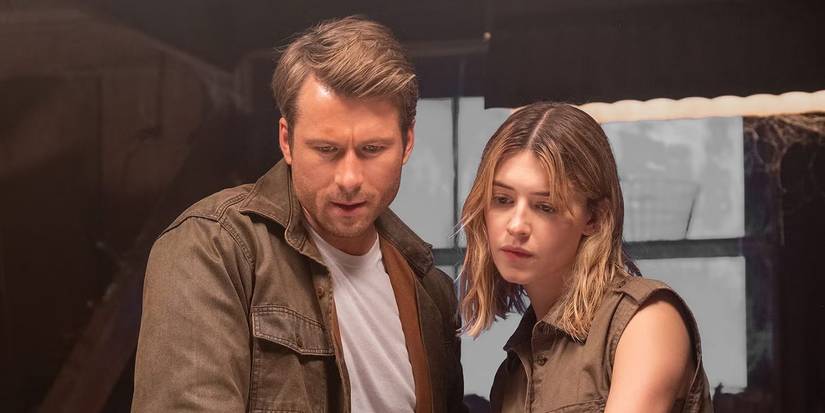
Glen Powell and Daisy Edgar Jones looking at something on a table in Twisters, 2024.Image via Universal Pictures
Twisters understood exactly what made the original film so memorable, but didn’t blatantly copy the same tropes, which is why it stands as a great sequel. The 2024 film tells a much more personal story about why the most destructive forces in nature fascinate humans so much. The narrative follows meteorologist Kate Carter (Daisy Edgar-Jones), who walked away from storm chasing after a field experiment ended in tragedy. Years later, she reluctantly returns to Oklahoma to test a new tornado-tracking system with her former colleague Javi (Anthony Ramos).
There, she keeps crossing paths with Tyler Owens (Glen Powell), a viral storm chaser who has built an online following by driving straight into tornadoes with his crew. Kate initially dismisses him as someone thirsty for fame, but she gradually realizes there’s far more substance beneath his larger-than-life persona. Twisters takes these two wildly conflicting perspectives of science versus heart and builds its entire story around that. That gives every tornado sequence a clear emotional core beyond just the visual effects. The film doesn’t attempt to outdo its predecessor in terms of spectacle, but captures the strange mix of fear and awe that tornadoes inspire.
3
‘The Wave’ (2015)
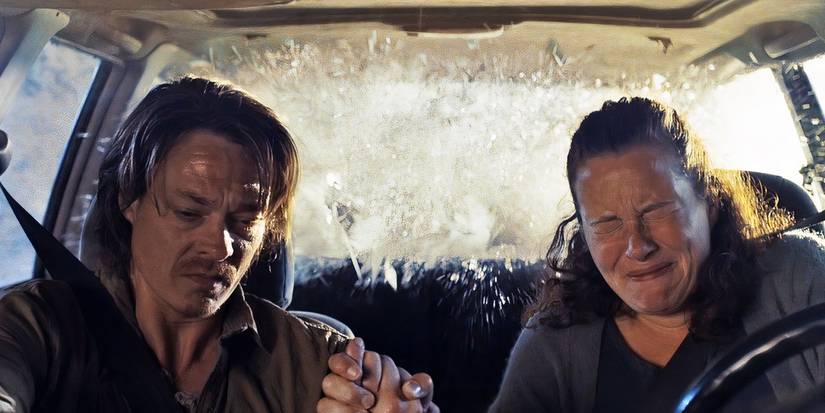
Kristoffer Joner as Kristian and Silje Breivik as Anna hold hands as water crashes into the car they are sitting in in The WaveImage via Magnolia Pictures
The Wave is a Norwegian disaster film that understands the genre better than many big-scale Hollywood productions. The story follows geologist Kristian Eikjord (Kristoffer Joner), who is preparing to leave the Geiranger monitoring station after spending years watching the unstable Åkerneset mountainside for signs of collapse. However, on what should have been his final day there, Kristian notices a series of abnormal readings that suggest the mountain is finally about to give way.
His warnings are initially brushed aside, but within hours, millions of cubic meters of rock crash into the fjord and unleash a towering tsunami that gives the residents of Geiranger just ten minutes to escape. The horror in The Wave feels incredibly real because the film spends as much time building the tension before the disaster. The audience can practically feel Kristian’s desperation, and once the wave hits, the destruction is relentless. This realistic. slow-burning approach to the genre makes The Wave one of the most gripping stories of the last two decades.
2
‘Pandora’ (2016)
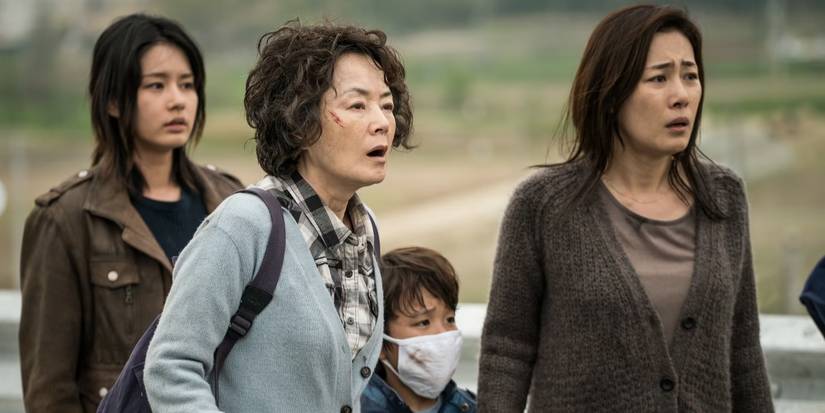
Image via Next Entertainment World
Pandora takes one of humanity’s greatest fears and uses it to tell a tale that feels unforgiving. The South Korean disaster film follows former power plant worker Jae-hyeok (Kim Nam-gil), who wants nothing to do with the local nuclear facility after it claimed his father’s life years earlier. However, when a powerful earthquake damages the aging reactor and a series of mechanical failures push it toward a catastrophic meltdown, Jae-hyeok is among the few people with the knowledge needed to prevent an unimaginable disaster. The stakes rise as radiation spreads across the region and the government struggles to control the growing panic while thousands of residents desperately try to escape before it’s too late.
Now, Pandora never treats this catastrophe as abstract. The audience sees how the crisis unfolds because of years of neglected safety standards, political indecision, and cost-cutting, which makes every new failure feel frustratingly believable. Jae-hyeok is a compelling protagonist who is caught between protecting his own family and risking everything to save countless strangers. Pandora shows the true human cost of disaster, and in doing so, it provides much-needed social commentary on the warning signs institutions are often willing to ignore.
1
‘The End We Start From’ (2023)
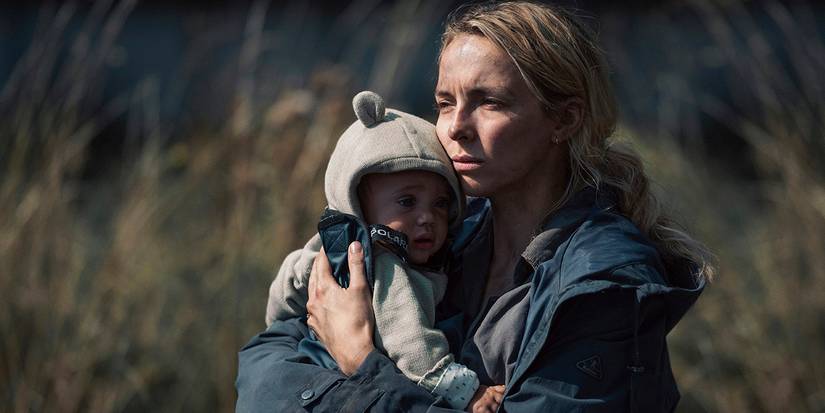
Jodie Comer holding a baby in The End We Start FromImage via Anika Molnár
The End We Start From is one of the most unconventional disaster movies released in recent years because it barely focuses on the disaster itself. The British film follows a new mother (Jodie Comer), who gives birth just as catastrophic flooding begins swallowing large parts of the United Kingdom. Essential services begin collapsing, and entire communities are forced to evacuate, which leads the protagonist and her newborn on a difficult journey across an increasingly unstable country. They move through temporary shelters, abandoned homes, unfamiliar communities, and meet people whose lives have been completely reshaped by the climate catastrophe unfolding around them.
The End We Start From doesn’t center on the destruction of the disaster at hand. The film actually explores what happens after survival becomes the only priority. The flood remains a constant presence in the background. However, the real focus is the emotional and physical challenges of motherhood in a world that doesn’t offer any kind of certainty. The End We Start From presents climate disaster through an intimate lens, and that perspective is what makes it so powerful.