
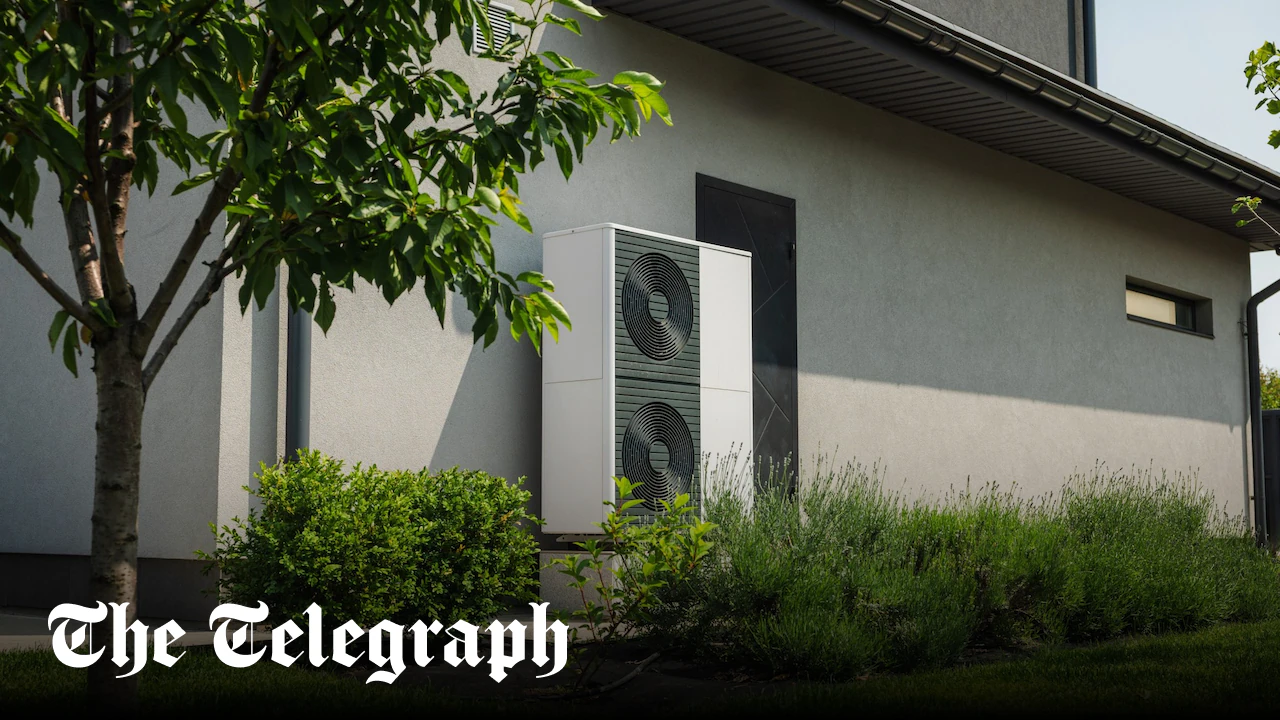
Heat pumps will become mandatory in all public buildings in Europe, as part of a renewed push towards net zero.
In plans to be issued next week, the European Commission will also urge the EU’s 27 national governments to offer tax cuts or subsidies for households and businesses switching from gas boilers to heat pumps.
The new policies are designed to meet a new 2040 target for the share of energy the EU gets from electricity, as it tries to curb dependence on foreign oil and gas.
Donald Trump’s war with Iran has injected fresh impetus into the EU’s electrification push.
The closure of the Strait of Hormuz, a major artery for the Middle East’s gas and oil exports, has added €50bn (£43bn) to Europe’s energy import bill since the conflict began in late February.
To encourage households to purchase heat pumps, the EU has urged countries to cut value-added tax, and offer loans, subsidies or discounts. Similar schemes could apply to electric vehicles (EVs) and domestic battery storage.
Household and business electricity bills will also be revamped so that taxes and subsidies no longer favour gas over electricity.
The EU plan reportedly proposes that households should pay no more than 2.5 times as much for electricity as for gas, and businesses should pay no more than twice as much for gas. Only two of the 27 EU countries currently have a ratio below this cap.
The new requirement to use heat pumps on official buildings will also form part of a broader public procurement reform. It could also include greater use of EVs in government fleets.
However, the European Commission may struggle to get all national governments on board with its new plan.
Germany’s parliament scrapped a law aimed at phasing out household gas boilers on Friday.
The 2023 law required any household replacing a boiler to install a system that uses at least 65pc renewable energy.
Instead, homeowners will now be able to buy a new gas boiler, as long as the conventional fuel is blended with an increasing proportion of biogas.
As in Britain, the biggest potential obstacle to the EU’s electrification ambitions is insufficient grid and storage capacity.
This makes it hard to switch to renewable electricity, which requires transmission lines and batteries to smooth out peaks and troughs in supply.
The EU’s electrification rate is only 23pc, and has barely moved for a decade. In China it is 36pc, which has helped insulate the Chinese economy from the Hormuz disruption.
Brussels proposes to boost energy storage capacity to 200 gigawatts by 2030, up from 55 gigawatts now. It is also pushing for faster approval procedures for pylons and lines.