
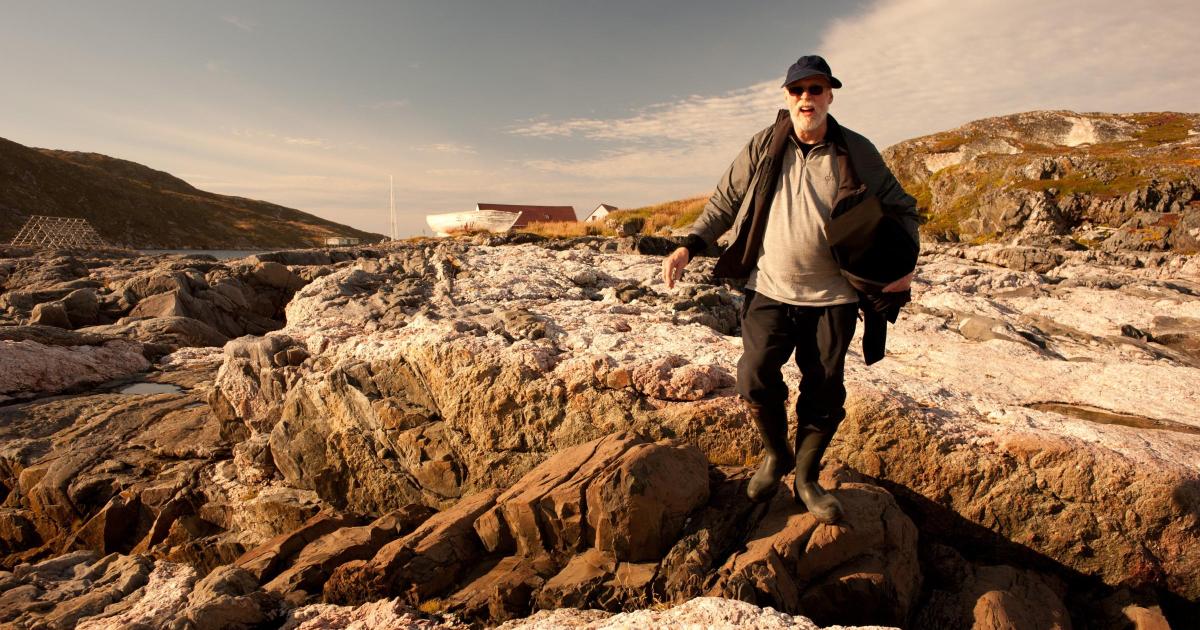
He has lived and worked in Glasgow since the 1980s and was formerly head of photography at Glasgow School of Art, where he helped establish the first fine art photography degree course in Europe.
Cooper is known for his black and white landscape photographs (Image: Thomas Joshua Cooper)
His work is strongly associated with journeys to edges, coastlines, islands, and other borderlands, especially around the Atlantic.
Over the course of the last three decades, Cooper has circumnavigated the globe making photographs of the most extreme points and locations surrounding the Atlantic Ocean.
His long project The World’s Edge took more than three decades and resulted in hundreds of photographs of places around the Atlantic rim.
He is the only artist to have ever made photographs of the two poles,
He typically uses an 1898 large-format camera, makes only one exposure at each site, and then develops and prints the image by hand.
Thomas Joshua Cooper founded Glasgow School of Art’s fine art photography course (Image: Thomas Joshua Cooper)
Cooper said he enrolled in a photography course to “meet girls” but failed the initial class.
“I pleaded with the tutor to give me one more chance,” he says.
“I began to understand that the visual world had a structure that I’d never thought of before.
“I did really well and eventually he said, ‘You may have an eye for making pictures.”
He said he chose landscapes over people because he is “socially awkward”.
“I needed to find out what the physicality of these places looked like,” he says.
Thomas Joshua Cooper, pioneering photographer, founder and former head of GSA’s Fine Art Photography Programme. (Image: Laura Indigo Cooper)
He had his first brush with death while working in south America in “daunting territory”.
He said: “I worked from the north eastern end of South America, which is Venezuela.
“It’s a jungle and tropical and everything that I don’t know how to deal with including snakes and very big bugs.
“It takes three days by speeding motorboat to get from the mainland to this point.
“Then the motorboat man leaves because he’s smarter than I am.
“I find these places that Columbus set foot on. One night I was in a tent with a mosquito covering over it.
Thomas Joshua Cooper has risked his life to take photographs in some of the world’s most extreme locations (Image: Thomas Joshua Cooper)
“I woke up one night really really hot and sweating. I couldn’t understand why I wasn’t feeling very good.
“I sat up and saw this very large bug on my thigh, eating its way across my thigh.
“So I feel nothing but this giant flood of blood that is the trail of this carnivorous bug eating me.
“I panicked, I’d never seen such a thing. I grabbed this thing and threw it on the ground.
“Because I panicked I did the right thing the wrong way.
“I couldn’t think of how to stop the blood so I thought I need to cauterise it. The way I decided to do it was to take my burning lamp and place it on the wound, cauterising the wound but causing third degree burns.
“At some point the light went out and I passed out. I was able to call the boatman using a satellite phone.
“That was the first close call.”
Read more:
He says 11 more times he found himself in life-threatening situations including getting caught in quicksand on the American border along the Rio Grande.
“I waded across into Mexico and made the picture I wanted,” he says.
“I found myself trapped in quicksand that I couldn’t get out of with my 20 kilo tripod on my back.
“I had to make a decision because I knew I was going to die. I thought I’ll drown myself and that will be it.
“But then I finally realised this huge weight on my back was a potential help for me.
“I thought, okay the tripod extends, if I extend it maybe I can lift myself out of this because the tripod could reach out to more supportive land.
“So I did this and it worked. Over six hours I finally got myself out of the quicksand.
“There were 12 experiences where I thought I was dead duck.”
Cooper lives in the west end of Glasgow with his wife, the author Kate Mooney. He was presented with an honorary doctorate on Friday by Glasgow School of Art.
Thomas Joshua Cooper, who was presented the accolade of Honorary Doctor of Letters at the GSA graduation Ceremony Friday 10th July (Image: Elaine Livingstone)
Professor Penny Macbeth, Director and Principal of The Glasgow School of Art said: “I am delighted the GSA has conferred this honorary doctorate on Thomas Joshua Cooper in recognition of the exceptional contribution he has made to the School, to photography, and to the wider cultural and creative world.
“Through decades of uncompromising practice, he has redefined the relationship between landscape, time, and the photographic image, inviting us to encounter the world’s most remote places with patience, precision, and profound attention.
“As a teacher, artist and maker of singular vision, he has helped shape generations of photographers through rigorous studio practice, deep technical knowledge and an enduring commitment to the craft of image-making.
“His work exemplifies the disciplined creativity, curiosity and passion that lie at the heart of creative education.”