
In an extraordinary coincidence, two of the biggest celestial events of 2026 will happen within hours of each other.
First, millions of people across Britain will see one of the deepest solar eclipses visible from the UK in decades.
Then, after darkness falls, the sky will light up again as the Perseid meteor shower reaches its annual peak, producing dozens of shooting stars every hour.
For many people, it will be a once-in-a-generation opportunity to witness both events on the same day.
The afternoon will begin with a dramatic eclipse
The total solar eclipse will cross Greenland, Iceland and northern Spain, where lucky observers will see the Moon completely block the Sun for more than two minutes.
The UK will sit just outside the narrow path of totality, but will still enjoy an exceptional partial solar eclipse.
Around 90% of the Sun will be covered across much of Britain, creating an eerie twilight effect during the early evening.
In London, the eclipse will begin at approximately 6.17pm, reach its maximum shortly after 7.13pm, and finish around 8.06pm, with around 91% of the Sun obscured.
Cities including Manchester, Liverpool, Birmingham, Glasgow, Cardiff and Belfast are also expected to experience more than 90% coverage.
As the Sun sets while still partially eclipsed, many people will witness the unusual sight of the Moon appearing to take a giant bite out of the setting Sun.
Dark blue sky with clouds and sun at solar eclipse (Image: Getty Images)
Then the Perseid meteor shower takes over
The spectacle won’t end when the Sun disappears.
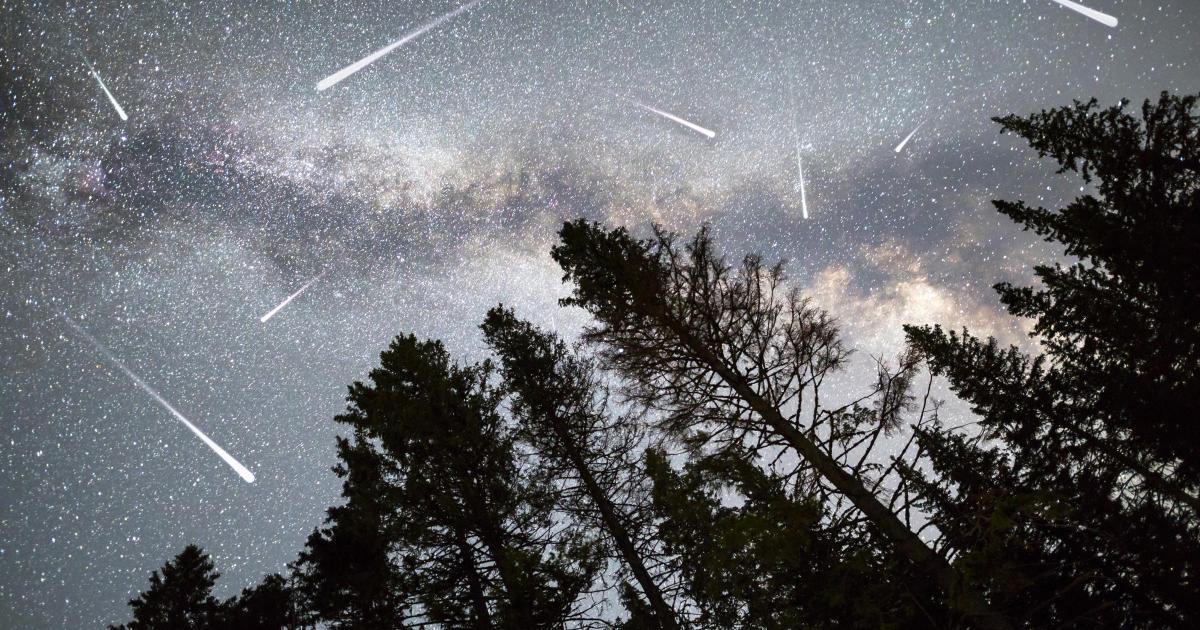
Later that evening, the Perseid meteor shower will reach its annual peak, producing one of the best displays of shooting stars of the year.
The Perseids occur every August as Earth passes through debris left behind by Comet Swift-Tuttle, with tiny fragments burning up in Earth’s atmosphere to create bright streaks of light.
Under ideal conditions, observers can expect to see dozens of meteors every hour, including brilliant fireballs that leave glowing trails across the night sky.
The Perseid meteor shower, showing a number of meteorites (Image: Dennis van de Water)
Why 2026 could produce one of the best Perseid displays in years
Astronomers say the timing couldn’t be better.
Solar eclipses always occur during a new Moon, meaning there will be virtually no moonlight to wash out the night sky.
Normally, a bright Moon can hide many of the fainter meteors.
But because the Moon will set with the Sun on August 12, skies will remain naturally dark throughout the night, giving the Perseids perfect viewing conditions.
That means more meteors should be visible than during years when a bright Moon interferes with the display.
Partial solar Eclipse through some clouds (Image: Getty Images)
How to watch safely and how to get the best views
Anyone planning to watch the eclipse must never look directly at the Sun without certified eclipse glasses or suitable solar filters, even when most of the Sun is covered.
Recommended reading:
For the Perseid meteor shower later that night, no equipment is needed.
Astronomers recommend heading somewhere with dark skies away from streetlights, allowing your eyes around 20 minutes to adjust to the darkness and simply looking up.
With a spectacular solar eclipse during the evening followed by one of the year’s biggest meteor showers after dark, August 12, 2026, is shaping up to be one of the most remarkable nights for UK skywatchers in decades.