
 Image: Nile Bowie / Nintendo Life
20 years ago, Nintendo published some of its most boldly experimental games on the Game Boy Advance – and only in Japan. Released across two waves in July 2006 and developed largely by Skip Ltd., the studio behind Chibi-Robo!, the seven-game bit Generations collection stands out as some of the most abstract game design Nintendo has ever put its name to.
If the Game Boy Advance had its own eShop back in the day, bit Generations feels exactly like the kind of titles that would have thrived there: small-scale, playable curiosities built around a single strong idea. These releases arrived at a time when the notion of a downloadable game had yet to become commonplace on Nintendo hardware.
All seven games were released on physical cartridges, and their packaging alone announced them as something different. Each of the box arts shared a common visual aesthetic designed around typography on a white field and a single abstract emblem representing the game inside, and the cartridges were jet black, unlike regular ones.
Completed the Bit Generations collection just in time for its 15th anniversary this month.
by
u/Silo-Joe in
Gameboy
That common identity carried into the games themselves, each designed around simple controls, short bursts of play and striking audiovisual presentation that leans all the way into futuristic early-2000s minimalism, an almost Apple-like sparseness that Nintendo itself would soon embrace in its design and UI more broadly during the Wii and DS years.
The series is delightfully genre-eclectic, ranging from racing and falling-block puzzling to traffic management, orbital physics and even a game designed to be played almost entirely through audio using headphones. Despite never being released outside Japan, the menus in each game is entirely in English and already feel localised for an international audience.
We can only speculate as to why Nintendo chose to keep bit Generations exclusive to Japan. These were, after all, small-scale and highly experimental games, with abstract visuals and unconventional mechanics that were hardly the easiest commercial sell alongside the more fully featured first- and third-party releases of the era.
Perhaps, Nintendo simply decided that localising and distributing seven such niche cartridges in the West was unlikely to justify the cost, particularly as the DS was already well-established by 2006. Ironically, those same qualities have only added to their mystique. Today, original cartridges and boxed copies are coveted collectibles, often commanding eye-watering prices on the secondary market.
Four of the games — Dotstream, Dialhex, Orbital, and Digidrive — were later reworked as part of the Art Style series on WiiWare and DSiWare, but Boundish, Coloris, and the wonderfully strange Soundvoyager were never revisited. I recently sat down with the complete collection to find out whether these seven experimental titles still hold up two decades later.
Mileage will vary depending on each player’s tastes, but taken as a whole, bit Generations remains a fascinating collection to revisit. These seven games capture Nintendo playfully unconcerned with convention, exploring ideas that still feel full of unrealised potential today, perhaps nowhere more so than Soundvoyager and its audio-based gameplay.
Nintendo GBA bit Generations Series
Boundish
Boundish is a collection of minigames built around the basic idea of Pong, with each pushing unusual court layouts and a different twist on ball physics.
It has the immediate appeal of a Game & Watch title in that its rules can be understood within seconds, and it never demands too much dexterity or concentration, making it quite tempting to chase a better score.
Coloris
Coloris, a striking match-three puzzler where you alter the colour of square tiles along a predefined spectrum, is the hardest one to put down. Each stage establishes a limited palette, like shades of yellow through blue, and the cursor alternates between opposite ends of that range. Pressing ‘A’ nudges the selected tile one step toward the cursor’s current colour.
Matching three or more tiles of exactly the same colour horizontally or vertically clears them from the board. Other pieces fall into place, and further matches can cascade almost effortlessly, making it feel like every input clears something. Stellar sound design fuels the dopamine kicks further, making it all too easy to lose yourself in a flow-state.
Dialhex
Dialhex is a falling-block puzzler in which you control a six-sided dial that rotates groups of adjacent triangles clockwise or counterclockwise, with the goal being to form them into hexagons and clear them from the board.
It takes a little longer to click than Tetris, but each run teaches you how to recognise useful formations faster and it soon becomes quite addictive.
Digidrive
Digidrive is a minimalist traffic-management puzzle game built around a four-way intersection. Using the D-pad, you direct abstract vehicles into one of the four lanes, sorting and stacking them to build up a fuel gauge that propels a hockey puck-shaped core forward, which tallies your high score.
It sounds convoluted, but it’s actually quite brilliant and quickly frenetic. With Q-Games developing, this was the only game of the series not made by Skip.
Dotstream
Dotstream strips arcade racing down to its barest readable elements, putting you in control of a single coloured line as you compete against five other coloured lines atop a black background. The goal of this horizontally scrolling, vector-influenced racer is simple: reach the right side of the course ahead of the others while weaving through cascading geometric hazards.
The courses are full of near misses, sharp turns, and tiny decisions, all driven by excellent breakbeat-heavy sound design. What gives it bite is how carefully calibrated the risk-reward design is. Your boosts are also your hit points, so manoeuvring with precision gives you more freedom to push ahead, while every mistake eats into your safety net.
Orbital
Orbital is a momentum-based space navigation game that moves much slower than anything else in the collection. You guide a tiny celestial body through self-contained solar systems and use gravitational attraction and repulsion to alter your trajectory and absorb smaller objects while avoiding head-on collisions that result in a game over.
Much like Atari’s Lunar Lander, it’s all about carefully managing momentum to avoid crashing out while patiently waiting for the ideal point in your trajectory to act. Sling-shotting around a planet or gently nudging yourself into a star’s orbit unscathed is highly satisfying, all accompanied by an ambient soundscape that suits the meditative pace perfectly.
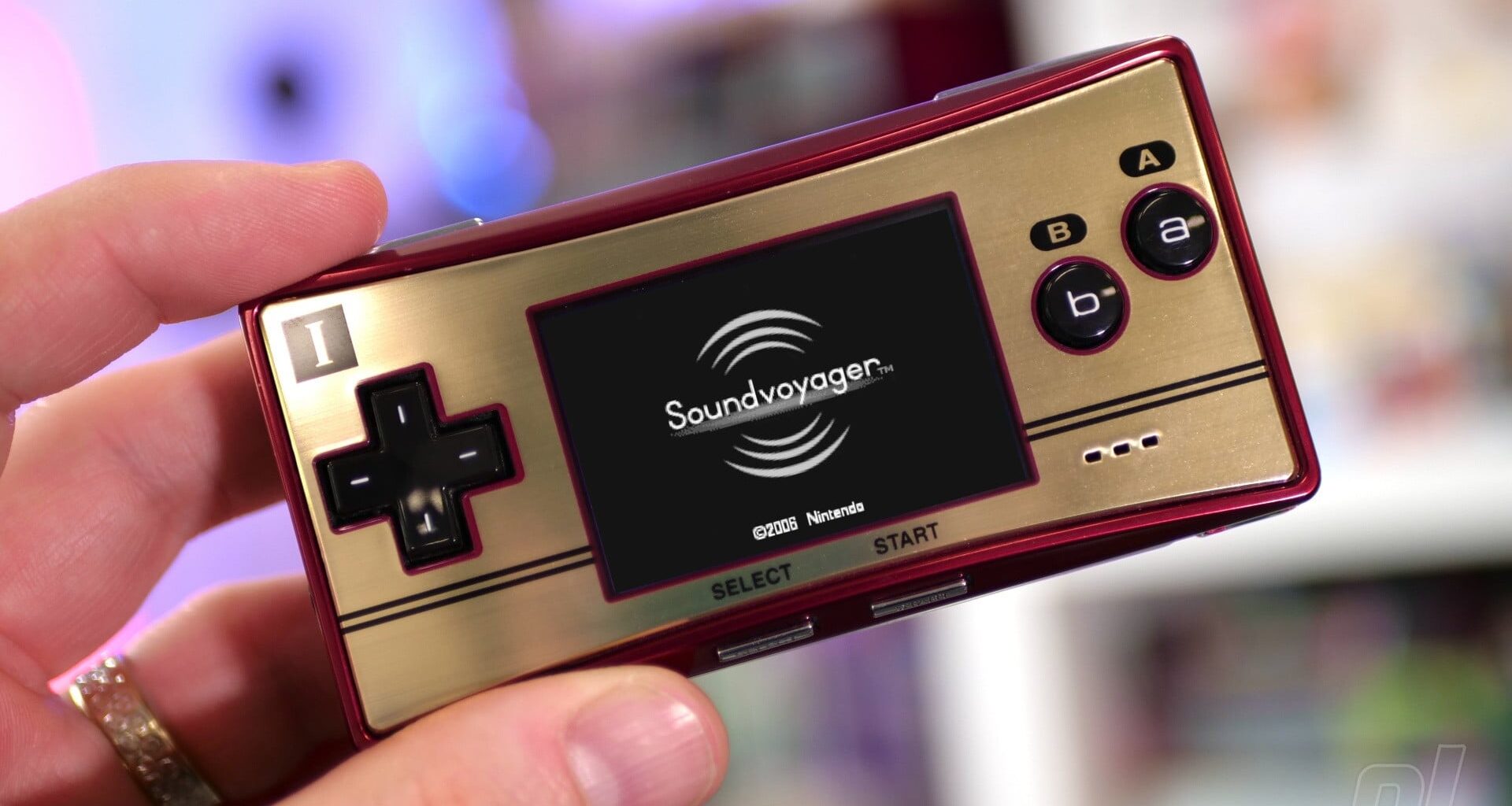
Soundvoyager
Soundvoyager is the standout game of the lot, both for the novelty of its gameplay and just how well it executes its premise. It is a collection of audio-based minigames that can be played with your eyes closed. Individual elements of a song play in loops along the stereo field. It might be a jazzy bassline, a choral melody, a burst of percussion or an ambient texture.
You shift left or right on the D-pad until the sound is perfectly centred in order to ‘capture’ it so that the element becomes part of the background music. Piece by piece, the composition gradually assembles itself around you. Other twists on the formula have you locate, avoid, chase and even shoot various sounds. Headphones are obviously essential here.
Lying in bed playing this with my eyes closed was a sensorily unique gameplay experience, to say the least. The sound design and various compositions are superb, and the creative ways in which samples are utilised consistently surprised and delighted me. It’s certainly striking when gameplay succeeds in being compelling even when the ‘video’ is taken out of video games.
 Image: Damien McFerran / Nintendo Life
Let us know if you’ve played any games in this series over the last two decades.
Related Games
See Also

Nile Bowie is an American journalist based in Singapore who grew up on Nintendo. When he isn’t reporting on politics, business, and international relations, he’s very likely playing his Switch, tracking down old Game Boy cartridges, or reading Nintendo Life with a cat on his lap.