
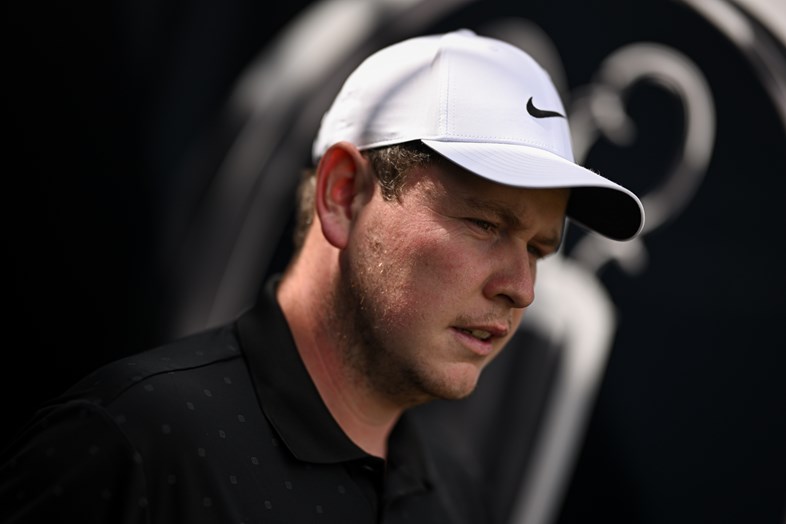
Bob MacIntyre sits down with TG to discuss his Open chances, dealing with criticism, and why he’d happily retire if he won the Claret Jug.
“I’ll be honest, I could happily retire from the game of golf if I won a major,” says Bob MacIntyre ahead of his first visit to Royal Birkdale and another crack at the tournament he regards above all others.
Beyond the sense of hyperbolic finality from a golfer in his prime years is a window into MacIntyre’s uncompromising intent as he turns his attention to his seventh Open Championship. “I play this game for myself,” he tells TG in a quiet corner of the Renaissance Club in East Lothian. “I play this game because I love it. I enjoy trying to get better and I enjoy competing. That’s why I still play the odd game of shinty. It’s because I love the fight.
“But if I won a major and then something happened to me and my golf game went downhill, I could sit back and go, you know what? I’ve achieved everything that I’ve ever dreamed of. I’ve won the Scottish Open. I’ve won home and away Ryder Cups. A major is just a missing piece just now.”
Even a tournament as precious to MacIntyre as the Scottish Open – which he won in such dramatic fashion with a birdie on his 72nd hole two years ago – takes on a slightly newer meaning these days. “There’s different things that come and go but for me I’m not so much chasing anything other than major championships,” he continues. “This is like a major for me so obviously I’m preparing as hard as I can but it’s also looking ahead. I’ve managed to win this one so now it’s like how can we fine-tune for [The Open]?”
Last year, MacIntyre holed a putt at Oakmont convinced he had done enough to win the US Open. His evolution from the unassuming underdog from Oban in Scotland’s West Highlands to a true contender on these defining weeks was complete long ago, but that also makes his major record thus far in 2026 so jarring. His results at the Masters, PGA Championship and US Open read MC-MC-T39. These tournaments have passed him by quickly, but not quietly.
MacIntyre describes himself as a kettle – “always boiling away, ready to erupt” – and Augusta National felt his wrath in April. During a miserable week in Georgia, he was spoken to by officials after microphones caught him swearing and then gesturing angrily at the 15th hole during a galling first-round 80. MacIntyre did not speak with reporters at Augusta, but posted an AI-generated image of himself resembling a Masters gnome giving a middle-fingered salute.
“I just try and have a laugh,” he admits. “I was never going to speak to the media the way I was feeling. It’s going to happen again at some point and people have to understand that. If I stand up in that stand, I’m going to make bigger problems than what the negatives are of me not speaking.
“There’s a few things we need to sort out. I’m trying my best to not lose the plot as much. When you’re having bad days at work, it’s not easy to accept, especially when you feel you’ve put all the effort in and it’s not working out. It’s like in my golf, it’s not easy and nothing’s given.”
MacIntyre says he is continuing to work on controlling his emotions on the course. His elevated position in the game comes with popularity and adulation, but also backlash when his behavior crosses the line. MacIntyre, however, keeps a small circle and has never been fazed by the noise outside of it.
“I’ll be honest, I don’t give a s***,” he says when asked about dealing with criticism, particularly on social media. “I’ve got a saying that I wouldn’t say but, everyone’s got an opinion. You see the people that I’ve employed that are closest to me – friends, family, they’re the ones I trust. That’s why they’re in my team. If they tell me something, if I do something wrong, they are going to tell me. ‘That was out of line, Bob.’ They understand that I wear my heart on my sleeve and I’m volatile at times.
“But it sounds daft, I think golf needs that. I think golf needs personalities and sometimes it can cross the line. Yes, there’s two-shot penalties here and there now. It used to be fines.”
Indeed, player behavior is going to be in sharp focus at this Open as The R&A cracks down on players guilty of on-course meltdowns. The new Code of Conduct agreed by the major governing bodies enables referees to hand out these penalties for serious offences. The hotheads will be under the microscope at Birkdale and a temper tantrum could transform a leaderboard.
Joaquin Niemann was the first golfer penalized for breaking the new rule introduced this year at the US Open, the Chilean throwing his sand wedge in frustration after going out of bounds twice on one hole at Shinnecock Hills. “I didn’t see how it all unfolded,” MacIntyre says. “When you cross the line, I think a warning’s good at the start and that gives you a yellow card.”
Like Niemann, MacIntyre was also irked at Shinnecock, but this time because it felt like a major got away from him. The Scot was playing well 32 holes into the tournament, but contrived to make two bogeys and a double late on in his second round and only just snuck into the weekend.
“Until the last four holes on Friday, I was doing great,” he says. “I was in a great position at level par, but I just lost the plot for four holes and I probably should have missed the cut. I made the cut and I played all right over the weekend, but it wasn’t what I wanted to do. But it was a positive.It was the first major cut for the year. Positive signs. I was wanting to be in contention, but I wasn’t, so it was like, ‘Right, let’s try and build on it.’”
MacIntyre’s pursuit of a scintilla of an edge over his rivals – “we’re just looking for 0.2 of a shot, it’s so small now” – led him to a new set of Titleist irons at the start of major season that unknowingly stalled his momentum. “I tried to tweak things this year to try and get that a little bit better with approach play and it backfired,” he admits. “So I rewinded it, reversed it and I feel like I’m starting to see the signs again.”
He’d never use it as an excuse but MacIntyre’s brief major slump can also be attributed to a change of priorities. In January, MacIntyre and his partner Shannon welcomed their first-born son, Findlay. Since then he has been navigating fatherhood in Oban with long stretches away on the PGA Tour. MacIntyre moved to Florida in 2024, but returned home after quickly realizing that everything he cared about was back home on Scotland’s west coast.
“I wasn’t enjoying it,” he says. “I was meant to do eight months and I did six months. I’ve not even thought about living in the US. The travel’s not too bad. It’s tough when it’s just one weeks off, when it’s two weeks off it’s no bother, but life’s great. I’ve got no complaints. I love Scotland, it’s always going to be home. Who knows? Never say never about living in the US, but for right now, I prefer being here.”
It has taken some adjustment, but MacIntyre is now able to separate his two lives – the family man who occasionally turns out for his beloved Oban Celtics at shinty – a game he describes as field hockey without rules that shaped his competitive instincts – and the star left-hander in America.
“I don’t worry about work, I don’t even think about work when I come home,” he says. “I hardly touch the golf clubs, to be honest. I enjoy life when I’m at home.”
Which is why, even after three disappointing majors, MacIntyre arrives at Southport in a relaxed frame of mind. He’s not particularly fussy about which one he wins, but the Claret Jug has always been his ultimate prize. It also feels highly attainable. With three top-ten finishes across his six starts, this major is where he feels at home. A burned-out Lancashire links should suit the guile of MacIntyre.
“It’s just natural for me,” he says. “It’s what I’ve been brought up playing. You’ve got a bit of an advantage on that. I’m good at the tough tests, the real tough tests. That one or the US Open is probably the one that suits me the best.”
MacIntyre, though, won’t be forcing the issue at Birkdale – where patience will be paramount as he bids to end a tumultous major season on a high.
“I’ve seen a video of a basketball player being asked, ‘Is this season a failure?’ He said, ‘No season’s a failure, it’s just all learning.’ That’s massive for me,” the Scot explains. “I think [majors] do pass by now because they’re too tightly packed. I get four chances a year if I’m in the top end of the game. If I’m playing professional golf at the top level for 10 more years, that’s 40 chances.
“I fancy my chances to have a good few real close calls – if not win one out of a few.”