

Updated July 17, 2026 — 5:45pm,first published 1:27pm
Save
You have reached your maximum number of saved items.
Remove items from your saved list to add more.
AAA
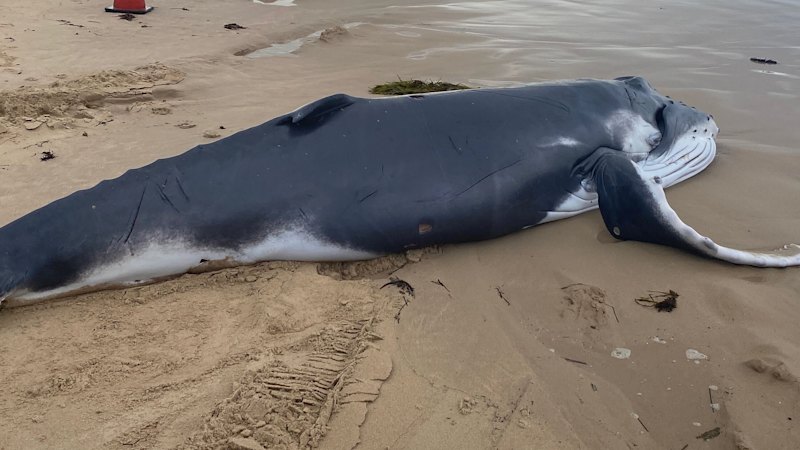
A newborn humpback whale that was stranded on a Sydney beach overnight has died, and the carcass will be tested for H5N1 bird flu as a precaution.
A member of the public reported the stranded whale on Greenhills Beach in Cronulla about 6.30am on Friday by calling the Organisation for the Rescue and Research of Cetaceans in Australia (ORRCA) hotline.
ORRCA president Ashley Ryan said responders were deployed rapidly but “despite rescue efforts by responding agencies, the calf sadly died shortly after responders arrived”.
Ryan said it was a male humpback whale neonate calf, about 4.5 metres in length, that still had the umbilical cord attached and foetal folds – visible creases on the skin from being curled up in the womb. ORRCA was working with NSW National Parks and Wildlife Service, Indigenous ranger group Gamay Rangers and Sutherland Shire Council to complete operational requirements and First Nations cultural protocols.
The carcass has now been removed from the beach, and Ryan said it would be tested for H5N1, the virulent strain of bird flu that has devastated marine wildlife overseas. It had not yet been decided whether to perform a full necropsy, she said.
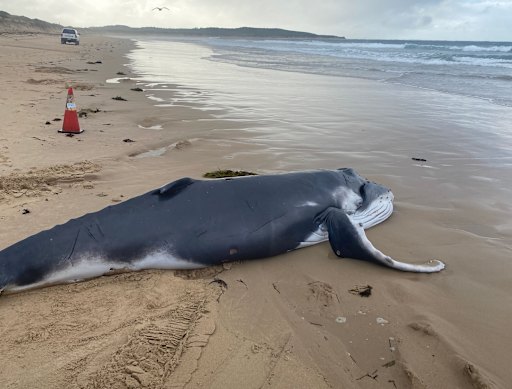 A newborn humpback whale was stranded and died at Greenhills Beach in Cronulla.Thomas Hollywood
As a precaution, the NSW Department of Primary Industries and local lifeguards had been notified so appropriate SharkSmart alerts could be implemented.
Ryan said the cause of the stranding was unknown at this stage.
“There are many reasons why whales can become stranded, including illness, injury, separation from their mother, navigational challenges or other natural factors,” she said. “It is too early to determine what led to this particular incident.”
A NSW H5 Avian Influenza Response spokesperson said there had been no recorded cases of humpback whales contracting the virus anywhere in the world. Precautionary testing of marine mammals found on beaches might occur as part of the “agreed national approach to monitoring and surveillance for H5 bird flu”, the spokesperson said.
H5N1 has infected dolphins, porpoises and seals, all species known to scavenge dead seabirds. Baleen whales such as humpbacks are at lower risk because they feed on krill and some small fish, but they are capable of carrying viruses.
Dr Vanessa Pirotta, a marine biologist at Macquarie University who specialises in the study of whales, said the calf was probably a few days old or even a few hours old, and it could have been stillborn or sickly at birth. Occasional strandings could be expected with or without bird flu, Pirotta said, especially since it was peak humpback season.
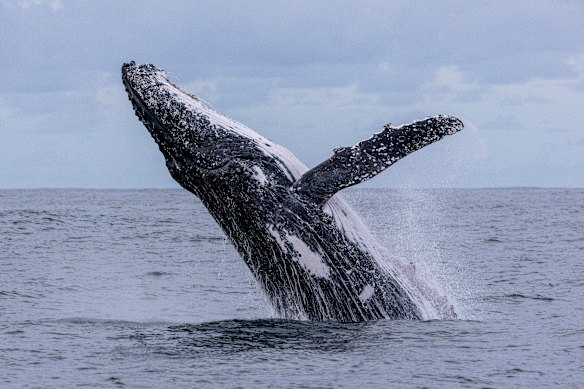 It is peak humpback season on the NSW coast, as the whales swim from Antarctica to the tropics for winter. This whale was passing through Ballina last month.Danielle Smith
However, Pirotta said when whales died they did not normally get washed ashore, so the situation with bird flu and whales was unknown. There were concerns on the west coast that the numbers in the annual humpback migration could be lower this year because of the virus, she said, though this was uncertain.
“Given the opportunity to sample from a whale like this one, it’s a no-brainer that we sample for bird flu as well,” Pirotta said. “Birds and whales do co-occur, and often we see birds in close proximity to whales, and these whales are directly coming from areas we know have bird flu, such as Antarctica.”
Related Article
H5N1 bird flu arrived in Australia last month, after having spread to every other continent. In June, sick seabirds blown off course from the sub-Antarctic flyway started to land on the Australian coastline, first in Western Australia, then in South Australia and NSW. A week ago, the virus was detected in a local bird in South Australia.
The virus has devastated seabirds and marine mammals worldwide, and experts warn more than 100 Australian species are at risk of being driven to extinction or to the brink. It has also hammered the poultry industry overseas.
State and federal governments in Australia have prepared with monitoring and mapping of migratory bird fly routes and have some vaccines in reserve for endangered species.
Gamay Rangers manager Bryce Liddell said humpback whales or “burriburri” had deep cultural significance, and his group should be involved in any testing and disposal.
“On-country burial is the priority,” Liddell said. “The importance of burriburri to traditional owners and the broader community is why events like this should prioritise culturally appropriate options, rather than ending up in a rubbish tip.”
Related Article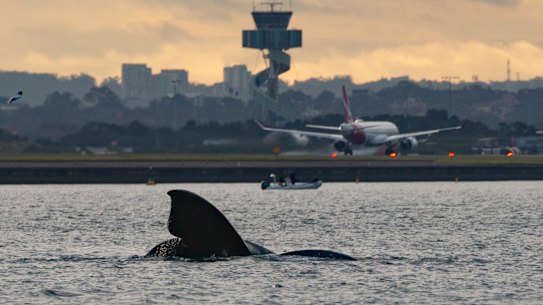
Members of the public are reminded to keep well away from stranded marine mammals, keep dogs on leads and away from the area, and follow directions from emergency personnel.
Anyone who encounters a stranded, injured or entangled whale, dolphin or seal should immediately contact the ORRCA 24-hour rescue hotline on (02) 9415 3333 or NPWS on 1300 072 757.
Get to the heart of what’s happening with climate change and the environment. Sign up for our fortnightly Environment newsletter.
Save
You have reached your maximum number of saved items.
Remove items from your saved list to add more.
 Caitlin Fitzsimmons is the environment and climate reporter for The Sydney Morning Herald. She was previously the social affairs reporter and the Money editor.Connect via email.From our partners