
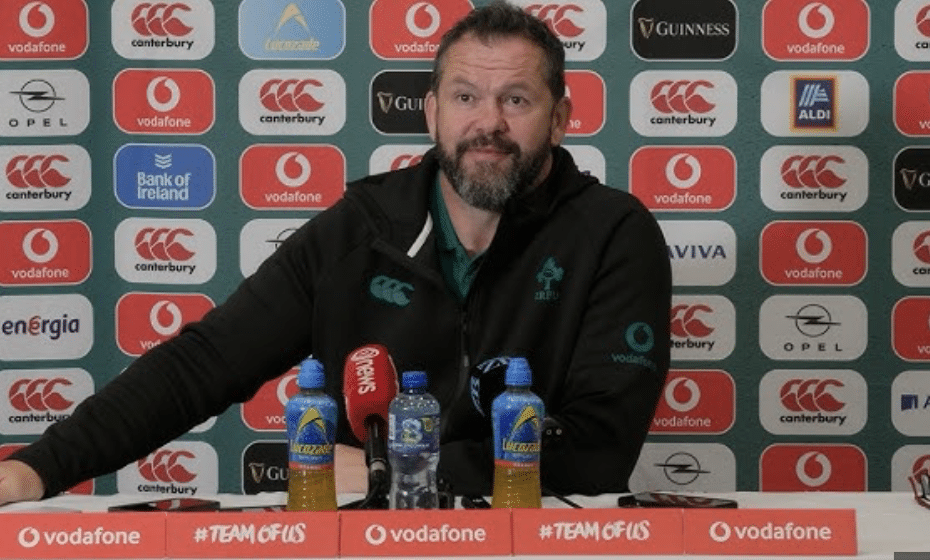
Andy Farrell’s new contract as Ireland head coach has not only secured his own future until 2031 – it has also increased the chances of one of his sons pulling on the green jersey.
The Ireland boss recently confirmed that his younger son, Gabriel, is eligible to represent Ireland through residency after moving to Dublin with the family in 2019.
⭐ Save us to your Google Favourites for nonstop RUCK content!
With Owen Farrell’s international future once again sparking debate online, many supporters have questioned whether the former England captain could also one day switch allegiance.
Here’s why the answer is no – and why Gabriel’s path is very different.
Gabriel Farrell’s Ireland dream edges closer
Gabriel Farrell has spent the majority of his teenage years living and playing rugby in Ireland after relocating to Dublin when Andy took charge of the national team in 2019.
Under World Rugby’s eligibility regulations, Gabriel qualifies to represent Ireland through residency, provided he continues his rugby development and reaches international standard.
Andy has previously joked that his youngest son was already further ahead than Owen had been at the same age.
“He’s goal-kicking already. He’s probably ahead of Owen at that age.”
Unlike his older brother, Gabriel has come through his formative rugby years within the Irish system, leaving the door open for him to one day represent Ireland.
New contract strengthens Gabriel’s Ireland prospects
Farrell’s decision to sign a new contract through to 2031 could prove significant for Gabriel’s rugby future.
Rather than returning to England after the 2027 Rugby World Cup, the family will remain based in Dublin for another four years, allowing Gabriel to continue his development in Ireland throughout some of the most important years of his career.

Speaking after agreeing the extension, Farrell admitted family was the biggest factor in his decision.
“Family was the only thing… Absolute no-brainer for me.”
He also revealed that discussions with his children made the choice straightforward.
“When I got asked, I just said, ‘Can I have a week to just talk to family at home… I’ve got a daughter over there living in England… and two living in Dublin. So, I had to have the right chats with them, and it was clear and obvious.’”
Farrell also spoke warmly about the family’s life in Ireland after committing his future.
“I am incredibly proud to continue the journey with Irish Rugby through to 2031. The connection with the players, staff, supporters and everyone involved in the game in Ireland is pretty special.”
By the time Andy’s contract expires after the 2031 Rugby World Cup, Gabriel will be an adult and potentially pushing towards the professional game, making an Ireland call-up a far more realistic prospect if his development continues.
Why Owen Farrell can never play for Ireland
Despite repeated speculation on social media, Owen Farrell is not eligible to represent Ireland.
Although World Rugby allows certain players to switch nations after a three-year stand-down period, that route is only available to players who qualify through a parent or grandparent born in the new country.
Owen does not have an Irish-born parent or grandparent, meaning he cannot make the switch.
His long England career also means residency is irrelevant. Once a player has been internationally captured, they cannot change unions through residency alone.
That is why Gabriel has a route to Ireland, while Owen never will.
EDITORS PICKS:
“Stinker” – Four Ireland players who FLOPPED against the All Blacks
While there were positives to take from Ireland’s set-piece and periods of attacking intent, too many players endured off-nights when the pressure was at its highest.
⭐ Save us to your Google Favourites for nonstop RUCK content!
Sam Prendergast
There were glimpses of quality, but far too few to outweigh a difficult afternoon.
Prendergast deserves credit for his defensive commitment and produced a lovely pass to send Hugo Keenan over for Ireland’s second-half try. His kicking to touch was also generally excellent, aside from one costly error.
Unfortunately, almost everything else lacked the accuracy required at Test level. A pass into touch inside the New Zealand 22 wasted one promising attack, while another poor pass drifted into touch early in the second half. Too often he stood flat behind the gain line, allowing the All Blacks defence to line him up without ever worrying about his running threat.
He also finished with four missed tackles, although his willingness to put his body on the line was better than many critics will acknowledge.
Perhaps the biggest winner from Ireland’s summer tour has been the injured Jack Crowley, whose position in the pecking order now looks even more secure.
 AUCKLAND, NEW ZEALAND – JULY 18: Sam Prendergast of Ireland shows his frustration during the Nations Championship match between New Zealand All Blacks and Ireland at Eden Park on July 18, 2026 in Auckland, New Zealand. (Photo by Joe Allison – Nations Championship/Nations Championship via Getty Images)
Join the RUCK’s WhatsApp community here and get the latest news sent straight to your messages.
CONTINUES ON PAGE TWO