
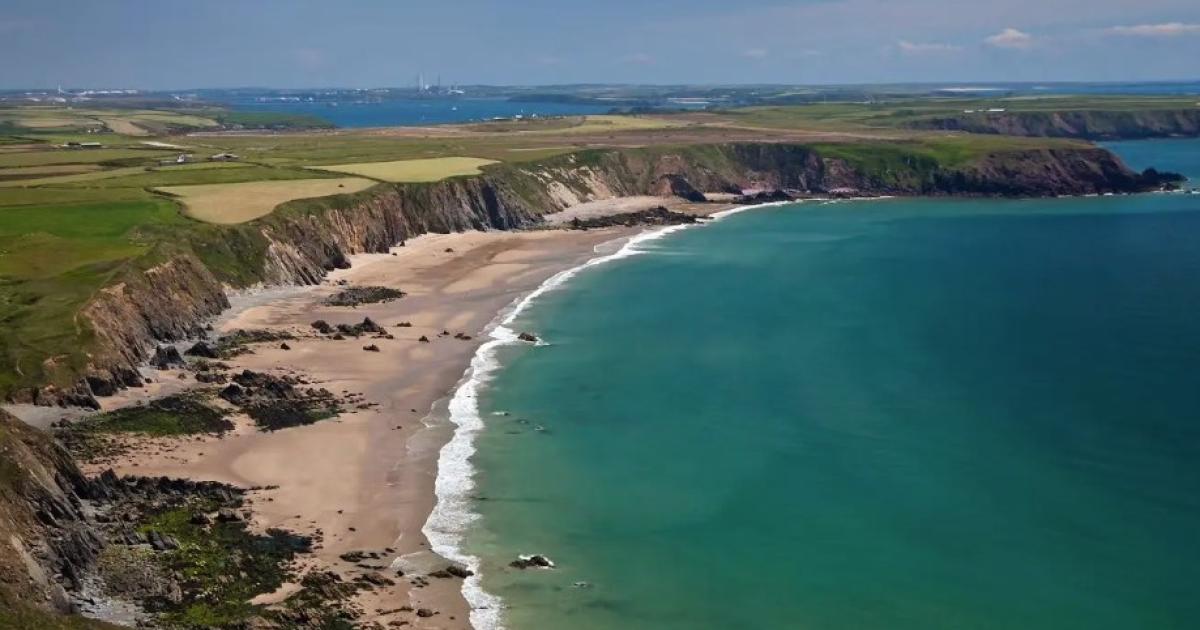
Marloes Sands in Pembrokeshire has secured a spot on The Sunday Times’ 2026 list of the 50 best beaches in the United Kingdom.
The beach is one of three from the county to make the list, alongside Broad Haven South and Abereiddy.
Chris Haslam, chief travel writer for The Times and The Sunday Times, who spent five weeks visiting 607 beaches before finalising the list, praised Marloes Sands for its geological significance and unspoilt beauty.
He said: “Remote, raw, rich in wildlife and geology, and scrubbed clean by a community that genuinely loves it – Marloes Sands earns its place on any list of Britain’s finest beaches.”
Visitors must walk nearly half a mile from the National Trust car park to reach the bay, passing the Runwayskiln café along the way.
There is no car park at the beach itself, no ice cream van parked on the sand, no promenade.
One of the standout features of Marloes Sands is its fossil-rich cliffs, which make this stretch of coastline unlike anywhere else in Wales.
The cliffs are among the most scientifically significant on the Pembrokeshire coast.
They reveal Lower Palaeozoic sedimentary rocks, tilted almost vertically by ancient geological forces, and are estimated to be hundreds of millions of years old.
The beach is a designated Site of Special Scientific Interest.
Fossils such as corals, brachiopods, and trilobites can be found in the scree at the base of the cliffs.
At low tide, the unique rock formations divide the bay into smaller coves and rock pools.
Marloes Sands offers far more than geological intrigue.
When the tide is out, more than a mile of golden sand is exposed, creating a vast, south-facing stretch open to the full force of the Atlantic.
Water quality is rated as excellent by the Marine Conservation Society.
The surrounding waters form part of Wales’ only Marine Conservation Zone, recognised for its biodiversity.
Wildlife is abundant.
Seals often haul out on the rocks, and the sky is filled with seabirds riding the Atlantic winds.
Just offshore, the islands of Skomer and Skokholm are visible from the beach.
These islands host the largest puffin breeding colony in Britain and attract birdwatchers from around the world.
Just inland, Marloes Mere is a 17-hectare wetland area and a Site of Special Scientific Interest.
The natural beauty of the bay has also attracted filmmakers.
It featured in the 2012 film Snow White and the Huntsman and the 1968 historical drama The Lion in Winter, which starred Peter O’Toole, Katharine Hepburn, and a young Anthony Hopkins.
The community plays an active role in maintaining the beach.
Annual beach cleans, including a long-running Midwinter clean held in memory of a local resident, are a key tradition.
reflecting exactly the kind of grassroots care for a coastline that the Sunday Times’ judging panel said it was looking for this year.
Marloes Sands’ unspoilt character, geological significance, and community care have cemented its status as one of the UK’s best coastal destinations.