
norman lebrecht
July 22, 2026
This must be one of the most famous and intriguing paintings in the world.
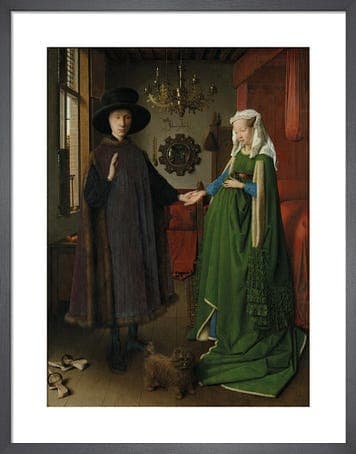
Jan van Eyck’s jewel-like masterpiece, was created in 1434. A richly dressed man and woman stand in a private room. They are probably Giovanni di Nicolao di Arnolfini, an Italian merchant working in Bruges, and his wife.
Although the room is totally plausible – as if Jan van Eyck had simply removed a wall – close examination reveals inconsistencies: there’s not enough space for the chandelier, and no sign of a fireplace. Moreover, every object has been carefully chosen to proclaim the couple’s wealth and social status without risking criticism for aping the aristocracy.
The man’s hand is raised, apparently in greeting. On the back wall, a large convex mirror reflects two men coming into the room, one of whom also raises his arm. Immediately above it is Van Eyck’s signature. Could the man in mirror be van Eyck himself, with his servant, coming on a visit?
Here is a short film that delves into each intricate detail and discovers van Eyck’s groundbreaking technique. The film was made for a recent National Gallery exhibition.
I had always understood that the wife in this delicate work of art was pregnant and that this was a painting made to celebrate the couple’s first long-awaited child. Not at all. It turns out that Mrs Arnolfini died the year before van Eyck created this painting. The painting is therefore now believed to be a memorial, commissioned by Mr Arnolfini to the memory of his late wife. Memorial portraits of the dead with the living were apparently not unusual at that time.
Other scholars have made observations about the symbolism of the painting. For example, Mr Arnolfini stands by an open window looking out onto the world of the living. She stands before a bed, a symbol of sleep and repose. He stands underneath a lit candle, a symbol of the living. She stands under a candle stub that has gone out, a symbol of death.
Another scholar speculates that the mirror in the background is surrounded by scenes of the life of Christ. Those on the left side, where Mr Arnolfini stands, depict His life and miracles. Those on the right side, behind Mrs Arnolfini, depict His passion and death.
The National Gallery dismisses much of this speculation and concentrates here on the artistry of Van Eyck. Whether or not it is a memorial is left to the viewer to decide.
Read more