
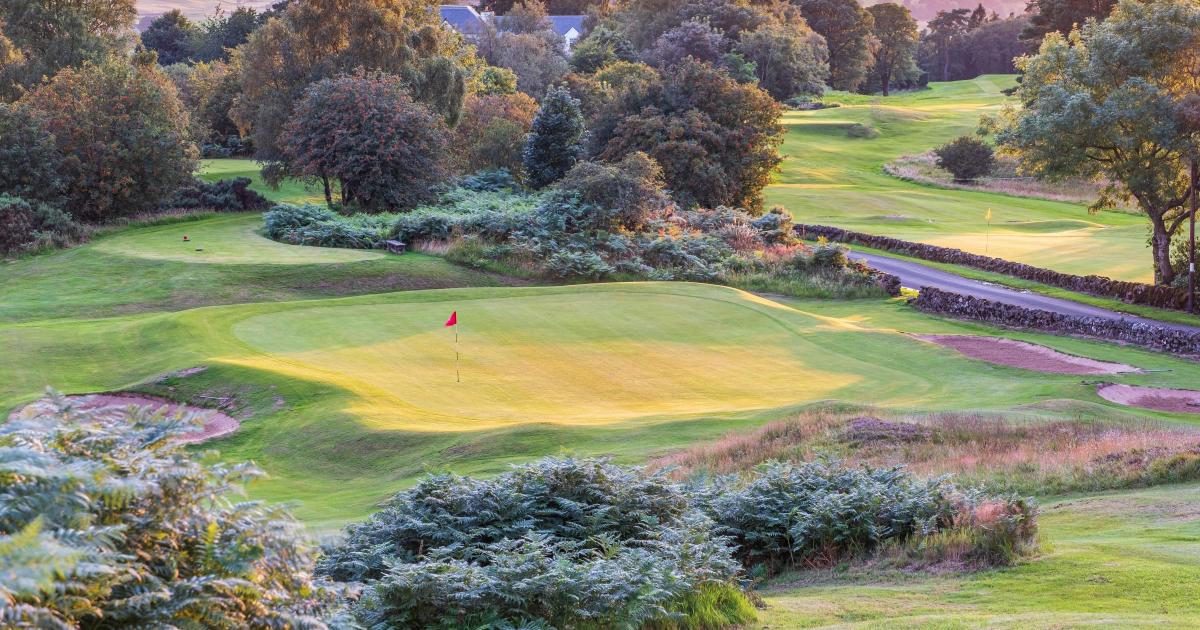
Kilmacolm GC has come through an intense spell of weather disruption and disease to restore its greens, upgrade irrigation and set out a 10‑year course management plan aimed at keeping the club competitive in an era of changing rainfall patterns.
Captain Steve Dickie has been working with a young course manager and the greens team to tackle Fusarium, a highly destructive turf disease caused by fungus, while also securing member‑backed funding for a £200,000 irrigation project. There are further plans to reshape the competition calendar by moving the playing season back to later in the year.
Mr Dickie also explains why the club is now formalising a “Kilmacolm Standard” to guide future governance.
(Image: Damian Shields)
You say there have been more competitions cancelled or delayed this year than in any other during the past decade – what’s going on?
That may not be 100% accurate, but does feel that way and a lot of the guys I’ve played with for years say the same.
It appears that our seasons are changing, to the extent that we’re thinking let’s maybe not have our opening event on April 1 as we always do. Let’s move it back a bit and then play longer into October, because I think we’ve got a course that can play that long into the traditional autumn.
Have these weather changes been dramatic, or more subtle?
In the west – the “wet of Scotland” – we already get most of the rain that lands on Greenock, which sees around 66 inches a year. Last winter we probably had three inches more, so it’s not enormous in percentage terms, but we’ve seen many more days with rain and heavier bursts of showers.
That gives you flooding where previously you had none. Traditionally, Kilmacolm’s heathland profile drains quickly, but in recent “monsoon” conditions we’ve had areas ponding and have also had to abandon competitions due to thunder and lightning.
What was the disease plaguing the greens until recently?
Fusarium is a natural problem that can hit any course when heat and moisture combine in the wrong way. We had a policy of trying to limit fungicides three years ago, and in retrospect that was the wrong call.
When Fusarium came, lots of courses were affected, but we got it worse, which I wasn’t happy to simply accept. We consulted the R&A, who confirmed the scale of the issue, and the real question became: how do we make the course more disease‑resistant?
What changed?
We moved away from a biological treatment approach and went back to traditional methods – more sand, more aeration, more air and better drainage.
With R&A advice we put a proper disease‑prevention programme in place. It meant higher fungicide costs in the short-term, but less than two years later we’ve got, in my view and in the view of many, the best greens in the area. Hosting three major competitions, with visiting players highly complimentary, has underlined that.
Steve Dickie says the decision to limit fungicides was, in retrospect, ‘the wrong call’ (Image: Supplied)
The club has also invested heavily in an irrigation project – how was that funded?
We were upfront with members about the problem and asked them to help. Rather than borrow externally, we offered members the chance to lend to the club in return for preferential subscription rates over five years, with their loans repaid at the end. Enough members came forward to cover the project cost, which was around £200,000.
On the course, we did a lot of research. Big clubs might irrigate greens, tees and fairways, but fully irrigating Kilmacolm would have been a seven‑figure sum and hard to justify. We asked members to prioritise; greens were overwhelmingly number one. We installed a four‑head, U‑shaped sprinkler system on every green and laid irrigation tails to every tee for future use.
It’s now an automated Rain Bird system, looped around the course, and the course manager can control individual heads from his phone or laptop, giving him precise control over moisture levels.
You now have a 10‑year course management plan. What does that cover?
The plan runs from 2025 to 2035 and is publicly available, including a pictorial version showing each hole and what we intend to do. It was our long‑term response to being caught out by Fusarium.
Looking back over the 4th hole towards the Knapps (Image: Supplied)
The greens committee went back to basics – looking at drainage profiles, ground and sward testing with European specialists – then wrote a list of what needed to change. We can’t afford everything at once, so it’s phased; we focus first on projects in the early years where funding is realistic and keep longer‑term ambitions on the radar.
What is the “Kilmacolm Standard”?
When we produced our course management and maintenance plans we realised we were mainly looking at the course. The Kilmacolm Standard is about looking at the whole club – course, clubhouse, service and member experience – through the same lens.
It’s a way of articulating a long‑term vision: we’re stewards of a great asset, and every decision should make the club better for the future. It’s still in draft, but the idea is to set clear standards for how the club should look and feel, then get staff, committees and members to buy into them.
Click here to sign up for The Herald’s Business of Golf newsletter, out every Sunday.
(Image: Damian Shields)