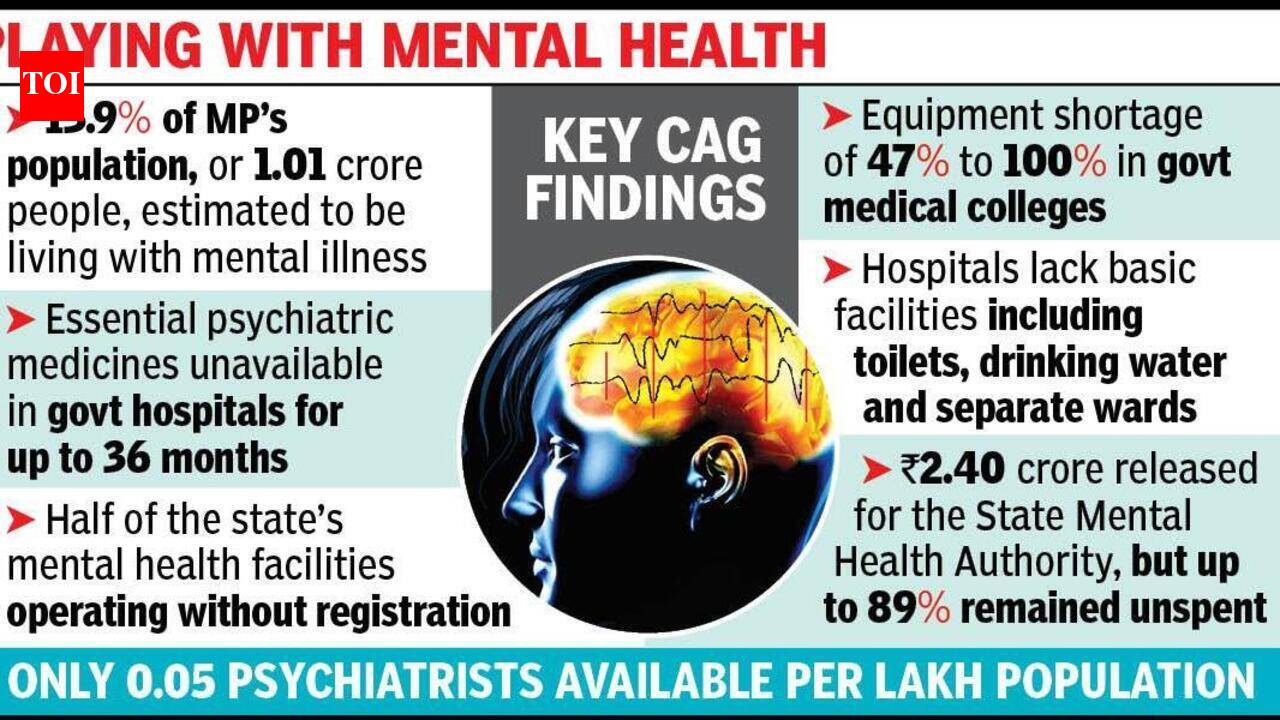
 PLAYING WITH MENTAL HEALTH Bhopal: Equipment shortages of up to 100%, staff vacancies touching 67% and the unavailability of psychiatric medicines unavailable for three years and counting. This, in a nutshell, is the state of Madhya Pradesh’s public mental healthcare system.Standing literally on the crutches of broken infrastructure, the existing facilities are ill-equipped to serve a state where the burden of mental illness is higher than the national average, a report by the Comptroller and Auditor General (CAG) has revealed.In a disturbing find thrown up by a pan-India performance audit by CAG, 13.9% of Madhya Pradesh’s population suffers from mental illness, significantly more than the national average of 10.7%. The figure works out to about 13 of every 100 persons, underlining the seriousness of mental illness as a public health concern in the state.Combined with a higher load of patients with mental illness, the audit also pointed to serious deficiencies in infrastructure, manpower, regulation and patient care across the state’s mental healthcare institutions.Essential psychiatric medicines were unavailable in test-checked govt mental hospitals, govt medical colleges, district hospitals and community health centres for periods ranging from one month to 36 months between 2021 and 2024. The shortages persisted despite the rollout of Mental Healthcare Act, 2017, mandating free medicines for persons with mental illness and the state’s drug policy requiring buffer stocks.Infrastructure deficiencies were also found a lot to be desired in the CAG audit, as in five govt medical colleges, shortages of equipment prescribed under Medical Council of India norms ranged between 47% and 100%. The audit also found that no radiologist was posted in either of the state’s two govt mental hospitals during 2021-24, forcing psychiatrists to interpret X-rays and other diagnostic images themselves.Hospitals were found lacking basic amenities, including adequate toilets, sanitation facilities, separate wards and toilets for men and women, sufficient beds and pillows, and access to safe drinking water. None of the inspected mental healthcare establishments had separate accommodation for minors.The audit also pegged manpower shortages as ranging between 13% and 67% across inspected mental healthcare establishments. Madhya Pradesh has only 0.05 psychiatrists per lakh population, highlighting the shortage of specialists despite the state’s higher prevalence of mental illness, the report specified.The national auditor also questioned the functioning of the State Mental Health Authority (SMHA), constituted under the Mental Healthcare Act to regulate mental healthcare institutions. The authority was constituted in September 2020 after a delay of two years and seven months and remained only partially functional till July 2025 because of shortages of experts and staff.Although the state released Rs 2.40 crore to the SMHA Fund during 2020-24, no expenditure was incurred during the first two years, while 46% to 89% of the funds remained unutilised during 2022-24. Four years after its formation, only four of the sanctioned 15 members had been appointed.The audit found that no Mental Health Review Board was constituted, no mental health professionals were registered and neither were state-specific regulations framed for registration, renewal or enforcement of minimum standards. As a result, only 82 of the state’s 163 mental health establishments are provisionally registered, while the remaining 81 continue to operate without registration, the report revealed.The report also found that 409 patients either left hospitals against medical advice or absconded from four mental healthcare establishments. However, none of these institutions had a mechanism to track such patients or ensure continuity of treatment.The audit also raised concerns over nutrition provided to in-patients. While the National Human Rights Commission had recommended increasing the daily food allowance, the govt-run mental hospitals in Indore and Gwalior spent Rs 48 and Rs 65.43 per patient per day, during 2021-24, below the amounts recommended by the rights body.