
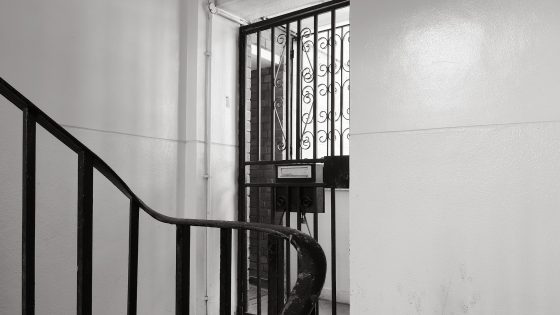
This photograph was taken on 12 May, 2026. It depicts the threshold to a two-bedroom flat with three aspects, located on the first floor of a five-storey social housing block that is joined at a right angle to another, three storeys higher.
In the foreground of the image, a black-painted steel balustrade with a continuous shallow-D handrail elegantly describes the journey upwards and down. Behind it, a similarly painted steel barred security gate is fixed between two thick white-painted walls. A letterbox is welded to it at its centre and a steel plate to its right conceals the deadlock mechanism.
Most of the dwellings in this building, (originally commissioned by Stepney Metropolitan Borough Council and built between 1954 and 1957 by the contractor Browley Brothers), are accessed by decks open to the elements, a wonderful type in many ways (though privacy can be compromised on the deck side) as their two aspects enable cross-ventilation and, unlike most housing types built in recent history, the flats’ kitchen, toilet and bathroom, receive ample daylight and fresh air.
The threshold, a small space off the stair landing, was thoughtfully conceived of by its designer. But, at some point, someone – the local authority on behalf of one of the original tenants, the first owner who bought it through the right-to-buy scheme, or a landlord who had bought it with a buy-to-let mortgage – installed this extra layer of protection to keep its occupants safe from harm.
Safe From Harm is the opening track of Massive Attack’s sublime first album, Blue Lines, released in April 1991 as the first Gulf War prevailed. This brooding song begins with a rather ominous sounding bass line, sampled from jazz drummer Billy Cobham’s 1973 instrumental Stratus.
The video for Safe From Harm, directed by Baillie Walsh, begins with a panning shot, the lens focused on a dead bird lying on the ground before moving to look up to the body of a social housing tower and then turning its gaze to the building’s entrance, where the singer of this song’s absolutely perfect vocal, Shara Nelson, starts her journey on foot up the tower’s escape stair to the highest floor. The lift is not working and its entrance is taped up, a not unusual thing to happen in this housing type.
We now talk of safe spaces, in which everyone or maybe just a small subset of us feels free from external threats. Many who live in social housing estates do not have this privilege. Poverty often leads to crime, some petty, some of a violent nature. This is why vast amounts of steel have been used to provide the extra layer of protection.
Yet the gates will be removed at some time in the near future as a consequence of the recently introduced Building Safety Act. If this extra layer of steel is locked, it is argued, the fire service will be unlikely to enter a flat where a fire has started. Consequently, the owner or private or social landlord will be required to remove the steel gates and replace the front door with a Secured by Design version of it at significant cost.
We live in strange times, no?
David Grandorge is a photographer and senior lecturer in architecture at London Met. His fee for this column has been donated to support the publication of new and diverse voices in the AJ