
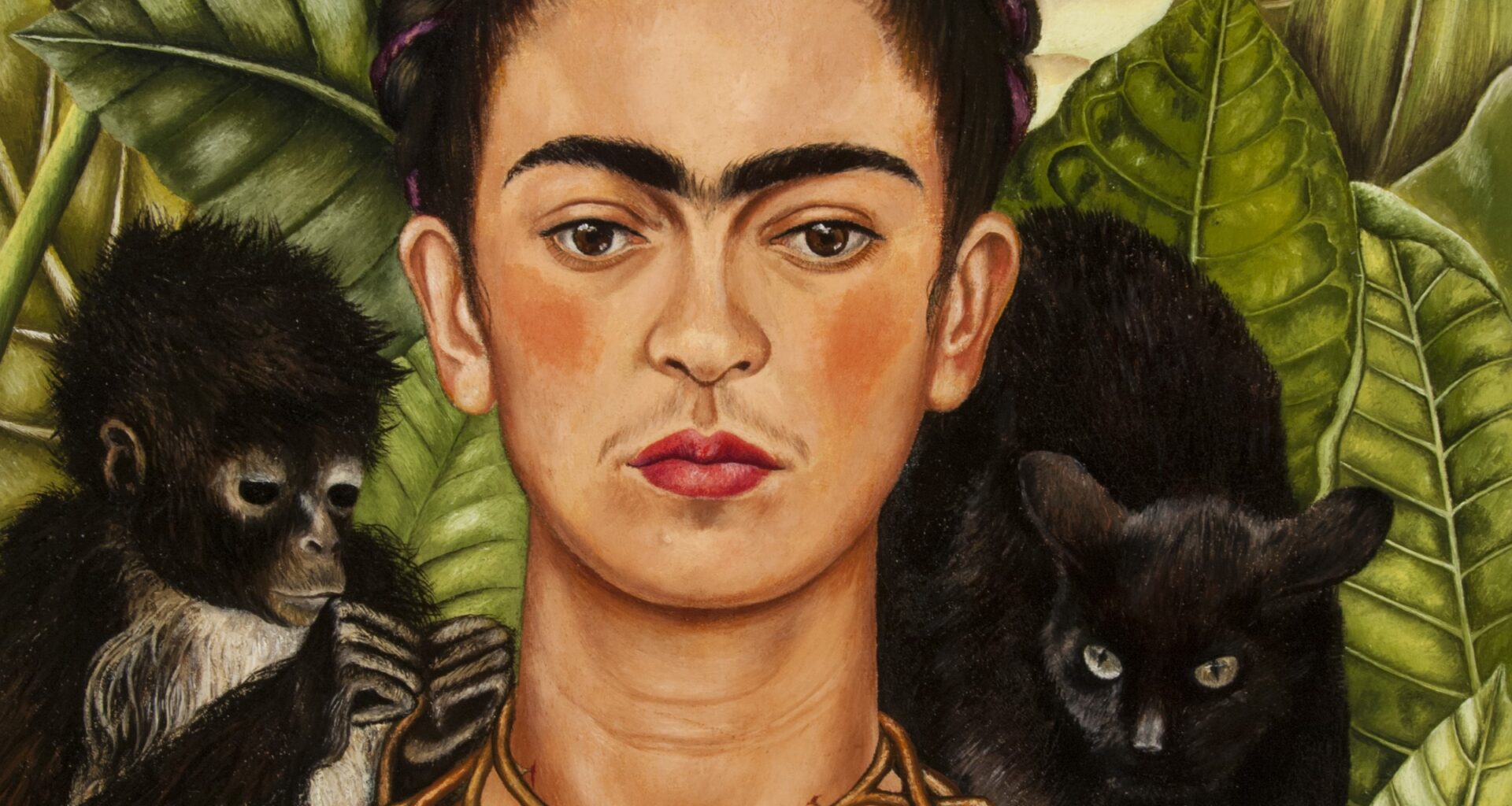
‘I do not like to influence others. I would not like to become famous. I have done nothing deserving of acknowledgement in my life.’ In what is the first of many puzzling choices, Tate Modern has selected this Frida Kahlo quote to open the accompanying catalogue of their new exhibition, Frida: The Making of an Icon. I use the word ‘exhibition’ deliberately here rather than ‘retrospective’ because — as many have pointed out since it opened — only thirty-six of the roughly 190 works on display are actually by Kahlo herself. The rest come from her friends and family, her interlocutors and imitators, and, worst of all, the copious bits of merchandise bearing her likeness.
I’m far from the first, and definitely won’t be the last, to point out this issue with the main show; in fact, quite a few writers and critics have already done a wonderful job. For Frieze, Emily Steer writes that by ‘the time we reach the gift shop, such pieces blend seamlessly with the merchandise, much of it emblazoned with Kahlo’s unforgettable visage — a conflation that, whether intentional or not, feels like the show’s greatest disservice to her legacy.’ Nearing the exit, Chloë Ashby wonders ‘how many more hackneyed versions of this resilient and talented artist I can take.’ And Hettie Judah, author of Lives of the Artists: Frida Kahlo, proves her point by quoting the show’s own co-curator, Beatriz García-Velasco: ‘The commercialisation of [Frida’s] image is inseparable from capitalism and consumerism.’
García-Velasco claims that this ‘can also be understood as a form of democratic ownership — a way for people everywhere to literally and metaphorically make Frida their own.’ This may be true in a certain sense; the stronger works on show, like Joe Bastida Rodriquez’s Kahlo Pains (1977), an exquisite watercolour of a spinal column and ribcage, hold their own and are allusive enough to Kahlo without feeling derivative. But the lazily referential quality of some pieces merit their inclusion simply by toying with her aesthetic and image — or, in the case of Manuel López, by painting a picture of several books about Kahlo without saying anything meaningful about her at all.
This particular piece is featured in the exhibition’s final room, where what could have been a genuinely critical interrogation of ‘Fridamania’ — a chance to reappraise the flood of senseless Frida tat — instead settles for straightforward display. The wall text here notes Kahlo’s commodification as ‘a type of global brand’ but is concertedly neutral about the ethical ramifications of this, likely because the gift shop through the door sells much the same thing. It’s rather disappointing, really; institutions are not, after all, beholden to uncritical reverence. (Tate itself proved as much last year, when its Leigh Bowery! show made no effort to offer a blemish-free account of its subject, and there’s no reason the same curatorial nerve couldn’t have been applied here.) But if, as García-Velasco suggests, the goal is to democratise Kahlo’s legacy under the catch-all idea of universal resonance, then doing so also risks flattening her intractable commitment to decolonial and Marxist politics, not to mention her groundbreaking depictions of disability and medical trauma.
Much has also already been said — and is well documented throughout the exhibition — about the near-fatal tram accident that Kahlo suffered at eighteen, which marked the beginning of decades of pain, repeated surgeries, periods of immobility, and lasting damage to the artist’s pelvis and uterus. The resultant miscarriages she experienced are the subject of the show’s most affecting section, Frida y el aborto (1932), tucked away in a small space out of public view: a lithograph fuses her thwarted ambition to study medicine with an anatomical rendering of a foetus. The graphic print is unsparing about pregnancy loss in a way that few artists have managed to eclipse — except perhaps for Tracey Emin, who appears nearby in a Mary McCartney photograph dressed as Kahlo taken in 2000. There’s a gratifyingly conversant quality between their respective bodies of work, too, as is true for all company Kahlo is placed in here: Kiki Smith’s paper sculpture of a fragile foetal body; Judy Chicago’s embroidered Birth Tear Embroidery 3 (1984); and Regina José Galindo’s harrowing filmed performance protesting the systemic impunity for wartime rape in Guatemala.
Also brilliant is the room centred on ‘Neo-Mexicanisms’. Here, a later generation of Mexican artists — like Georgina Quintana, Dulce María Núñez, Adolfo Patiño, and Julio Galán — take up Kahlo’s fusion of folk Catholicism, Indigenous iconography, and self-portraiture to interrogate Mexican identity during the economic and political transformations surrounding the 1994 North American Free Trade Agreement. Even the show’s more crowd-pleasing final stretch, ‘Frida Folk’, with its nichos, sacred hearts, and calaca skeletons, situates the commercial afterlife of Kahlo’s image within a fittingly devotional tradition.
The Making of an Icon is, however, more tentative on Kahlo’s communist affiliations. It’s not silent on the topic, exactly; a wall text credits her with a ‘commitment to revolutionary causes’; an early self-portrait places her among a circle of high-school friends beneath a mural of Mexican revolutionary Francisco ‘Pancho’ Villa; a corset gets a caption noting she decorated her medical supports with ‘political emblems’; and, in a slightly oblique move, Rio Yañez’s Ghetto Frida’s Mission Memories (2009) features a tiny tattoo of the Leon Trotsky under a comic-book style image of Frida. But it’s a detail that will mean little to anyone who doesn’t already know that Kahlo and her husband Diego Rivera sheltered the exiled Russian revolutionary at their home, Casa Azul, or that Kahlo even had a brief affair with Trotsky. And there is no mention here of her late, avowedly propagandistic paintings, made when she was confined to bed and closer to death, like Marxism Will Give Health to the Ill (1954); there is also no mention of the Mexican Communist Party flag that was draped over her coffin.
And what of, in Judah’s words, the Kahlo who was ‘sharp-tongued and scandalously rude’, the ‘heavy drinker’, and ‘prodigious drug user’? It’s one thing to venerate Kahlo as a queer, disabled, mestiza icon; it’s harder to account for the artist’s 1954 self-portrait with Joseph Stalin.
I think Kahlo presents an interesting, and potentially useful, challenge for the left. We are characteristically bad at dealing with our comrade’s foibles (just look at how quickly Your Party’s utopian promise was stymied by public feuds and factional warfare). That tendency is what leaves this particular exhibition so oddly unsatisfying: the Tate struggles to hold Kahlo in tension as both politically radical and personally self-destructive, as someone capable of cruelty as well as conviction. In canonising the artist, the collection equally fails to explain what made her such a spellbinding artist in the first place. Kahlo never set out to become a global icon, nor could she have ever imagined the scale of her posthumous reverence. What she might have recognised, however, and perhaps even admired, is a portrait willing to make a mess of her.