
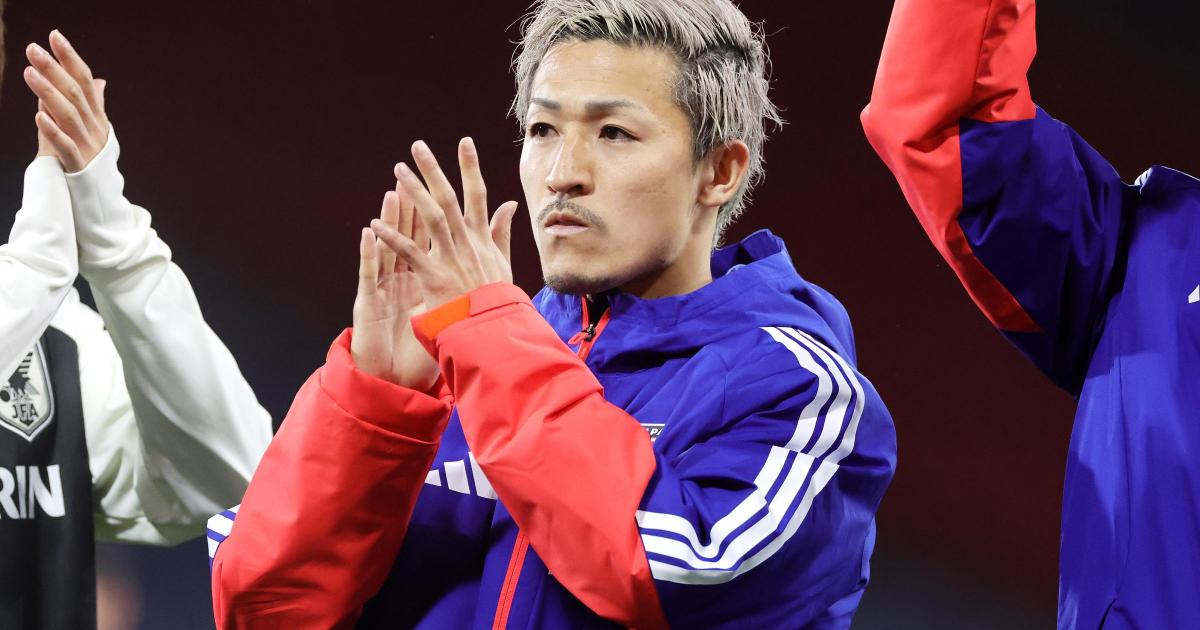
Maeda reinvented himself after being suspended from his college football team (Image: PA)
EARLY SETBACK
Born in Osaka, Maeda grew up in Taishi, south of the city – a small, green, rural town. His name, in fact, comes from the word Japanese word ‘daishizen’, which translates to ‘great nature’.
He didn’t come from a football family. His mother worked for an animal hospital and his father is a veterinarian. Maeda himself didn’t take up football at a young age.
He was still active, however. His mother recalled, from the age of two, waking him up at 5am to climb nearby Mount Nijo before taking him to nursery school. They would eat rice balls at the summit before coming back down.
Maeda initially tried gymnastics, like his father had before, but eventually quit as he disliked the flexibility work, feeling that it wasn’t for him. A few years later, a friend encouraged him to try football instead, which changed everything.
He almost threw a promising career away when he played the sport at high school. By his own admission, he ‘only thought about himself’, and when he broke disciplinary rules in his first year, he was suspended from the team for roughly 12 months. That saw him removed from the team dormitory and forced to live in a tiny apartment on his own.
But Maeda used it as an opportunity to reinvent himself. He would get up early every morning and run barefoot in the mountains. He worked for a bakery, making bread at 5:30am every day. He also tidied his school before lessons, and he trained with the local adult football team when permitted.
“I learned I couldn’t do anything on my own,” he said. “I learned the importance of running for the team.”
The attacker flourished after a loan spell in Portugal (Image: PA)
FLOURISHING IN JAPAN
Maeda didn’t explode onto the Japanese football scene. After graduating from Yamanashi Gakuin High School in 2016, he had offers from a handful of clubs, opting to join then J2 League side Matsumoto Yamaga.
Immediately, his biggest strengths became clear – his speed and stamina. But he lacked composure in front of goal, a polished first touch and tactical understanding.
He was described as ‘chaotic’ at the start of his career, but learned from the professional players around him in the dressing room. By 2019, he was a regular starter, playing in a variety of roles across the forward line, which he can still do to this day.
A loan spell in Portugal followed. He didn’t get many starts at Maritimo, but they gave him exposure to a different style of football. When he returned to Japan, signing for Yokohama F. Marinos, manager Kevin Muscat was able to get the best out of him with his high-intensity, attacking philosophy.
Suddenly, Maeda became the key cog in a J1 League team. In 2021, he finished as the league’s join top scorer with 23 goals. He was then ready for the next step in his career.
Maeda quickly became one of Celtic’s star players (Image: PA)
SUCCESS AT CELTIC
Arriving at Celtic in January 2022, Ange Postecoglou – formerly Yokohama F. Marinos boss – knew exactly what to expect from Maeda. He joined the club alongside fellow Japan internationals Reo Hatate and Yosuke Ideguchi.
He made his debut for the club just over two weeks later, scoring in the fourth minute against Hibernian at Celtic Park. But other aspects of his game stood out, especially the way he pressed, hassling defenders and chasing every lost cause.
On the flip side, his finishing was often criticised, but fans accepted that it was part of his game, knowing that he’d instantly work hard to win the ball back and go again if he missed a chance.
Maeda felt like a big-game player at Celtic. He enjoyed Old Firm derbies against Rangers, scoring within 30 seconds at Ibrox in April 2024, firing in an astonishing overhead kick last season, and regularly giving James Tavernier nightmares.
Under Brendan Rodgers, Maeda arguably became more important. The Northern Irishman described him as ‘exceptional’, and he was quickly handed a new deal to keep him in Glasgow.
He developed into a better finisher, too. Over the course of the last two seasons, he found the back of the net 30 times in the Scottish Premiership. It helped establish Maeda as a cult hero among supporters.
Five league titles, three Scottish Cups and two Scottish League Cups isn’t a bad return in such a short period of time.
The 28-year-old has featured at the last two World Cups (Image: PA)
INTERNATIONAL STAR
Former Japan manager Hajime Moriyasu has always been a big fan of Maeda, including him in a young squad for the 2019 Copa America in Brazil, despite the fact that he was still playing for Matsumoto Yamaga at the time.
He made his debut with a start against Chile, and despite a poor tournament from the Samurai Blue, Moriyasu liked what he saw of Maeda, keeping him around the national team.
He narrowly missed out on an Olympic bronze medal two years later, but his big break-out came in 2022 at the Qatar World Cup. Japan were one of the stories of the tournament, beating both Germany and Spain to win their group.
Maeda started as a central no.9 against the former, running relentlessly before being replaced by match-winner Takuma Asano. Against the latter, he scored the equaliser from close range after a scramble in the box, which came minutes before Ao Tanaka’s famous winner.
He also scored in the round-of-16 against Croatia, but the game ended in a penalty shoot-out defeat.
He remained an important part of Moriyasu’s squad for the 2026 tournament, starting all three group-stage games and scoring in a 1-1 draw against Sweden. He was also named in the line-up for Japan’s round-of-32 exit to Brazil, where he faced some criticism for his display.
Nonetheless, he remains one of the nation’s most talented players. As a low-possession team who will rarely dominate games against the strongest countries, Maeda is vital for Japan due to his work rate and pace on the counter.
In his eyes, the 2030 World Cup will likely be his last shot at international glory.
Maeda looks set to fulfill his dream of playing in the Premier League (Image: PA)
WHAT TO EXPECT
Maeda’s biggest characteristics have already been outlined. Pace, stamina and work rate, primarily playing off the left.
There are two big question marks – how will he adapt to the Premier League, and where will he fit in Ipswich’s team?
The former is harder to answer. At 5ft 8ins, there could be some concerns about his physicality, sometimes facing defenders nearly a foot taller than him. At Celtic, he was levels above his opponents, but the Scottish Premiership is very different to the English top flight.
But he feels like the kind of player who could terrify opposition right-backs. His end-product will need to improve for that to happen, but he’s clearly taking the right steps.
As for his role at Ipswich? The arrival of Issa Diop already suggests that Town could line up with a back five next season. Maeda feels like an excellent fit in that role, playing in the inside left channel, just off the striker.
He probably suits that role better than Jaden Philogene, and with Jack Clarke also competing on that left side, it feels like there’s a strong possibility that the former Aston Villa man will move on amid interest from Premier League and European clubs.
Maeda feels like an excellent fit for a team playing low possession, high intensity football on the counter in a 3-4-2-1 formation, like Japan do at major tournaments. I think Ipswich may take a similar approach.