
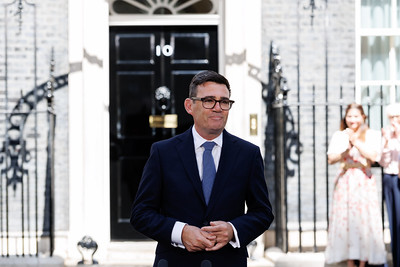
Prime Minister Andy Burnham takes office at a time when our international system is under profound strain, where international law and the UN Charter are violently challenged, and when citizens in the UK and globally are increasingly facing the fallout of intersecting crises and global shocks.
Escalating violent conflicts, cascading economic, energy and food crises, the proliferation of new technologies, and the climate emergency all require global solutions. We have seen the crisis in the Strait of Hormuz already have knock on effects on the livelihoods of people at home, and should this instability worsen food prices will likely spike. As the new Prime Minister arrives in Downing Street, UNA-UK calls on his Government to emphasise that economic and political investment in international cooperation is an opportunity to build a safer, more resilient and sustainable world, and in turn a more prosperous Great Britain.
The UK has an opportunity to build on its record of leadership in tackling the climate and nature crisis and fulfil its responsibility as a Permanent Member of the UN Security Council to play a constructive role in the international system. Prime Minister Burnham’s experience as Mayor of Manchester can help ensure the UK further develops international cooperation among cities and local authorities at a time when their role in multilateralism is ever more vital, from work on protecting future generations, implementing the 2030 agenda and actioning climate pledges. Moreover, Foreign Secretary Ed Miliband has been at the helm of the UK’s recent leadership on climate action, positively leading implementation domestically and demonstrating constructive engagement in global climate mechanisms.
There are early opportunities for the UK to set the tone for how it intends to positively use its international influence, in particular the ongoing UN Secretary-General selection process. The UK must play a positive role in the current process. Supporting a robust, merit-based process is vital, as well as clear messaging that any candidate who does not clearly support the UN Charter or has engaged in initiatives that go against it, would be unacceptable to the Government. Subsequently, the upcoming UN General Assembly, and preparations for hosting next year’s G20 summit, present opportunities to engage directly with other member states and set out the UK’s foreign policy priorities.
In recent years the costs of illegal, unilateral acts of aggression by member states, including Permanent Members of the Security Council, have demonstrated that when the Charter is violated by some, it becomes easier for others to follow suit. Russia’s ongoing assault on Ukraine has repeatedly violated international humanitarian law, with constant attacks on civilians and civilian infrastructure. The US’s unilateral and illegal war on Iran violated the Charter and has fuelled a wider conflict in the region where civilians are paying the highest price. Perceived double standards in adhering to international law has weakened the architecture of global norms established to prevent escalation, grave violations and harms.
The Prime Minister has rightly recognised that Keir Starmer’s response to Israel’s military action – which the UN Independent Commission of Inquiry has assessed constitutes genocide – has been inadequate, and this must now be followed by urgent action to prioritise ending all arms sales to Israel, meet the UK’s legal obligations to ban trade with the illegal Israeli settlements in the West Bank, and publish the government’s long-awaited response the International Court of Justice’s 2024 advisory opinion. It is also imperative for the UK to go further in efforts to support the people of Sudan by using maximum diplomatic leverage to prevent escalating atrocities. This should include highest-level engagement with Gulf partners, especially the UAE as the main backer of RSF, and concerted efforts to reduce the risks of this deadly conflict conflating with instability in Hormuz and Red Sea that will exacerbate fallout on global trade.
Against this backdrop, the UK has increased its military spending without adequately resourcing diplomacy and international engagement. This approach has undermined the UK’s capacity to engage and lead on peacebuilding, atrocity prevention and development. Against the backdrop of a volatile international security environment and deep mistrust between nuclear weapons states and non-nuclear weapon states, the UK must recommit to its disarmament obligations under the NPT. In addition, the UK should play a positive role in efforts to establish international regulation of autonomous weapons by supporting negotiations at the upcoming CCW Review Conference, especially given its ability to play a positive role on AI governance and security more generally.
Recent details on UK development cuts have shown some of most drastic cuts in the world, including to much of Africa and to Lebanon. The UK should reconsider these budget priorities. It should also further prioritise debt relief and engage its experts and diplomats in the international policy conversations about rethinking the future of aid and development in a way that genuinely empowers local responders not merely uses them as an excuse for cost cutting. In addition, the Home Office’s new visa policies ensure that Afghan and Sudanese women, praised by UK diplomats for their resilience, are now forbidden from coming to the UK to study in case they prove to be eligible for refugee status. Talk of assisting women and girls rings hollow when programmes dedicated to them are being decimated and hostile policies block their access to protection and education.
At a time when trust and investment in international cooperation is under threat, the UK should lead by example by matching rhetoric with action. Successive governments have stated the UK’s commitment to the UN and multilateralism while at the same time slashing development spending and shrinking foreign office resources and staffing. The UK’s history as a founder of the UN and its responsibility as a Permanent Member of the Security Council demands political and financial investment to bolster the UN system by supporting its reform and renewal. We look forward to supporting the Prime Minster and Foreign Secretary to position the UK as a champion for global cooperation at a time when it is vitally needed.
Read more: