

‘The Otter’ – who wants to remain anonymous – owes £1,200 after boycotting Wessex Water’s bill for more than four years
06:00, 27 Jul 2026

A scene from the documentary film Rave On For The Avon, about campaigners in Bristol fighting to clean up the city’s rivers, featuring ‘The Otter’, a man from Fishponds who has been boycotting paying his water bill for four years(Image: Eightysita Productions)
A Bristol man is being taken to court because he has been refusing to pay his water bill in protest at the performance of Wessex Water in dealing with sewage in Bristol.
The man owes around £1,200 after stopping paying his water bill more than four years ago. His identity has so far remained under wraps, but he has told Bristol Live he plans to ‘unmask’ himself at a new screening of a film made last year about the issue, called Rave On For The Avon, and speak publicly for the first time.
In the film, the man is known as ‘The Otter’, and he meets with the chief operations manager from Wessex Water to discuss his refusal to pay.
He was even given a tour of his local sewage overflow system, to explain what happens when untreated sewage is discharged into storm overflow drains and then into the rivers.
But ‘The Otter’ is still refusing to pay, and now Wessex Water have begun legal proceedings against him, with a court mediation hearing scheduled for August 11, and a full hearing shortly after.
The documentary film, which showed the man’s identity hidden behind a superimposed otter’s head, will be screened on August 8 on the John Sebastian barge venue on the Floating Harbour – at which he will identify himself and speak publicly for the first time.
“I have been boycotting my water bill for more than four years now in protest at Wessex Water’s contribution to river pollution,” he told Bristol Live.
“I have made official complaints, had correspondence with their CEO, even been taken on a tour of my local storm overflow by an operations manager – which featured in Rave on for the Avon.
“But Wessex Water has done everything other than resolve the problem. Wessex Water says that the overflow we visited in the film won’t meet government water targets until 2045.
“Bristol Water and Wessex Water are now taking me to court to recover my unpaid bills and I have decided to fight the case. We shouldn’t have to pay for sewage services that aren’t being carried out,” he added.
In the film, ‘The Otter’ meets with a senior operations manager at Wessex Water, who explains that, during periods of rain, sewage is diverted into the storm drain network, to prevent it backing up the pipes back into people’s homes, or from overflowing out into roads.
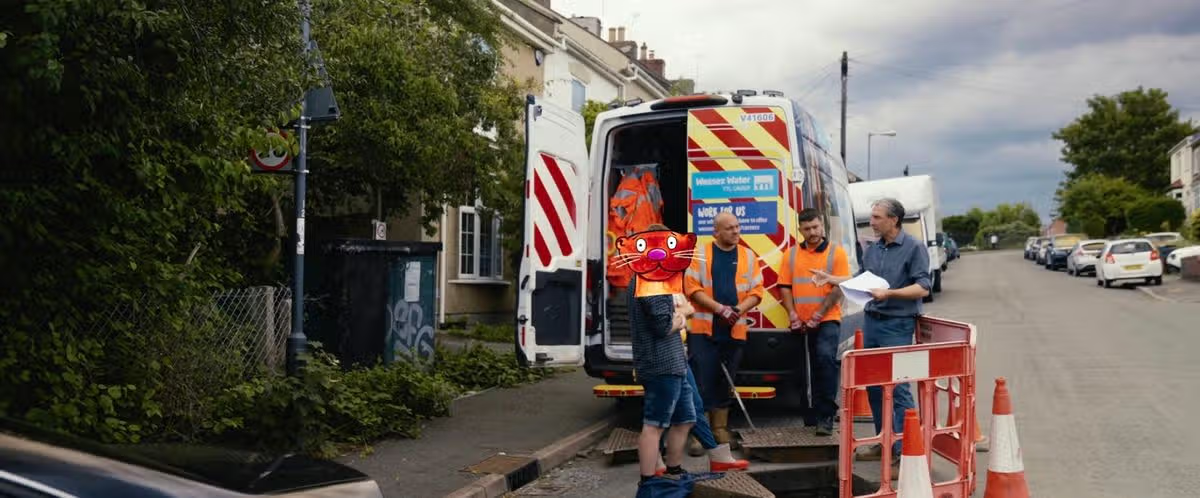
A scene from the documentary film Rave On For The Avon, about campaigners in Bristol fighting to clean up the city’s rivers, featuring ‘The Otter’, a man from Fishponds who has been boycotting paying his water bill for four years(Image: Eightysita Productions)
That then ends up in the rivers – but the Wessex Water boss tells ‘The Otter’ and other campaigners from the Conham River Park wild swimmers group, that it’s not considered a problem.
“Compliance is something like 99.5 per cent,” he said. “Our storm overflows all have permits. The Environment Agency issues those permits because the EA don’t believe they have a big effect on the ecology, not bathing, the ecology.
“There’s never been an aspiration from Defra, Ofwat, Environment Agency, water companies, to do our bit to make rivers clean enough to swim in. The wildlife can shrug off bacteria,” the Wessex Water manager claimed.
The film shows the campaigners being taken to ‘The Otter’s’ nearest sewage overflow point – at Rose Green Road in Whitehall. In the film, the Wessex Water boss admitted it discharges sewage into a local river 60 times a year – which he acknowledged is ‘high’.
He acknowledged there was a solution, which involved Wessex Water buying an area of land next to it, and installing an underground holding tank, but that solution was ‘the work we’ve got to do in the next five, ten or 20 years’.
Wessex Water, which is owned by Malaysian company YTL, made £95.8 million in pre-tax profit in the last financial year, and according to campaign group We Own It,has paid its shareholders a total of £4.25 billion in dividends since it was privatised in 1989.
For ‘The Otter’, fixing the overflow near his home in up to 20 years, was not soon enough, and he pledged to continue his boycott of his water bill. And Wessex Water was named in a BBC investigation last year which found that three of the biggest water companies discharged sewage into the river systems on dry days – so-called ‘dry spilling’, which is illegal, but has not been dealt with by the Environment Agency.
“I have two really simple demands,” ‘The Otter’ said. “One of which is that they reduce my water bill by a percentage equivalent to the number of days that the sewage isn’t being treated.
“The second demand is maybe a bit pedantic, but basically all their literature says ‘every day we take away your waste water and treat it’, and so I’ve asked them to change that to say ‘some days’. I basically want a bit of humility in the literature that acknowledges doing things,” he added.
Wessex Water declined to comment on what will soon be an active legal process, but on the issue of sewage overflows, a spokesperson said: “While licensed overflows discharge mostly rainwater and groundwater, we agree they are outdated and we’re spending more than £8 million every month on schemes to reduce how often they operate in our region.”
The Consumer Council for Water (CCW), which represents water company customers in dispute with water companies, said it discourages people from boycotting water bills in protest at the issue.
“We’re aware of some customers who have decided to boycott paying part or all of their water and sewerage bill in protest at their water company’s environmental performance,” a CCW spokesperson said. “We completely understand customers’ anger and frustration on this issue.
“However our advice to people who approach us with a complaint regarding this matter is to continue paying their charges. Customers who are considering boycotting payment should understand they could face debt recovery action from their water company. This could negatively impact their credit rating and also potentially result in additional costs being added to their bill,” they added.
“There is no requirement for a water company to suspend or delay debt recovery action just because a customer has raised a dispute with them or CCW. Ofwat’s Paying Fair guidance only applies where a water company is investigating the accuracy of a customer’s bill or whether it has been paid. This is not relevant here as customers are choosing to boycott bill payment,” they said.
For Charlotte Sawyer, the director of the independent wild swimming documentary Rave On for the Avon, the moment the ‘Otter Man’ and other campaigners meet senior Wessex Water officials is an important point of the film.
“The film explores a community’s fight to save their bathing spot in unique, daring and distinctly Bristol ways,” she said. “It’s a universal story of our deep connection to rivers in this modern world where ordinary people turn creativity and citizen science into a weapon against sewage pollution.
“Audiences have been so inspired by the way that people in Bristol don’t accept the status quo and push back in their own creative and whimsical ways from building wild swimming infrastructure around a ‘No Swimming’ sign, marrying the river and citizens scientists taking samples to understand the health of the river.
“The joyful campaigning seen in the film has even inspired new campaigns in York, Cambridge and Liverpool. The Otter Who Won’t Pay His Bills provides an important movement in Rave On for the Avon that explores how ordinary people can make a difference by pushing back against those polluting our rivers,” she added.
“It’s been a long road for The Otter and we’re here to support him through this next stage of protest,” she said. “We are all just ordinary people just trying to do our best. The hopeful message from Rave On for the Avon is that whatever you can do to protect our rivers plays a part in the incredible and ever-growing grassroots movement that is making it clear to polluters and decision-makers that we will not accept pollution in our rivers,” she added.