
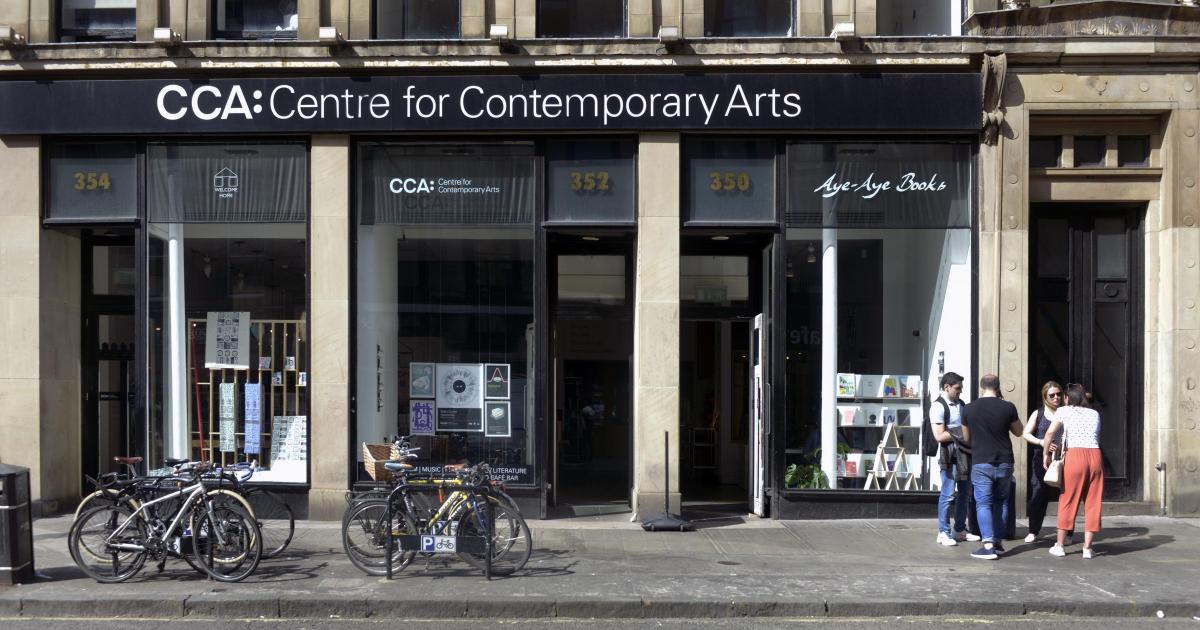
The nationally important collection, which details a unique chapter in the city’s contemporary art and music scene, includes a variety of both physical and digital records relating to past exhibitions, events, workshops, festivals and performances.
Since news of the venue’s liquidation, there has been clear interest from researchers, academics and the Scottish archive sector in ensuring this important collection is safeguarded and preserved for the long-term.
When it opened its doors in 1974, Glasgow’s Third Eye Centre was hailed as a “shrine to the avant garde”, quickly becoming known as a hub for the city’s counter-culture.
Later known as the Centre for Contemporary Art (CCA), its vast and nationally-important archive of paper and digital records is now up for sale.
The Third Eye Centre archive covers around 20 years from January 1973 to December 1991, and includes committee papers, legal documents, exhibition posters and flyers and publications, such as exhibition catalogues, video and audio recordings and images in multiple formats.
The CCA archive, which takes in everything from 1992 to the present day, comprises 14 collections, including slides, VHS, photographs, publications and posters.
It also contains ephemera, audio, film, news cuttings and paper records which are subdivided into CCA (1992-present) and Third Eye Centre (1973-1991).
Writer and playwright Tom McGrath founded the centre and the list of artists and performers who have appeared there through the decades is an impressive one.
Paisley’s John Byrne was the first living artist to exhibit there, in 1975; Alasdair Gray launched his ground-breaking novel Lanark there; and in 1984, before she was an Oscar-winning actor, Whoopi Goldberg performed a solo show at the centre as part of Mayfest.
Beat generation poet Allen Ginsberg, comedian Billy Connolly, Scotland’s first Makar Edwin Morgan and novelist and punk poet Kathy Acker also performed at the venue.
(Image: CCA)
It became a hub for key exhibitions by the new Glasgow painters such as Steven Campbell, Ken Currie and Peter Howson, and the building, at 350 Sauchiehall Street, was also the home of the National Review of Live Art.
With the demise of The Third Eye Centre at the turn of the 1990s, the Centre for Contemporary Arts (CCA) was established in its place, opening in 1992.
The venue has had four directors in its history: Jo Beddoe, Penny Rae, Graham MacKenzie and Francis McKee.
The 1990s saw a programme bristling with energy and excitement.
A challenging live art programme welcomed Ron Athey and Goat Island, as well as a series of adventurous and often provocative exhibitions such as Bad Girls and Slip of the Tongue, Janine Antoni’s first solo show.
In 1994, CCA presented New Art in Scotland, by Douglas Gordon, Jane Lee and Nicola White. Key emerging artists presented in this show included Nathan Coley, Jacqueline Donachie, Louise Hopkins, Carol Rhodes, Richard Wright and David Shrigley.
Ross Sinclair’s Real Life Rocky Mountain and The Persistence of Painting helped to confirm the breadth of the 90s art scene in Glasgow.
In 2006, the organisation itself underwent a profound cultural shift, deciding to pursue a more open curatorial policy – an “open source” approach – which encouraged artists and organisations to propose their own programs to sit alongside those curated by CCA.
It meant a livelier and more varied programme, offering a new kind of accessibility to audiences, drawing on the spirit of The Third Eye Centre and the early history of the CCA.
It was a huge success – in 2014-15 alone, more than 42,000 people attended 802 events in the building, and arts centres from around the world were getting in touch to learn from its model. Four South African cities, including Johannesburg and Cape Town, were in discussions with the venue to discuss how to follow its open source approach.
(Image: CCA Glasgow)
The centre’s links with South Africa stretched back to the 1970s, when it was a platform for South African musicians living in exile in London during the apartheid era, such as Chris McGregor and Johnny Diyani.
Folk was supported at the centre, with Rab Noakes, Bert Jansch, Richard and Linda Thompson, Christy Moore and The Whistlebinkies among the big names appearing there.
The sale of the CCA archive provides interested parties with a rare opportunity to buy a visually rich collection of physical and digital records which represent a valuable part of Scotland’s contemporary art scene.
The archive is now on sale. For all enquiries regarding purchasing the archive, contact Middleton Barton, who are offering the archive for sale on behalf of the liquidators, via the website www.mbvaluation.com or call Tom McWilliam on 0141 478 0732 or 07861 389917 or email: thomas@middletonbarton.com
Expressions of interest and/or offers are invited by August 14th, 2026.