
The American dream, in all its varieties of optimism and poverty, has come to the Dulwich Picture Gallery.
A new photography exhibition looks at how Americans viewed themselves, but also, thanks to reproductions in magazines, how we often see Americans.
Moving from the optimism of the early skyscraper age, through the trauma of the Great Depression, and into the uneasy prosperity of the post-war decades, the exhibition follows both the evolution of photography and the emergence of the United States as a deeply unequal nation.
The opening galleries set the tone.
Opening with Alfred Stieglitz’s The Steerage, in which the photographer looks down from his first-class room on a liner at the 3rd class below, is presented as the moment when photography broke away from being seen as an alternative to painting and became an art form in its own right.
It’s a little known fact that most seagoing liners made most of their money from the 3rd class passengers crammed in below, and that allowed them to lavish money on the 1st class facilities above. The poor subsidised the rich.
The city as a promise
The exhibition shows how, between 1900 and 1930, American cities expanded at an unprecedented pace, fuelled by immigration, industrialisation and new forms of labour. Buildings such as the Chrysler Building and Empire State Building became physical expressions of national confidence.
The photographers clearly shared that fascination.

There’s Lewis Hine’s famous, almost homoerotic photo of an ironworker working on building the Empire State Building. The man balancing hundreds of feet above the city is identified as Victor “Frenchy” Gosselin, a migrant worker labouring with minimal safety.
It’s a reminder of how much of modern America was built on the backs of migrant workers.

Elsewhere, on a more human scale, Walker Evans approaches the city differently and rather than recording the modern architecture, he focuses on the ordinary streets, battered and often grim in the shadows of the modern skyscrapers around them.
Prosperity for some, but there was hardship for many.
Dorothea Lange’s photographs of unemployment and migration sit alongside John Gutmann’s photographs of families travelling west in search of work.
And at a time when women had few opportunities, the exhibition celebrates those few who carved out successful careers as photographers.
Berenice Abbott returned from Paris carrying European modernist ideas into New York. Dorothea Lange abandoned a successful portrait business to document the lives of the unemployed. Helen Levitt developed a new style of street photography through children at play and everyday life in working-class neighbourhoods.
The daughter of an actress, Ruth Orkin found herself barred from becoming a cinematographer simply because she was a woman, and went on to reinvent herself as both photographer and photojournalist.
Although skyscrapers dominate much of the exhibition, another object quietly recurs throughout the galleries – the motor car.
However, Mary Ellen Mark’s The Damm Family in Their Car may be the exhibition’s most devastating inversion of the American dream. The car – the classic symbol of American independence – has become the family’s home. The cramped interior is filled with possessions squeezed into every available space.

The American dream has become a nightmare.
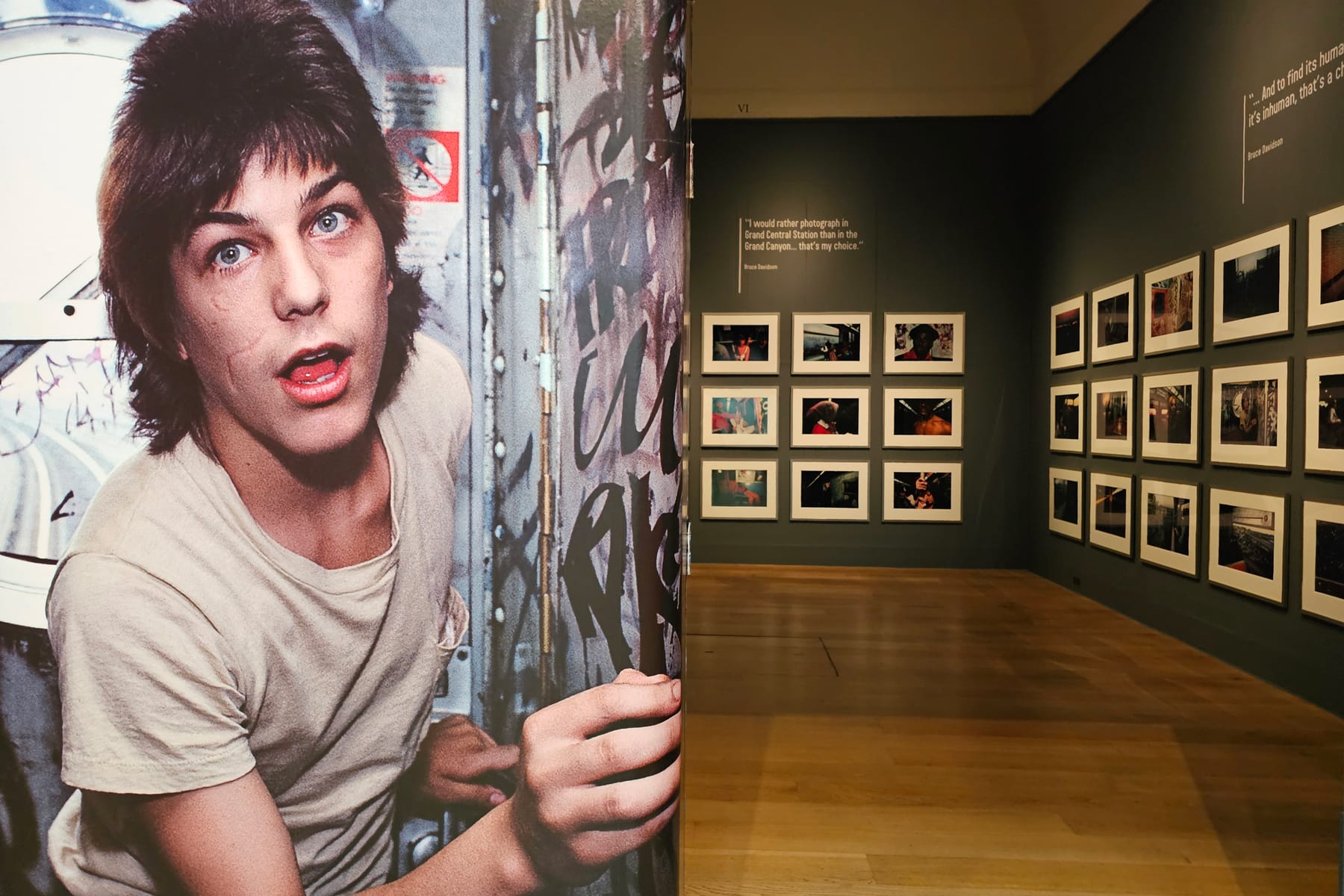
The collection ends with the antithesis of the motor car – the New York subway at a time when it was more of a selling point for not using public transport.
That contrast is what makes the exhibition – it neither celebrates nor condemns Americana, but highlights the contrasts and hopes you will come to the correct and obvious conclusion. For all its wealth, it’s built on the backs of poverty.

Roughly a century of photography in roughly a hundred photographs.
The exhibition, Portrait of a City: A Century of American Photography, is at the Dulwich Picture Gallery until 4th October 2026.
Standard Ticket: £14.50
Student: £10.50
Disabled: £7
Universal Credit and Pension Credit: £1
Under 18: Free
Members: Free
Details here
The collection on display came from The Savings Bank Foundation DNB, which purchases art to display it in galleries.
