
From solstice fire festivals and a ritualised football match to ancient spiritual sites and a holy march across a tidal causeway, Prudhoe-based documentarian Dave Brewis is currently on a quest to capture what he describes as “the region’s most enduring communal rituals”.
Dave Brewis (Image: Supplied)
Centred around the concept of “once around the sun via the true north of England”, his new 90-minute film takes audiences on a linear journey over a calendar year through annual customs and folklore in Northumberland – serving as a long‑term cultural record viewed through a modern lens.
In a cathartic homecoming, Brewis is taking on the project after 20 years of covering folkloric events in the UK and across Europe. Notably, it follows the release of last year’s Gatherings series, a six-part TV documentary on folklore in Britain, available to watch on Amazon Prime and Apple TV.
In the Northumberland-based documentary, still without a set title, local events like Allendale‘s Tar-Bar’l and Ovingham’s Goose Fair feature, alongside Alnwick’s Shrovetide football, the Easter pilgrimage to Holy Island (Lindisfarne), and more.
Allendale Tar Bar’l 2025 (Image: Veronika Zolotoverkha)
“There’s so much positivity in living folklore,” said Dave. “I’m fascinated by our intangible culture. These gatherings and events are passed from generation to generation; most of which are currently thriving.
“I’m really excited about the project. I feel the resulting film will be a celebration of an extraordinary people, with an unrivalled ‘sense of place’.
“Northumbrians don’t tend to shout too loudly, but our story deserves to be documented for the big screen.”
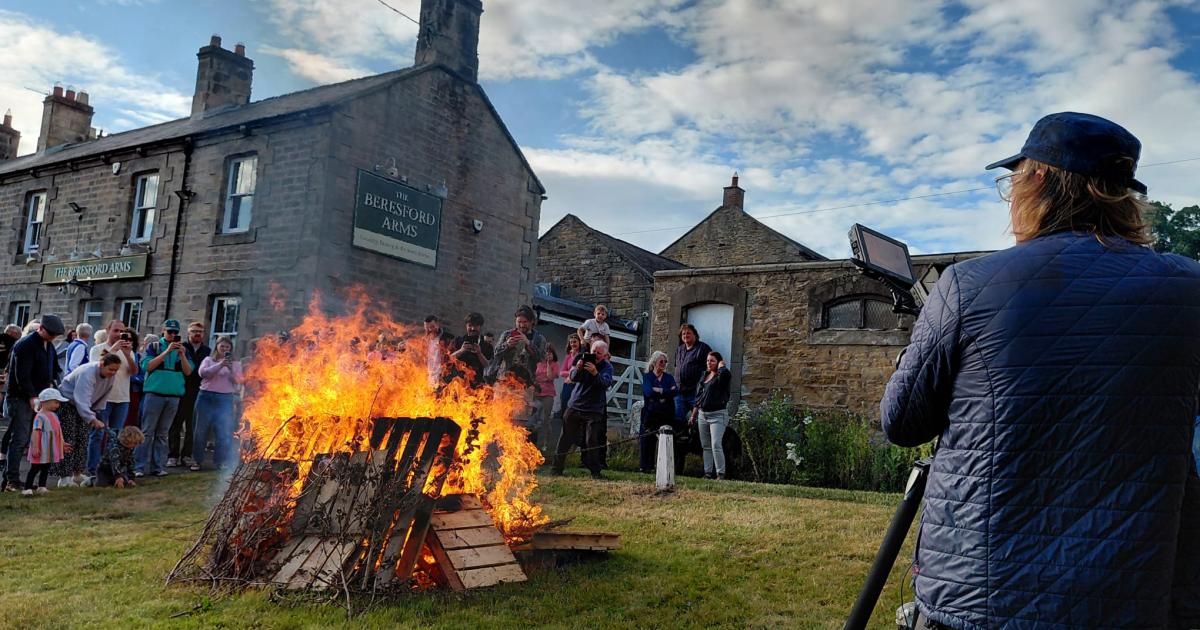
One of the events in the documentary is the Whalton Baal, which regularly draws crowds into the hundreds (Image: EWishart)
One of the lesser‑known rituals covered, yet still highly culturally and historically relevant, is the Whalton Baal – often described as one of England’s last surviving midsummer Baal fires.
Set in the small village of Whalton, six miles from Morpeth, the bonfire event marks the old midsummer eve, which since the calendar change of 1752 has fallen on July 4.
Every year on that date, locals pile into the centre of the village, around Whalton’s only pub and key meeting point, the Beresford Arms, to bear witness to the bonfire.
Whalton Baal 2026: Children and families dance around the bonfire before it’s lit (Image: EWishart)
“Lighting fires to mark old summer’s eve was very common, but gradually the tradition disappeared across Britain during the 19th century,” Dave added.
“However, one remained strong until this day, here in Whalton in Northumberland. So despite the Whalton Baal being a relatively small community event, it’s actually of national importance within the Folklore calendar.”
Jamie Thompson, secretary of Whalton Village Hall and one of the organisers of the event, said that the fire has its roots in pagan worship.
From left: Richard Grix (bonfire lighter), Jamie Thompson (secretary of Whalton Village Hall) and Stephen Trobe (chairman of Whalton Village Hall) (Image: EWishart)
In a village that was once a predominantly farming community, locals lit the Baal fire as part of a pagan midsummer rite asking for protection and a good harvest, a practice the church “would have hated” and was “keen to start getting rid of” by the 18th century, as Jamie puts it
“It is a living relic in a way that very few things are, and goes back, uninterrupted, an untold number of years,” said Jamie.
Whalton Baal 2026: Hexhamshire Lasses (Image: EWishart)
He added that there was a reluctance among the village to add a commemorative blue plaque in Whalton as “this is our thing” and “we don’t do it for tourism; we do it because this is what we do”.
He said: “Where do you get your identity? One of the interesting things about this area is that there is a pride, isn’t there? I’m so proud to be a Northumbrian.”