
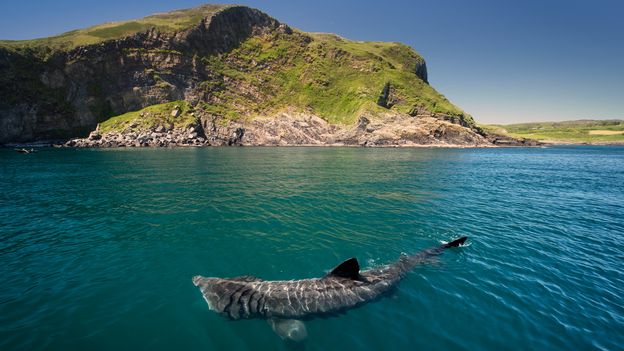
Each year from April to early July and then again in August and September, hundreds of endangered basking sharks come to Ireland’s western and south-western coasts to feast on copepods and plankton blooms so large they can be seen by satellites. In fact, the area from Donegal Bay to County Cork is arguably the best place on Earth to see basking sharks, as these temperate-water titans swim so close to the shore in shallow-water bays that you can almost reach out and touch them.
According to Dr Chelsea Gray, a researcher with the Irish Basking Shark Group (ISBG), “basking sharks are global citizens”. But while the animals live in cold waters from Scotland to New Zealand, she notes that “Ireland is really unique in that they come so close to shore”, making it easy to spot them from both the land and sea.
Basking sharks are the second-largest fish in the world and just one of three plankton-eating sharks. A closer relative of great whites than its fellow filter feeder, the whale shark, these slow-moving gentle giants can grow up to 10m (33ft). Their name comes from their propensity to swim along the ocean’s surface to feed on zooplankton, making them appear to bask in the Sun’s rays. As a result, the fish’s local Gaelic name is liamhán gréine, or “sun fish”.
Since Ireland’s shallow coastal shelf attracts zooplankton especially close to its beaches, the island has become the place for travellers seeking a close encounter with the mammoth creatures.