
A partial Solar eclipse, the Perseid meteor shower, a planetary parade and
a selenelion Lunar eclipse grace our August sky.
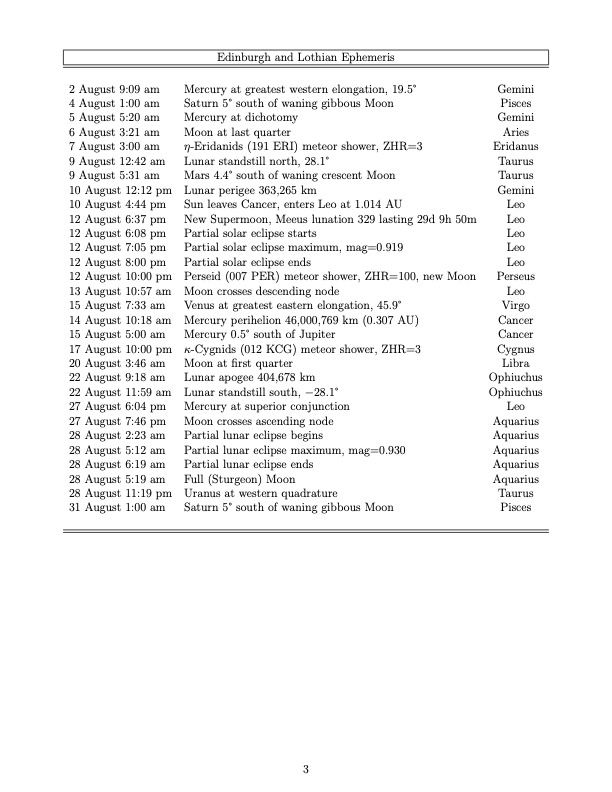
The Sun passes from Cancer (The Crab) on 10 August at 4:44 pm and enters
Leo (The Lion) but comes closer by 847,817 km (0.006 AU). Daylight shortens
from 16:03 (16.054 hours) on 1 August to 13:55 (13.912 hours) on 31 August
so we gain 2 hours and 9 minutes of night time, by the end of the month.
Consequently, we emerge from perpetual astronomical twilight and anticipate
ever darkening skies in the months ahead. On 12 August, there will be a
partial solar eclipse starting at 6:08 pm. Maximum will occur at 7:05 pm
with an eclipse magnitude of 0.919. This is not the same as a stellar
(apparent or absolute) magnitude in the night sky but the percentage of the
Sun’s surface covered by the Moon. The eclipse lasts 1 hour and 51 minutes
to finish at 8 pm. Remember, as always, to protect your naked eye from the
Sun (eclipse or not).
The Moon begins the month in Aquarius (The Water Bearer) and ends in Pisces
(The Fishes) and approaches by 14,564 km. The Moon starts August at last
quarter on 6 August at 3:21 am in Aries (The Ram). Lunar perigee (closest
to Earth) on 10 August at 12:12 pm finds the Moon some 363,265 km away from
Earth—around 21,135 km closer than average—subtending an angle of 32.9
arc-minutes. The new Moon appears on 12 August at 6:37 pm in Leo (The Lion)
beginning a new synodic (Lunar) month which will last 29 days, 9 hours and
50 minutes. It is the last new Supermoon of the year. The first quarter of
the new Lunar cycle shows up on 20 August at 3:46 am in Libra (The Scales).
Lunar apogee (furthest from Earth) occurs on 22 August at 9:18 am and takes
the Moon to 404,678 km away from Earth—around 20,278 km further than
average—subtending an angle of 29.5 arc-minutes. Finally, the full
Sturgeon Moon makes an appearance on 28 August at 5:19 am in Aquarius (The
Water Bearer).
We can also look forward to a partial lunar eclipse over Edinburgh and
Lothian starting at 2:23 am on 28 August lasting 3 hours and 56 minutes.
The eclipse maximum will occur at 5:12 with an eclipse magnitude of 0.93.
For Edinburgh and Lothian, the eclipse ends when the Moon sets at 6:19 am.
Interestingly, the Sun rises at 6:09 am so both Sun and eclipsing Moon will
be on the horizon at the same time an effect known as a selenelion eclipse.
For the inferior planets: Mercury begins the month in Gemini (The Twins)
and ends in Leo (The Lion) but recedes by 79,059,577 km (0.528 AU). The
swift planet, however, increases in magnitude from 0.35 to -1.43 (5.15
times in brightness) over the month. On 2 August, Mercury reaches greatest
western elongation at 19.5 degrees This makes it reasonably well placed
for pre-sunrise observing in the first half of August. Mercury reaches
dichotomy, when half the surface is illuminated by the Sun, on 5 August. On
14 August, Mercury reaches another perihelion lying 46 million km (0.31 AU)
from the Sun. The following day, just before sunrise, we may peek Mercury
and Jupiter lying around 0.5 degree apart on the eastern horizon.
Thereafter, it gets lower in the sky and, on 27 August, Mercury will be at
superior conjunction (behind the Sun) and lost for observing. Venus,
meanwhile, remains in Virgo (The Maiden) and approaches by 36,781,050 km
(0.246 AU). The evening star planet increases in magnitude from -4.27 to
-4.62 (1.37 times in brightness) during August. On 15 August, the Venus
reaches greatest eastern elongation at 45.9 degrees. Venus is still
exceptionally bright so easy to locate but it will be low on the western
horizon, all month long, just before sunset.
For the superior planets: Mars begins the month in Taurus (The Bull) and
ends in Gemini (The Twins) and approaches by 22,061,434 km (0.147 AU). The
red planet increases in magnitude from 1.30 to 1.24 (1.05 times in
brightness) during August. Mars rises after 2 am all month long so is well
placed for observing for several hours before sunrise. In fact, on 9
August, Mars will pass within 4.4 degrees south of the waning crescent Moon
before sunrise making it easy to spot. Jupiter remains in Cancer (The Crab)
all month and approaches by 15,786,685 km (0.106 AU). The gas giant planet
increases in magnitude from -1.78 to -1.80 (1.02 times in brightness) over
the month. Jupiter emerges from last month’s solar conjunction to rise an
hour before the Sun after 10 August. As noted, above, you may use Jupiter
to pinpoint Mercury for observation for a couple of days around mid-month
since they will conjunct on the sky at that time.
Saturn remains in Pisces (The Fishes) all month and approaches by
58,849,906 km (0.393 AU). The ringed planet increases in magnitude from
0.63 to 0.48 (1.15 times in brightness) over the month. Saturn remains
visible after midnight for the whole of August. On both 4 August and 31
August, Saturn will be around 5 degrees south of the waning gibbous Moon.
Uranus remains in Taurus (The Bull) all month and approaches by 76,388,500
km (0.511 AU). The green giant increases in magnitude from 5.76 to 5.71
(1.05 times in brightness). On 29 August, Uranus reaches western quadrature
making the angle between Earth, Sun and planet exactly 90 degrees. Neptune
remains in Pisces (The Fishes) all month and approaches by 49,491,440 km
(0.331 AU). The blue giant increases in magnitude from 7.71 to 7.69 (1.02
times in brightness).
The eta-Eridanid meteor shower (191 ERI) is expected to reach a weak
maximum, with a ZHR of 3, around August 7. The source is disputed between
comets Chacornac and Pons-Gambart. They may be visible for a few hours
before sunrise in the low south-east.
It might be an opportunity to take a camping trip outside the city on the
night of 12/13 August. First, the Perseid meteor shower (007 PER) is,
usually, one of the most active and visible of the year. Specifically, the
evening of 12 August is opportune as you can enjoy the partial Solar
eclipse at sunset, the meteor shower overnight and a parade of 6 planets
the following morning in the hours before sunrise! Jupiter and Mercury will
be particularly close on the eastern horizon. Uranus and Neptune will need
binoculars or a telescope but Mars and Saturn should be visible.
For the Perseid meteor shower we can expect up to 100 shooting stars per
hour. The radiant point is close to the principal star, Mirfak. Conditions
this year are favourable as the new Moon means dark skies (even if it is a
new Supermoon). The parent comet is 109P/Swift-Tuttle discovered in 1862.
In the Catholic church they are called the ‘Tears of Saint Lawrence’
because mourners first saw these shooting stars whilst carrying the saint’s
body. 10 August is also the saint’s feast day.
Finally, the kappa-Cygnid meteor shower (012 KCG) is also expected to
reach a weak maximum, with a ZHR of 3, around August 17. The source is
believed to be the asteroid 2008 ED69. Although activity is weak, the
constellation is circumpolar so is visible all night long. The radiant
point is near the namesake star close to the border with Draco (The Dragon).
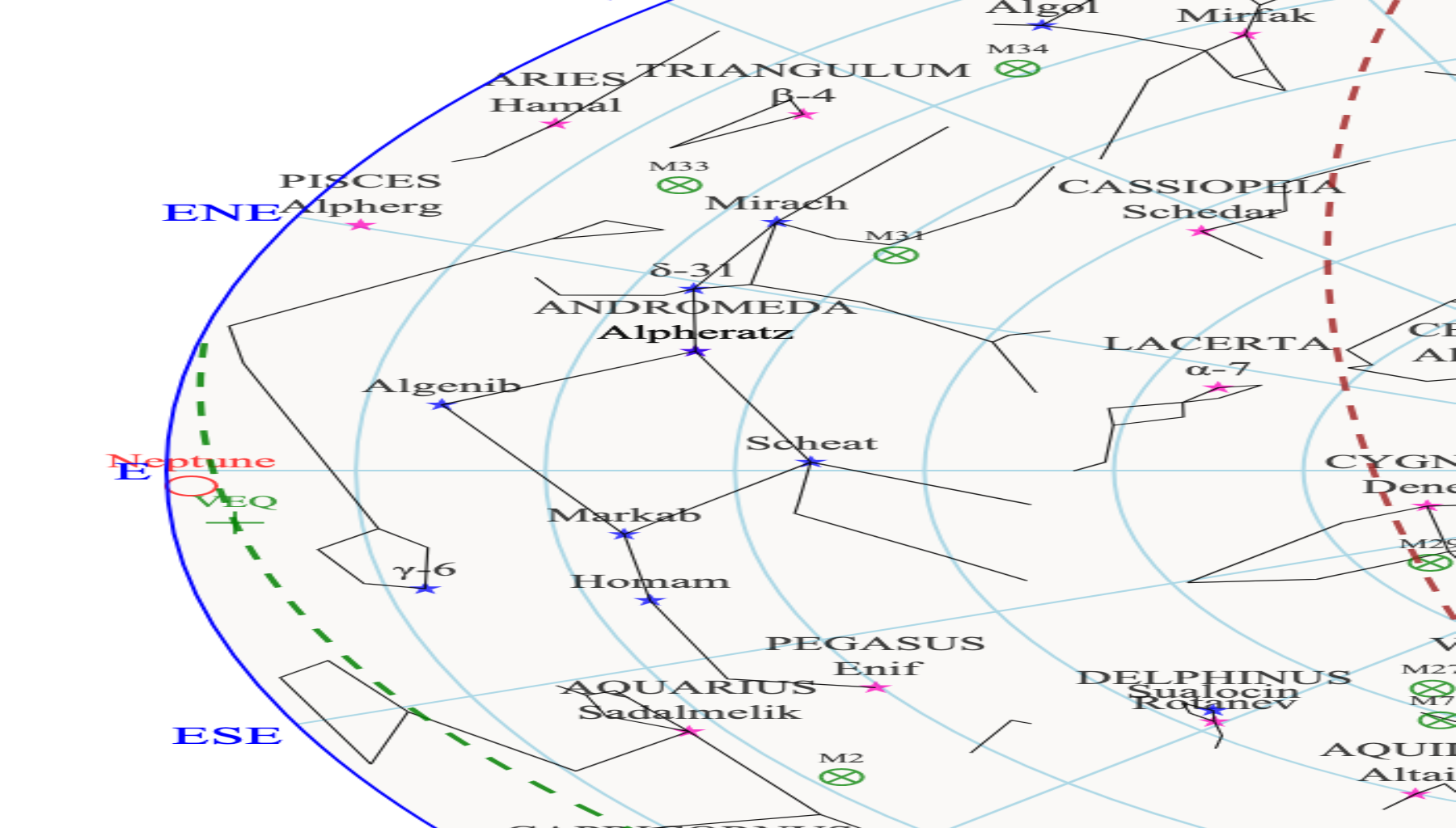
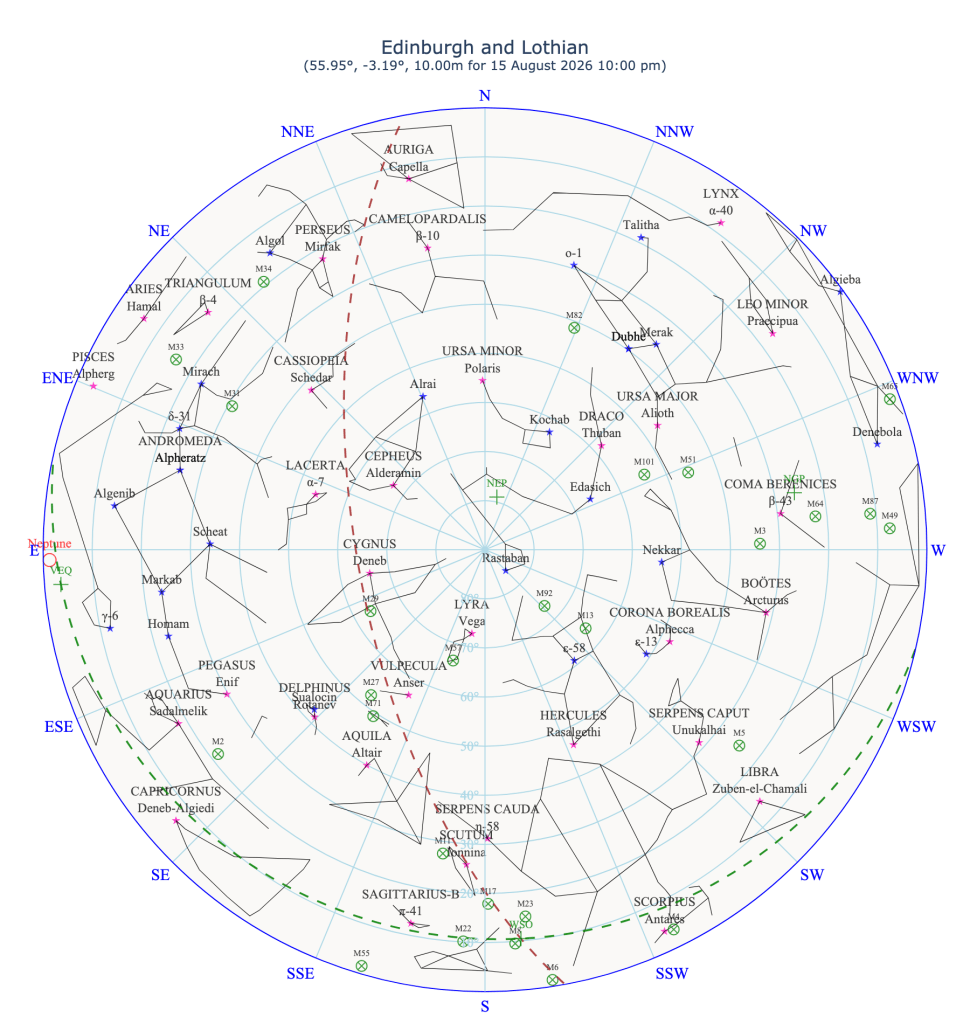
At the time of our sky map, some constellations visible are Draco (The
Dragon) at zenith, Lynx (The Lynx) in the north, Andromeda (The Chained
Maiden) in the east, Coma Berenices (Berenice’s Hair) in the west and
Scutum (The Shield) in the south. The ecliptic hosts Aries (The Ram),
Pisces (The Fishes), Aquarius (The Water Bearer), Capricorn (The Sea Goat),
Sagittarius (The Archer), Scorpius (The Scorpion) and Libra (The Scales).
The ‘Summer Triangle’—Vega in Lyra (The Lyre), Altair in Aquila (The
Eagle) and Deneb in Cygnus (The Swan)—is prominent at high altitude in
the south. It is bisected by the Milky Way. Also visible in the east is the
great square of Pegasus (The Winged Horse) with the sentinel stars Scheat,
Alpheratz, Algenib and Markab. Circumpolar constellations—always above
the horizon—include Camelopardalis (The Giraffe), Cassiopeia (The Seated
Queen), Cepheus (The King) and Ursa Major (The Great Bear).


Related