
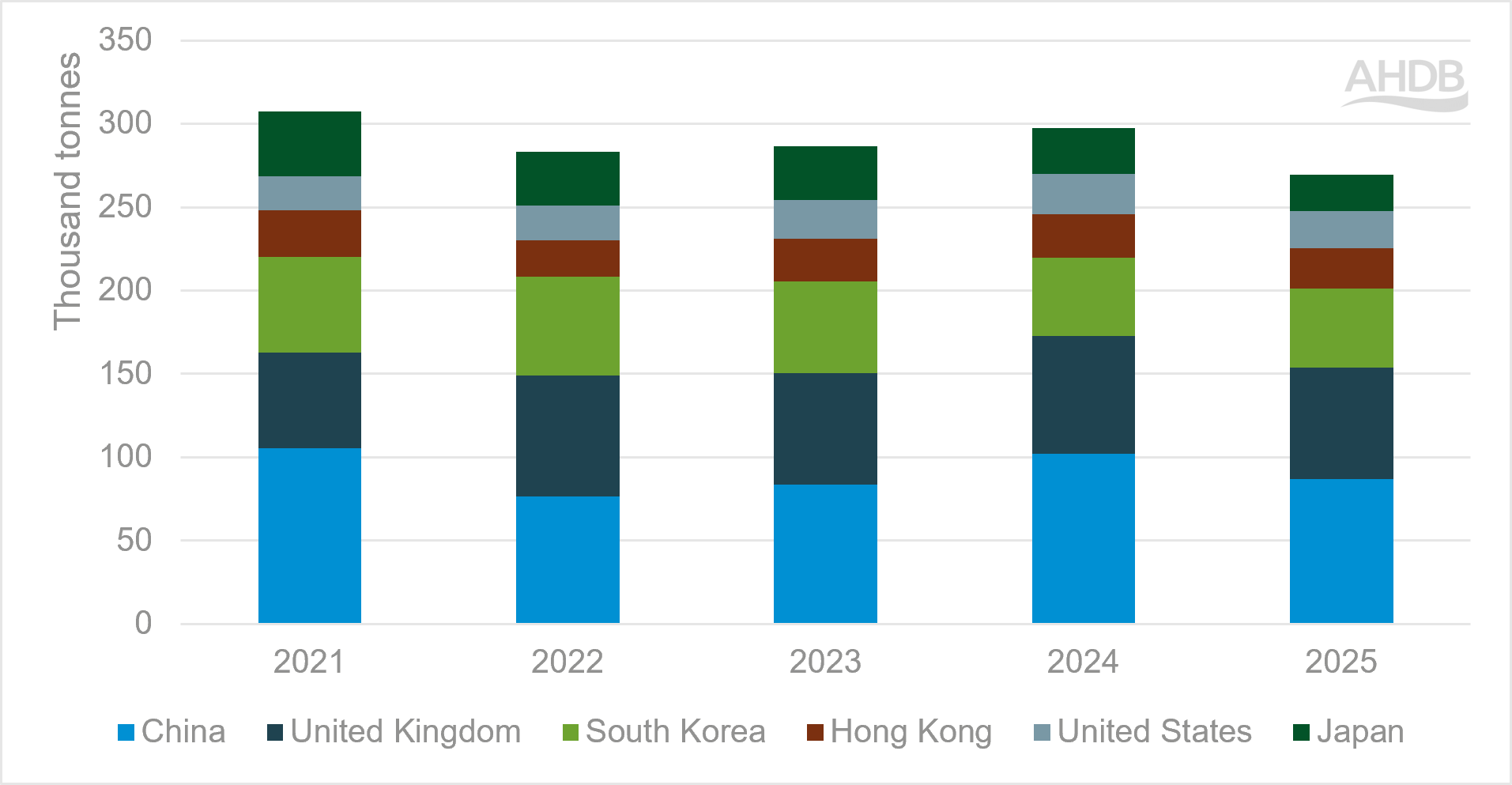
The Netherlands are an important dairy producer within the EU; in 2025 they accounted for 9% of EU milk production. A large proportion of dairy exports remain within the EU but outside of this the key destinations include China, the UK and South Korea (Figure 1).
We’ve explored how new plans to extensify livestock and dairy production could impact British opportunities.
Figure 1: Dairy exports from 2021 to 2025
Source: Trade Data Monitor LLC
Figure 1 shows that China remained the largest market throughout the period (2021–2025) and drove most of the year-to-year changes, while exports to the UK were broadly steady and volumes to South Korea, Japan, Hong Kong and the USA generally declined over time.
Summary of new emission targets
The Dutch cabinet has replaced previous nitrogen plans with more sectoral specific ammonia emission targets. The aim is to reduce agricultural ammonia emissions by 42-46% from 2019 levels by 2035. The plan focuses on nitrogen emissions, water quality, nature restoration, animal welfare and greenhouse gas emissions
Around 10% of agricultural land will be designated as a special zone such as protected biodiversity areas, near rivers and drinking water extraction zones. These zones will have an extra 20% ammonia reduction requirement and will encourage less intensive farming such as reduced crop protection products and lower manure application. Farmers in these zones may receive more subsidies as compensation for the tighter restrictions.
There is a €20 billion fund to compensate farmers for costs, the decline in land value, and to support the transition, most of this fund is allocated to agriculture with additional incentives for early adopters of emission reducing measures.
Dairy farmers are the first to receive specific targets, farmers can meet government targets by reducing livestock numbers, investing in emission reducing technology or purchasing additional phosphate or animal rights. The cabinet plans to impose an upper limit of 2.6 livestock units per hectare from 2035, this will force more intensive farmers, around 30% of current farms to reduce livestock numbers or expand land area which also has additional requirements.
The cabinet estimates these compared to 2019, this could potentially equate to a loss of 2705 million litres. This is also expected to reduce pressure on the manure market.
Opportunities for the UK
Dutch producers will face higher costs in order to meet stricter emissions targets; despite the additional subsidy it is likely that foreign producers will have lower production costs making their products more competitive in a global market.
A reduction in the size of the national dairy herd which is likely in order to meet emissions targets would equate to lower EU milk supply, potentially creating opportunities for UK producers. There could be increased competition from markets in Eastern Europe such as Poland which continue seeing production growth or from neighbouring countries although many of these such as Germany are currently subject to their own extensification efforts such as peatland restoration in Germany.