
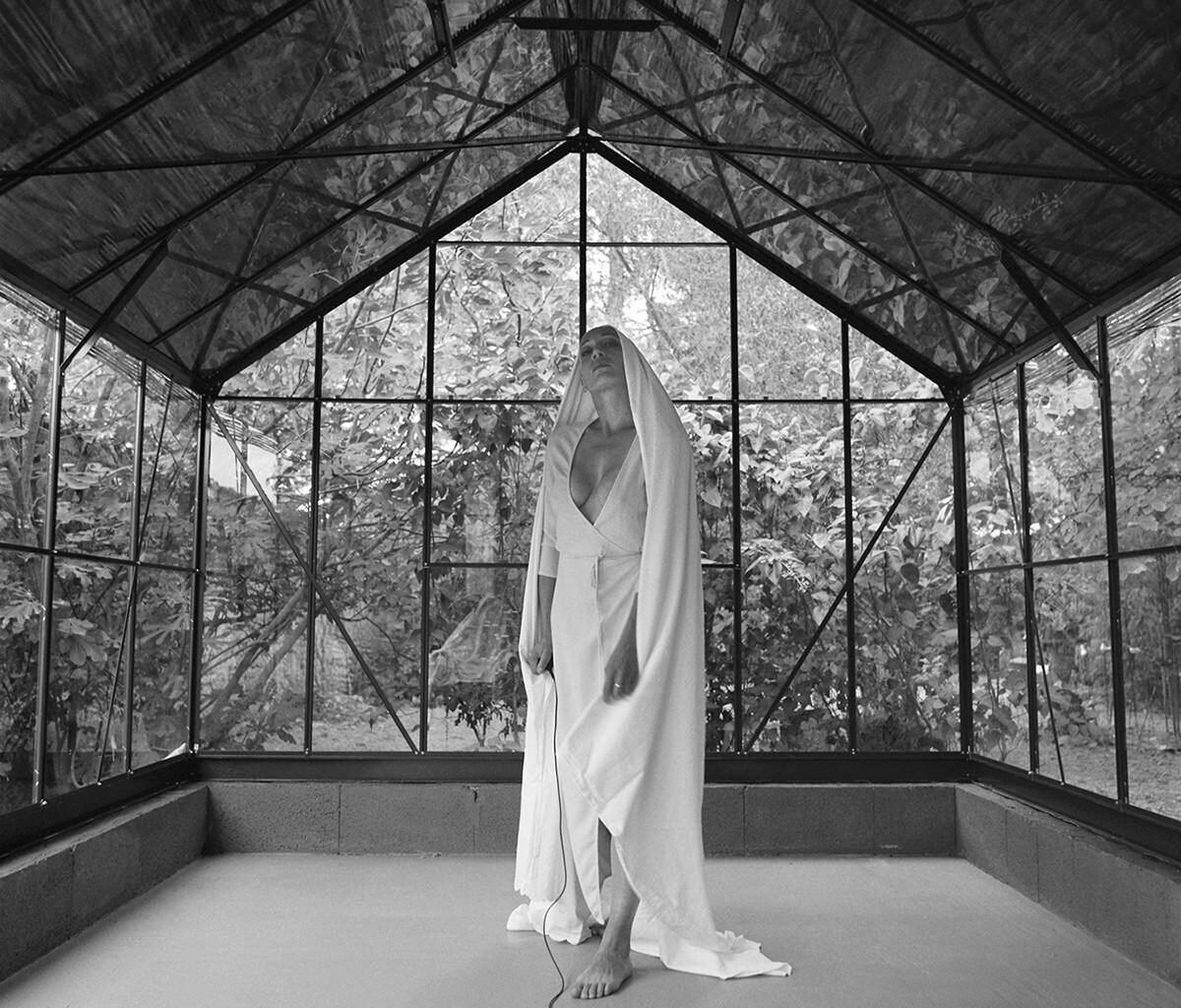
Marie Mons continues a kind of quest for identity in this photographic series, in which she once again probes the question of the self-portrait. With constancy, she interrogates appearances: those of her body, those of her own gaze, those of ours… A reciprocity of questions between the model, the artist, and the viewer, a back-and-forth between certainties (what Marie knows of herself) and discoveries (what the final image might reveal by capturing what escapes her).
During the summer of 2025, she immersed herself in a greenhouse, a space where outside and inside reflect one another between the transparency and opacity of light. In this fertile exchange, where the boundaries between interior and exterior become uncertain, the artist found a thread to pull, a possible echo well suited to her research: becoming one with the space. It was there that she found material to question her image; she imagined, built, and inhabited a set made of white sheets, a space within the space, a second envelope within the glass architecture, a kind of house within the house, a theater of possibilities, a second skin in which to replay her own appearance/disappearance. At once model and photographer, watcher and watched, thus contained within this closed space, she let images emerge that embody her own multiplicity. At times she absents herself from the scene, leaving it to emptiness or to an object (the armchair) to evoke her presence.
The protocol of this approach allows the one who submits to it to play a double game as subject/object. Moving from one side of this boundary to the other allows for an ambiguous, even contradictory approach, but one well suited to nourishing a creative eye: the distance and closeness of the I, the gravity and lightness proper to play. In this in-between space, the body begins to speak, and the self-image that surfaces lends itself to the pursuit of this strange strangeness: seeing oneself, recognizing oneself anew, both as oneself and as the other.
Who is this double of Marie in the images? Who is she really, what does she become, what does she show, what does she say in the staging of her photographs? Playing with herself, embracing her many facets in a deliberately dreamlike posture, losing herself and finding herself by turns, she appears and presents herself as a shifting, unexpected subject, opening onto the elsewhere of the self. In these self-portraits, some of which carry a spectral quality, visible and invisible, what is shown and what is hidden draw us into the deceptive play of appearances and invite us on an inner journey, one suited to opening our eyes.
Who is this woman, watching for herself, both observer and observed? She, of course, all the shes of her being, and no doubt at the same time all of us at once, with the other latent shes of our lives. Singularity and universality intersect in this experience of a reflexive gaze cast on the model who poses, and in the way she appears to herself and to us. Body and being closely overlap in the carefully constructed image, in which we find again the layers of outside/inside surfacing in the black and white of the images. In this digital age of avatars, the artist no doubt tells us of the renewed need to explore the embodiment of our being, with this observation standing as a form of resistance to all the virtualities on offer: reality has not yet said its last word.
Ça me regarde is a common French expression — literally “that looks at me,” used to mean “that’s my business” — often given in response to a question felt to be too intrusive. The artist takes hold of this expression in her own way, playing throughout this series with this paradox: being seen by what she sees.
Nicole Vitré-Méchain
Marie Mons : Autoportraits
Texts by Lucia Jalba
Les cahiers de la Maison François Méchain, 2026
210 x 297 mm
32 pages
French
€18 + shipping
https://mariemons.fr/Edition
Facebook : La Maison François Méchain
Instagram : @lamaisonfrancoismechain