
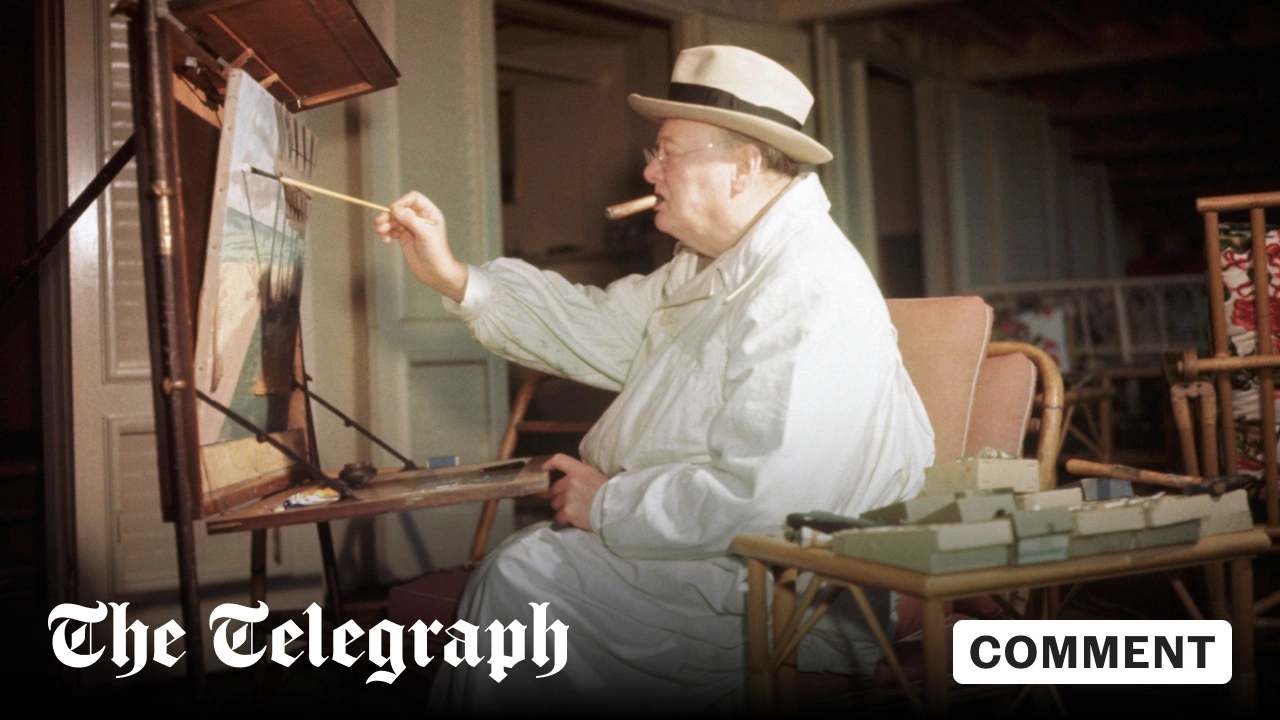
Hitler was a painter too. Indeed, it was as a would-be professional painter that he was rejected by the Vienna Academy – a decision which, though entirely justified, turned out to have catastrophic consequences. The embittered young Adolf became the vengeful and murderous Führer. I have often wished someone would put on a joint retrospective of his and Churchill’s work. It would show greatly to Churchill’s advantage. Hitler’s stiff, usually architectural efforts are deadly; Churchill’s works are full of life.
It speaks well of anyone that he or she can enjoy a pastime and communicate that enjoyment. In the case of Churchill, one cannot understand his achievements in every field without recognising that enjoyment played a part in all of them – as reporter, author, soldier and statesman. Even when the hour was very dark, his zest for life never left him. “I must say I like bright colours,” he wrote. For him, that was true both literally and metaphorically.
I like to think that if things had been the other way round and he had been a professional painter and only a part-time MP (as was possible in those days), Churchill could have written an equally brilliant essay called Politics as a Pastime. It was not that he was a dilettante – almost no one was ever more industrious – but that the pleasure principle was always at work.
For Churchill, it all began in 1915 when, because of clashes over his Gallipoli scheme, he was removed from the Admiralty but stayed in the Cabinet. He was “placed cruelly in the front seat”, as he put it. “I knew everything and could do nothing.” Painting, specifically painting in oils – “a medium…which offers real power” and permits “Audacity” (he used the capital A for this beloved concept) – was his escape.
Not much later, saddened by everything that had gone wrong, he temporarily left Parliament and politics to serve as an officer at the Western front. There, morose among the explosions, he painted; when he had painted, he cheered up. He compared painting to fighting a battle, because of the need for “a good plan”. Three of the exhibition’s nearly 60 pictures are of Flanders.