
Just south of Manchester, it has strong Metrolink transport links, attractive surrounding countryside, and boasts a Champion High Street Award.
What’s more, it has reinvented itself as one of Greater Manchester’s most desirable outposts.
No wonder Altrincham took top spot in the North West in the recent Sunday Times Best Places to Live 2026 guide – one of six locations in the region to make the grade.
But Altrincham’s heritage reveals another story: a medieval trading hub from the 13th century, the industrial heritage of the Bridgewater Canal, and a commuter boom town with the coming of the railway in 1849.
The Stamford Quarter, the modern retail centre, may be the gateway now but the town’s agricultural/trade origins date back to the Royal Charter, granted by Edward I in 1290, with stalls on the Old Market Place.
This article was originally published in Cheshire Life. If you enjoyed this content, consider subscribing to Cheshire Life for more insightful articles, in-depth features, and exclusive content. Simply visit our website at https://www.greatbritishlife.co.uk/magazines/cheshire/ to subscribe today!
The opening of the Manchester, South Junction and Altrincham Railway transformed the area in Victorian times, turning it into a desirable suburb for Manchester industrialists, while the suburb of Broadheath, founded by the Earl of Stamford in 1885, was the world’s first industrial park.
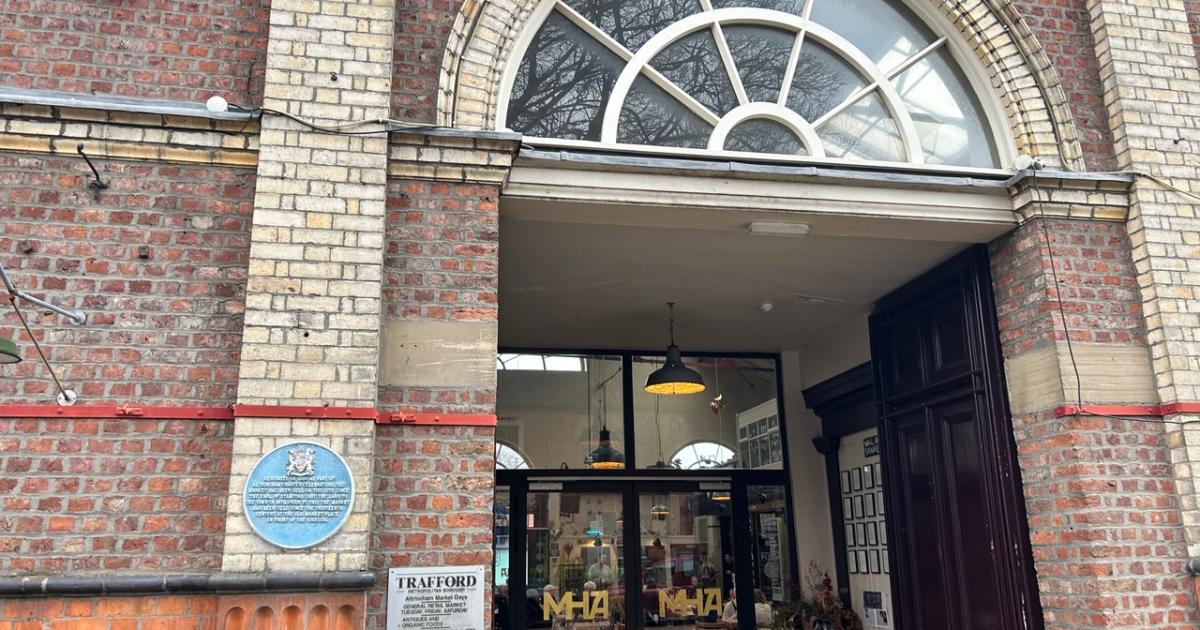
These days, the town’s modern take on its Victorian market hall is its main draw.
Indeed, the market is credited with kick-starting the modern renaissance, crowned Best Local Market at the 2015 Observer Food Monthly awards.
MARKET SQUARE
Start your self-guided walk from the clock tower outside Altrincham’s modern transport interchange.
The Altrincham clock tower (Image: NQ)
Built in 1880, the Grade II-listed clock has been a symbol of the town since the opening of the Victorian Altrincham and Bowden railway station.
Cross the road by the old police station and walk up the ramp into the Stamford Quarter.
This is the modern shopping centre, but a passageway, Stamford Passage, leads off the square to the former trading hub at Kingsway, the road renamed for the 1887 visit of the Prince and Princess of Wales.
The future Edward VII visited Altrincham as part of Queen Victoria’s Golden Jubilee celebrations.
He was hosted by Lord Egerton of Tatton and a series of decorative arches (now removed) were erected around town to welcome the royal couple.
Then cross the Dunham Road and walk into the Old Market Place with its half-timbered buildings.
Altrincham Market is credited with kick-starting the town’s modern-day renaissance (Image: NQ)
The sandstone replica of the historic market cross, commissioned by the local civic society, was given to the town in 1990 to mark the 700th anniversary of the market charter.
The nearby Butter Market was home to the stocks and a whipping post for public retribution in Tudor times, while the black-and-white bank building was built by the philanthropist Williams Cunliffe Brooks in the late 19th century in the Victorian-Gothic style.
Follow the cobblestones towards Church Walk and visit St George’s Church.
The church dates from 1799 but has seen several revisions over the years, adding the tower and the spire.
The construction of the chancel in 1886 added stained-glass windows designed by the Arts and Crafts artist, Mary Lowndes, later a member of the suffragette movement.
ROYAL VISIT
Leaving the churchyard behind, cross over the main road and head towards the building owned by the law firm Hill and Company Solicitors since 1886.
The firm, originally established by James Southern in 1852, has knocked through several townhouses as it expanded through to the 1930s.
Look out for the lion symbol marked Manchester 232, displayed on the façade.
It’s a fire insurance mark, identifying properties that were insured before postal services and formal addresses were widespread.
Nearby, at number 16 Market Street, is a blue plaque to commemorate the life of the Victorian artist, Helen Allingham.
She was the first woman to be elected as a full member of the Royal Watercolour Society in 1890.
Further along, cross over towards the imposing façade of Altrincham Town Hall.
The Gothic-style building has been a centrepiece of civic life since 1901.
The building was the work of the architect Charles Albert Hindle, who further expanded it in the 1930s.
A sandstone landmark in the grounds, from 2012, honours the Diamond Jubilee tour of Queen Elizabeth II, while a statue of a market trader – fish in hand – calls across the road to the market beyond.
SHOP THE GOOD STUFF
The centrepiece of the modern town is Altrincham Market, split between an outdoor market (open Tuesday, Friday, Saturday, Sunday) and an indoor food hall with stalls around a bank of central tables.
The market has traded on this site since the Earl of Stamford gave land to the town in 1879 and is now home to a thriving community of independent traders.
“Shop the good stuff,” says the sign outside.
Shop the good stuff at Altrincham Market (Image: NQ)
There’s a range of stalls from food to vintage clothes via artworks by local artist Don Grant.
One shows famous female characters from Corrie, while the other depicts a sign on the M6, indicating The North with a branch road leading elsewhere marked “Who Cares.”
Across from the market is the library (closed Sundays), where you can pick up a copy of the Altrincham Heritage Trail map, published by the Altrincham BID.
Outside, the installation, Eudaemonium, based on an ancient Greek term meaning to “live well”, collects words of wisdom from the market’s 13th-century origins onwards.
Leaving the market behind, head towards Regent Road, the mural of Brigitte Bardot making for a landmark on the façade of the Everyman cinema en route.
A plaque and displays of poppies mark the place where Chapel Street once stood, remembering the 161 men from the long-demolished houses there, who enlisted to serve their country in the First World War – 29 never returned.
King George V honoured their bravery and the community funded a permanent memorial.
From here, head towards Railway Street and bear right, heading towards the Cheshire Tap pub, gateway to the King’s Court al fresco space.
The courtyard was originally a grain store for the newly installed railway.
Finally, finish your walk by heading down the passageway across the road into the Goose Green conservation area.
This courtyard of cafés and restaurants, where geese were once herded, became an industrial hub of workshops and alehouses in the 19th century.
The statue of two wandering geese heralded the future regeneration of old industrial areas of the town.
From here, Railway Street leads back towards the clock tower to complete the circuit, or head back into town for refreshments at the market.
Altrincham’s fortunes have ebbed and flowed over the centuries, but the modern market town is clearly having a moment.
MAKE A DAY OF IT
Drink at … Within the King’s Court beer garden, the Cheshire Tap is a craft-ale pub with a rotating range of guest beers, including Cheshire Cat from Weetwood Ales; cheshiretapaltrincham.co.uk.
Eat in … The Market House at Altrincham Market (closed Mondays, open until 10pm Tuesday–Saturday) has all-day food and drinks with options from Honest Crust Pizza to the Great North Pie Co. instagram.com/altymarket
Check out … A day trip to nearby Dunham Massey, managed by the National Trust, reveals a Georgian manor house, season-changing gardens and 300-acre deer park. nationaltrust.org.uk/visit/cheshire-greater-manchester/dunham-massey
More from … Altrincham BID produces a self-guided heritage trail and maintains updated what’s-on information. visitaltrincham.com.
David Atkinson is a freelance writer and Green Badge tourist guide to Cheshire and North Wales.
His latest book is A Dark History of Chester (Amberley). davidatkinson.tours