
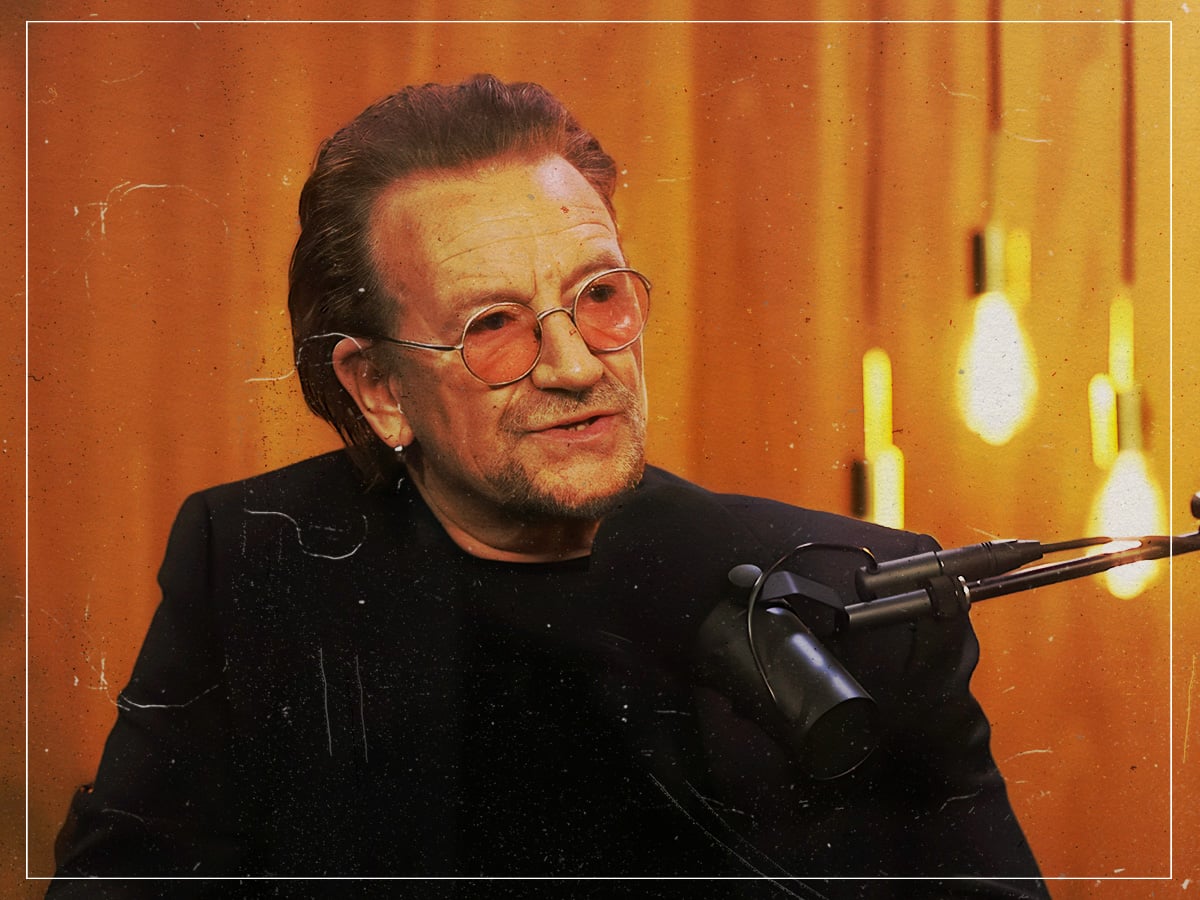
Credit: Far Out / YouTube Still
Sat 1 August 2026 11:29, UK
As U2 struggled to create their 1991 album Achtung Baby, creative differences and personal issues threatened to sink the band’s ship before any music was completed.
Bono and The Edge were insistent on moving the group in a new direction, while Adam Clayton and Larry Mullen Jr struggled to get a grip on the industrial and alternative styles that the other members were pushing. Even differing views on Jesus Christ were causing a chasm. It was a slow process, one that almost led to the band’s breakup during recording sessions.
At the band’s lowest point, The Edge began to mix up a chord progression that he had been working on. This innovation might have been borne from frustration, but it proved inspired. A simple ballad came to the fore, one that excited the other band members.
As a demo recording quickly took shape, Bono tapped into the divisiveness that U2 felt, forcing themselves to unite as a solitary unit. He sought inspiration from wider-world harmony, turning his focus to the reunification of Germany. The trilby-sporting frontman’s aim was to bring the band and their listeners back together. That notion was the basis for the lyrics that eventually became ‘One’.
“You’re overhearing conversations, and you draw your own conclusion,” Bono wrote about the band’s relations in his memoir Surrender. “All the intimacies from different rooms entwine into one story about how people are more the same than they are different. But still, they remain different.”
The idea of “one, but not the same” soon found its roots in several different topics. From the tumbling of the Berlin Wall to a rejection of hippie ideals to the struggles of HIV-positive people, ‘One’ was embraced as one of U2’s most universal tracks.
But Bono was irked at some of the simplified interpretations of his lyrics. When the Dalai Lama invited Bono to a celebration of “Oneness”, Bono rejected the notion, citing the lyrics to ‘One’ in his response. It’s a very Bono move to thumb your nose at a religious leader because he clearly hadn’t been listening closely enough to your lyrics.
“‘One’ is not about oneness; it’s about difference,” Bono explained in the book U2 by U2. “It is not the old hippie idea of ‘Let’s all live together.’ It is a much more punk rock concept.”
He continued, “It’s anti-romantic: ‘We are one, but we’re not the same. We get to carry each other.’ It’s a reminder that we have no choice.” Specifically, Bono couldn’t understand why couples were using the song at their weddings.
“I’m still disappointed when people hear the chorus line as ‘we’ve got to’ rather than ‘we get to carry each other.’ Because it is resigned, really,” he added. “It’s not: ‘Come on everybody, let’s vault over the wall.’ Like it or not, the only way out of here is if I give you a leg up the wall and you pull me after you.”
It’s still hard to see how that doesn’t represent vaulting the wall all the same, but he continued, “There’s something very unromantic about that. The song is a bit twisted, which is why I could never figure out why people want it at their weddings.”
“I have certainly met a hundred people who’ve had it at their weddings. I tell them, ‘Are you mad? It’s about splitting up,’” he concludes, despite moments ago telling people it is about helping each other over a wall in a more practical manner than people might first interpret.
The Edge had a similar take on the lyrics but was more focused on the positive aspects of the song. “The lyric was the first in a new, more intimate style,” he claimed in U2 by U2. “It’s two ideas, essentially.”
The guitarist added, “On one level it’s a bitter, twisted, vitriolic conversation between two people who’ve been through some nasty, heavy stuff: ‘We hurt each other, then we do it again.’ But on another level, there’s the idea that ‘we get to carry each other.’ ‘Get to’ is the key. ‘Got to’ would be too obvious and platitudinous.”
In the Edge’s view, choosing your burden is almost an indulgence in itself. As he concludes. “’Get to’ suggests it is our privilege to carry one another. It puts everything in perspective and introduces the idea of grace. Still, I wouldn’t have played it at any wedding of mine.”
Bono’s knack for looking at songs differently
Interestingly, it’s a recurring trait for Bono to interpret songs in a manner just a little different to the proletariat; he’s cool like that. By chance, he was in the same studio when Joy Division were recording ‘Love Will Tear Us Apart’, and that provided him with the chance to offer a different narrative to the norm surrounding the song.
“Talking to Ian Curtis is … or was a strange experience because he’s very warm … he talked – it was like two people inside of him – he talked very light, and he talked very well-mannered, and very polite,” the U2 singer recalled.
“But when he got behind the microphone he really surged forth; there was another energy,” Bono explained. “It seemed like he was just two people and, you know, ‘Love Will Tear Us Apart’, it was like [when] that record was released … it was like, as if, there were the personalities, separate; there they were, torn apart.”
In other words, the tearing relates to the dichotomy of Curtis’ own persona and the impact that was having on his life as opposed to the singer forecasting the befouling that comes with a tragic break-up in its inevitable final throes. Or maybe Bono just sees the world a little differently, perhaps because he’s always wearing sunglasses.
