
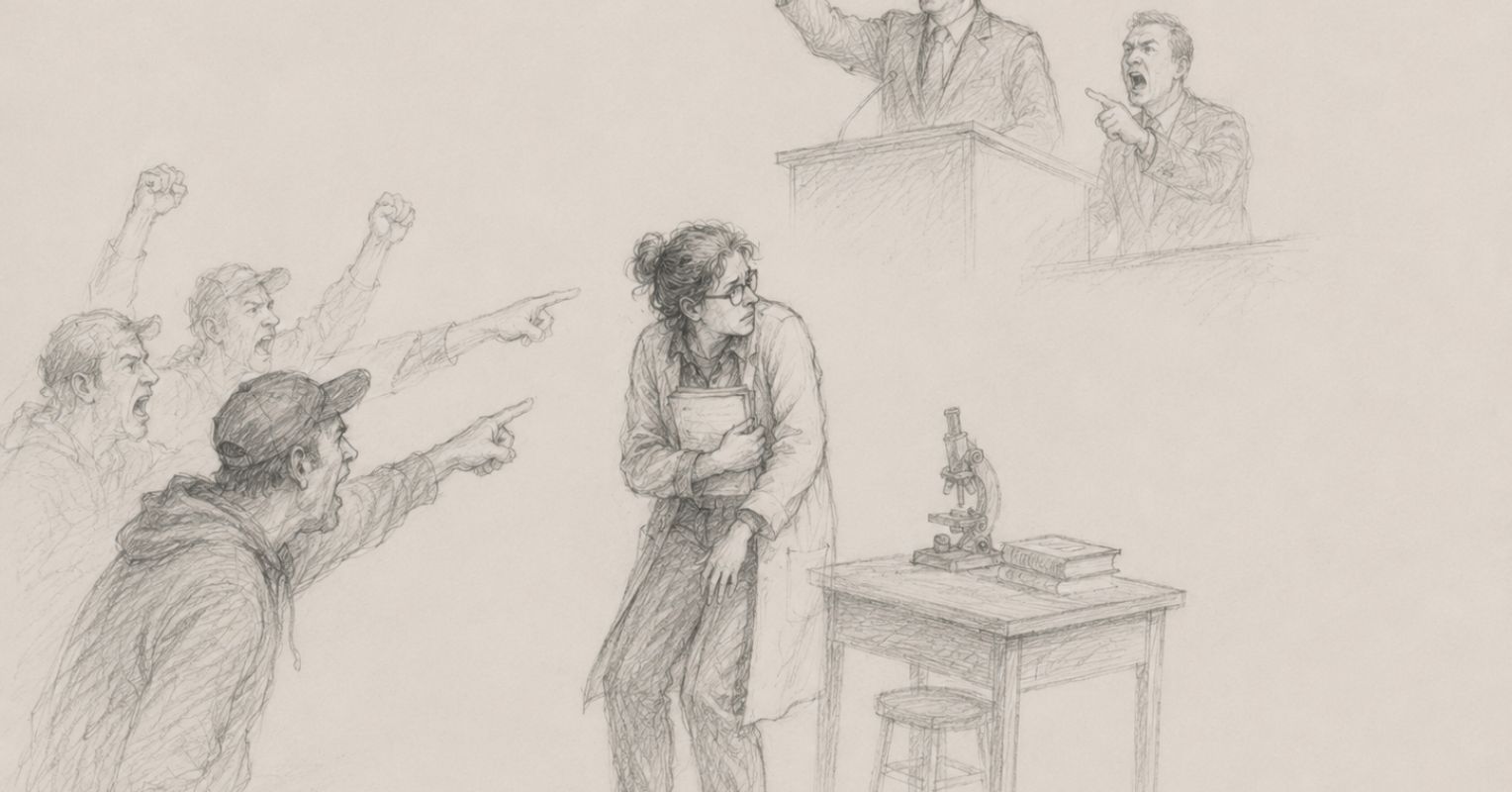
In November 2021, J. D. Vance delivered a speech titled “The Universities Are the Enemy,” ending with Richard Nixon’s declaration that “the professors are the enemy.” At the time, Vance was a candidate for the United States Senate; today, he is vice president of the United States. One of the most powerful men in one of the most powerful countries in the world had thus described professors, researchers, and teachers not merely as mistaken, politically biased, socially remote, or occasionally arrogant, but as enemies.
States have enemies in the form of hostile powers, terrorists, and those who seek their destruction. To place professors in this category is therefore not merely to criticize universities. It is to suggest that the pursuit, preservation, and transmission of knowledge have themselves become forms of hostility—and that those engaged in them are not simply citizens with whom one disagrees, but adversaries against whom the exercise of state power may be regarded as justified, perhaps even required.
As a professor, I found this harder to comprehend than ordinary disagreement or criticism of universities, both of which science can readily accommodate. What is new, and much more disturbing, is the transformation of knowledge itself into something sinister, and of those who devote their lives to acquiring it into a hostile social class.
What Denial Protects
Perhaps the explanation begins not in politics but in psychology. Science denial cannot be reduced to lack of education, stupidity, or ignorance, although it is often enough sustained by all three. Nor is it usually the result of too little information. More often, it also serves as a defense against fear, because a threatening reality does not merely add another fact to the world; it imposes demands upon us.
Climate change asks us to reconsider habits of consumption, mobility, production, and growth, but also the consoling story that the world we have constructed can continue indefinitely without requiring anything serious of us in return. A pandemic reminds us that our bodies are vulnerable, that ordinary proximity can become dangerous, and that what we do may have consequences for strangers whom we will never see. Both threaten the deeper assumption that life is essentially controllable and that the familiar order of things can somehow be preserved.
Denial does not remove the danger, but it offers relief from the burden of acknowledging it. This is why additional facts often accomplish less than scientists hope. Beliefs are woven into identity, social belonging, autonomy, self-respect, and the wish to regard oneself as a competent and decent person. To accept that one’s political community has been wrong, or that one has underestimated a serious danger, can feel less like revising an opinion than like surrendering part of oneself.
Research on climate attitudes has shown how motivated reasoning and social identity shape the reception of evidence, while experimental work suggests that people may become less defensive toward threatening information when their broader sense of worth has first been affirmed. A person who does not feel that his entire character has been placed in the dock will find it easier to acknowledge that one of his beliefs may be false.
The Political Uses of Fear
Yet the psychology of frightened citizens is only half the story. The other half concerns politicians who discover that fear can be converted into votes. Populists do not necessarily create every anxiety they exploit, but they give it a vocabulary, organize it into a worldview, and provide it with enemies. Scientists, physicians, journalists, universities, civil servants, and vaguely defined “elites” are no longer treated as fallible participants in a difficult public conversation, but as members of a coordinated class whose warnings are themselves presented as evidence of deception.
This offer is emotionally attractive because it resolves several painful tensions at once. The danger has been exaggerated, the experts are corrupt, and the people warning you secretly despise you. Your refusal to believe them is therefore not evidence that you may have misunderstood the problem; it becomes proof that you remain free, clear-sighted, independent, and unafraid. What presents itself as political courage is frequently little more than the removal of an unwanted reality from public consciousness.
The same pattern has appeared in responses both to climate change and to COVID-19. At first, the danger did not exist. Then it existed but was harmless. Then it was real but had not been caused, or did not spread, in the ways scientists had described. Finally, when the consequences could no longer plausibly be denied, attention shifted to individual errors, changing estimates, alleged hypocrisy, and the social status of those issuing the warnings, as though the vanity of a scientist or an inaccurate prediction could alter atmospheric physics, viral transmission, or the immense burden of post-viral illness.
The argument keeps moving because its purpose is not to arrive at an accurate account of reality but to prevent reality from ever becoming decisive. When one claim can no longer be defended, another takes its place, while the conclusion remains untouched: No substantial response is necessary, and those demanding one must have ulterior motives.
Who Pays for Denial?
And yet the central facts do not change. Human influence has unequivocally warmed the atmosphere, oceans, and land. COVID-19 was neither a media invention nor an unusually theatrical seasonal cold. The World Health Organization estimated approximately 14.9 million excess deaths associated directly or indirectly with the pandemic in 2020 and 2021. One may dislike these realities, resent their implications, or despise the people who communicate them, but none of this makes them less real.
The deeper problem is that denial causes harm. Hostility toward science eventually becomes hostility toward human beings, because the victims are rarely those who deliver the speeches, formulate the slogans, or receive the votes. They are more often the elderly, the chronically ill, the poor, and all those whose survival and well-being depend upon institutions recognizing dangers before those dangers become personally visible to the majority.
The vulnerable are particularly inconvenient to a politics of denial because their existence makes it difficult to sustain the fiction that there is no problem. Their illness, disability, or heightened risk testifies to realities that others would prefer not to see. A society may respond to that testimony with protection and solidarity, or it may redefine the vulnerable as excessively anxious, burdensome, or somehow responsible for the inconvenience that reality itself imposes. At that point, denial is no longer merely a mistake about facts. It becomes a moral decision about whose suffering is permitted to count.
Denial can appear democratic because it presents itself as rebellion against authority, education, and privilege. Yet its costs are never distributed democratically. Those with money, health, mobility, and access to good medical care can protect themselves better than those without them. The rhetoric of popular rebellion can therefore conceal a politics in which the strongest are liberated from responsibility while the weakest are left to bear the cost.
The Task of Science
Fear may help us understand why people turn away from threatening realities. It should make us more patient with individuals whose denial protects them from a world they experience as intolerable, and more attentive to the anxieties that facts alone cannot resolve. It cannot, however, excuse political leaders who deliberately strengthen those defenses, reward ignorance with moral prestige, and teach citizens that the people attempting to understand a danger are more threatening than the danger itself.
There is a profound difference between consoling frightened people and deceiving them. The first seeks to make reality bearable; the second makes reality someone else’s problem. When denial becomes policy, that someone else is usually the person who was most vulnerable from the beginning. Our task as scientists, therefore, is not to address people as we wish they were, but as they are—with all their fears, loyalties, and defenses—not to indulge falsehood, but because only truth that can be heard will protect those who can least afford its denial.