
Winnipeg’s Ellice Avenue tells a tale: of newcomer Canadians, with grocery stores focused on East African, South Asian and Caribbean products. Of students attending the nearby University of Winnipeg, who appreciate its affordable housing. Of award-winning restaurants, such as the Indigenous-owned Feast Café Bistro. The West End Cultural Centre here puts up regularly sold-out concerts; the Gargoyle Theatre mounts experimental plays.
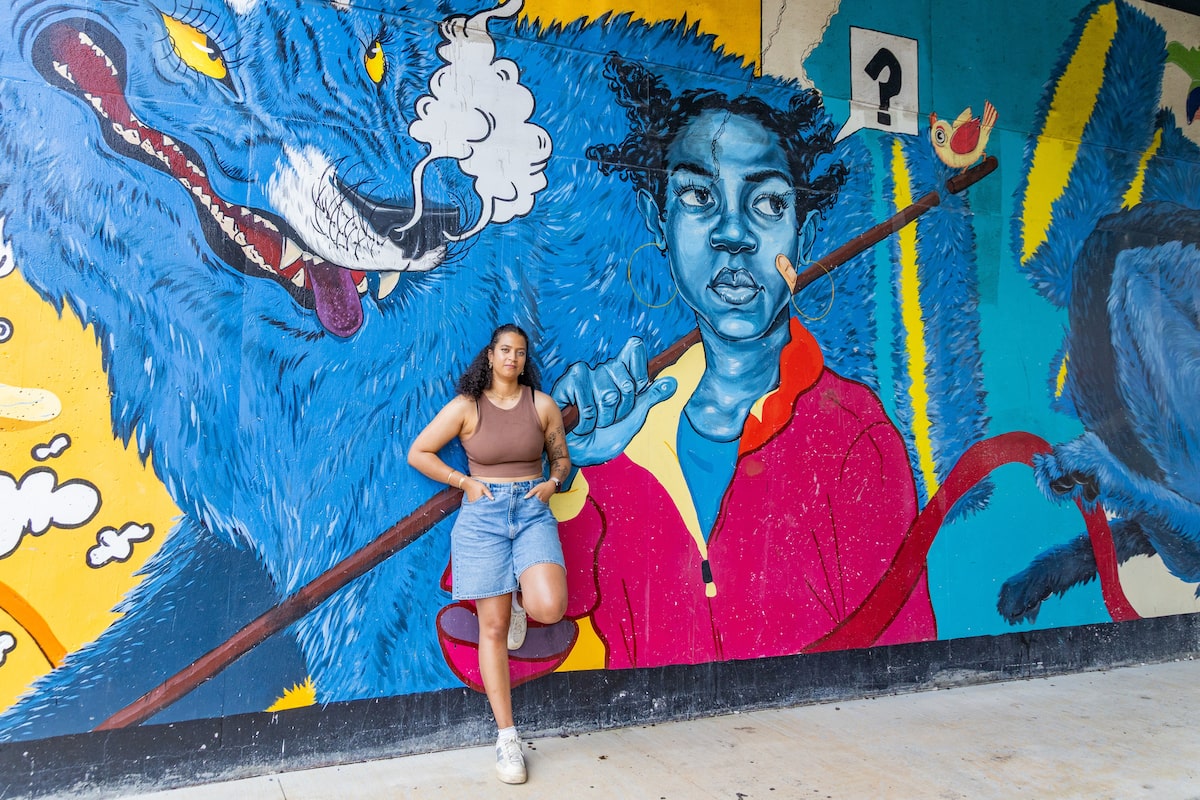
It also tells a story of dreams. Cutting through an assisted living seniors’ home in the middle of Ellice Avenue is an underpass. In this roughly four-metre-high enclosure, pedestrians will find a grinning wolf, its nostrils trailing white vapour, facing a young girl who looks away, a longing expression on her face. These painted walls and ceiling have been aptly named Dreamscape by 31-year-old artist Bria Fernandes.
The mural is enveloped by Ellice Place, an assisted-living building run by Manitoba Housing.Temur Durrani/The Globe and Mail
The figurative painter has created many similar moments of transcendence in other neighbourhoods across the city. Her reverie-inducing gateways are located next to a high school, on the side of a women’s health clinic and inside an emergency shelter and food bank.
Fernandes’s murals have helped define the city’s soul by allowing viewers to see her community the way she does.
But after spending the better part of a decade beautifying her surroundings wherever she could with acrylic and oil, she is bidding farewell to the Prairie metropolis that raised her to be an artist.
She is heading to the West Coast for postgraduate studies at the University of Victoria. “Things have changed so much since I was last in school,” she says. “There’s a lot more space for people who look like me.”
Winnipeg Art Gallery curator Julia Lafreniere says Fernandes’s “mark here, though, will be felt well after she moves away this fall.”
A cyclist pauses in the roughly four-metre-high enclosure on Ellice Avenue, where Fernandes has painted her surrealist work.EBUNOLUWA AKINBO/The Globe and Mail
Joe Kornelsen, executive director of the West End Business Improvement Zone, vividly remembers when Fernandes was commissioned for her Ellice mural, unveiled in the late fall of 2021. “I’m a big rube when it comes to art, but it was such a departure from anything we’d ever done before,” he says.
Fernandes was quite worried after making her pitch: “It’s very different from any other pieces I’ve seen anywhere in the city and I just wasn’t sure it’d be their cup of tea.”
But Kornelsen says it “wholeheartedly” was. “Usually, for murals we do, from our board to other stakeholders to committees to subcommittees, there’s a lot of gates they have to go through. But this one just got a positive ‘yep, yep, yep, absolutely yep’ at each turn,” he says.
The focal point of Fernandes’s mural is a girl with a Band-Aid on one cheek, resting a long stick against her shoulder. Her ears are embellished with golden hoops, she wears a maroon-red sweater and bantu knots are coiled on her scalp. A speech bubble containing a single question mark rises above her head. The background is a rich yellow; the wolf and the skin of the girl at the fore are shades of blue, the primary colours evoking a sense of childhood nostalgia.
A close-up of Dreamscape, Fernandes’s mural unveiled in 2021, showcases the central image of a young girl who looks away longingly.EBUNOLUWA AKINBO/The Globe and Mail
Its surrealist motifs of enlarged bugs and birds offers its audience a break from the world – to step away, ever so briefly, into another place. And if that aim wasn’t clear enough, there are colour-blocked doors and windows depicted on the opposing façade: portals to an alternate dimension, reminiscent of a youthful age.
“It’s quite distinct from the other work I’ve done overall,” Fernandes says. “But at that point, and even now, almost five years later, that mural’s still sort of representative of the amalgamation of my career.”
Ottawa-born Fernandes lived fleetingly in Ohio and Calgary before arriving in Winnipeg for Grade 3. In her heart of hearts, she always knew she wanted to be a painter; although her parents weren’t so keen. They worried about how such a job would pay the bills.
Initially, she set her sights on becoming an animator or illustrator. Maybe that would make her more employable, she thought. When the time came to apply for undergraduate programs, she enrolled in 2015 at the University of Manitoba, where she became increasingly fascinated by fine art.
Soon, she made the switch to study at the Alberta University of the Arts. “My mom was working for the school then. She had a place in Calgary, and it just made sense to move over to finish my degree there,” the soft-spoken, wavy-haired Fernandes recalled, in between sips of a strawberry-green-tea lemonade at The Forks, Winnipeg’s go-to hangout spot.
At both schools, Fernandes met a small coterie of fellow Black students. “There were just so few of us in each of those places,” she says.
Fernandes’s 2025 painting Past Perfect, Present Tense (74 by 60 inches) was bought for the Winnipeg Art Gallery’s permanent collection.Bria Fernandes/Supplied
Mixed-media artist Chukwudubem Ukaigwe was one of them. This “tiny number of ours is what made us all lean on each other for support, as we held each other up,” he says.
Ukaigwe was immediately blown away by his friend’s work when he met her in 2017, but he remembers seeing her struggling.
Fernandes did not find the academic environment conducive to honing her craft. She observed that her instructors at what she called the “very white” arts schools seemed to be worried about giving her any constructive criticism, which held her back.
Her earliest paintings, albeit still Baroque in scale (as are her later works – “big is always better,” she says) felt confined by the principles she was being preached in arts school, which emphasized clean lines, clear themes, consistent mediums, “and no animals, definitely no fun animals back then,” she chuckles.
Her canvas-based portraiture often looked like an homage to the 17th-century greats, Rembrandt and Caravaggio, with deft renderings of fleshy and shadowy figures. They still delved into subjects of self-doubt, grief and anxiety, but it is clear now that her exploration of these emotions was in its infancy.
Around that time, she began to start looking for opportunities with public art, quickly getting commissions from different groups in the city.
With her murals, Fernandes felt she could play more creatively because she didn’t need to make their meaning so obvious.
“I could just keep adding on to them, as I waited for the paint to dry, without needing to be too simple, the way I thought I had to be with my paintings.”
Roommates, a new mural painted by Fernandes in 2026 on the exterior of the Women’s Health Clinic, is one of her many reverie-inducing gateways across Winnipeg.EBUNOLUWA AKINBO/The Globe and Mail
Over time, she learned to marry her murals and paintings as a conjoined body of work, with a similar creation process and style. “I loosened up, especially when I started building my own canvas frames as part of the process,” she explains.
She doesn’t do everything from scratch, but the grand size of her paintings – which have previously measured up to 74 by 84 inches (almost the size of an adult bison or a single-car garage door) – are best accommodated by a custom build, for which she uses primed canvas by the yard.
As she begins to conceptualize any piece, she first sketches her thoughts and research, often asking her mom or brother to model for her or posing for photos herself. She uses those pictures to create a digital composition that she projects on a surface, whether a wall or a canvas, and then she begins underpainting.
One aspect is consistent, however, and it hasn’t changed much throughout her career: like multiple generations of Black artists who came before her, Fernandes’s favourite colour – blue – remains a central part of all her work.
The 2022 painting Walking Down Limbo Avenue (35 by 35 inches) highlights Fernandes’s love for the use of blue hues in her work.Bria Fernandes/Supplied
In his seminal 1976 book, On Being Blue: A Philosophical Inquiry, essayist William Gass writes that, of all the colours in the world, blue is what best forms the “basis of interior life,” as it most profoundly encapsulates our collective “states of feeling.”
For many Black artists – including the prominent examples of Lorna Simpson, Kerry James Marshall and Kehinde Wiley – the colour has long offered a visual vessel to both celebrate the rich history and address the issues of Blackness. The 2016 Oscar-winning drama Moonlight demonstrates its importance with a pivotal line: “In moonlight, Black boys look blue,” a reference itself to Tarell Alvin McCraney’s semi-autobiographical 2003 play of the same name.
So, when Fernandes paints her characters and figures, shades of blue seem like a natural choice to her. “I just love how it looks on them, especially how blue captures their introspection and inner dialogue,” she says. “And there’s clearly this big past of blue being a part of other Black artists’ work.”
In her 2023 painting, Come Rain or Shine, a central melancholic figure holds her head, sitting next to a kitchen table by a plate of segmented orange slices; she is depicted in a moment of time when a quarter of the room has turned blue, with looming figures in the same hue nearby. Similarly, in the 2025 work Past Perfect, Present Tense, which she created for an exhibition at the Winnipeg Art Gallery before it was bought as part of their permanent collection, blue symbols are a recurring element, too.
In the 53-by-66-inch Come Rain or Shine (2023), Fernandes explores blue again. It’s a colour that lets her show the multifaceted experiences of her characters, she says.Bria Fernandes/Supplied
Fernandes likes to use the colour to illustrate various iterations of the same characters in a frame, where feelings show up as physical visitors, at times in the most banal moments of the day to day. It’s a commentary on how humans are never truly alone with ourselves.
While she mulls the specific colours for her work, she says she also grapples with thoughts about how she wants to portray the hair of her characters.
“It’s annoying because it immediately becomes about race if, say, I have someone with an afro in there. The piece is about personal anxiety and the person shown happens to be Black,” she says. “I started getting these kinds of questions back in art school: ‘Why does the hair look like that? Why does it need to be that way?’ So, I just constantly have had to be conscious with my choices. I don’t want to be lumped into something that my work isn’t trying to be.”
“So often, Black identity is flattened into a sort of monolithic experience,” she says. “I think with my blues I try my best to show how multifaceted those experiences actually are. Even within the same communities or, honestly, even within the very same person, you have this wide range of emotions present.”
Fernandes’s 2020 piece, In Sunshine Manor, Will Everything Be Okay? (35 by 47 inches), depicts the looming imagery of animals amongst its central characters. In arts school she felt confined by the principles of clean lines, consistent mediums, ‘and no animals, definitely no fun animals,’ she says.Bria Fernandes/Supplied
Fernandes has had her work displayed in galleries such as Tribeca’s The Untitled Space in New York City, the House of Fine Arts in London, England, and multiple provinces in Canada. Still, she’s perhaps most proud of her murals, she says.
Reflecting on the universal approval for Dreamscape in 2021, Kornelsen, of the West End BIZ, says he thinks the “overwhelming burst of positive feedback it received has to do with the powerful message it sends,” including the mural’s chosen location.
Just down the street is an impoverished part of the city, a tough neighbourhood that Kornelsen acknowledges many people from other areas of Winnipeg often choose to avoid.
Ukaigwe, Fernandes’s friend, used to live on Ellice before moving away for Stanford University in California. Thinking of the neighbourhood and Fernandes’s work, he muses: “What Bria’s mural is doing there on Ellice is what poets do for Detroit,” likening Dreamscape to acclaimed poet Crystal Williams’s 2014 collection, Detroit as Barn.
“She is celebrating its potential and telling all of us that this place also deserves beautification,” Ukaigwe says.
For a little while now, however, Fernandes has been thinking that she’s outgrown Winnipeg; or at least needs to leave for a bit to maybe boomerang back.
There are colour-blocked doors and windows depicted on the opposing façade of Dreamscape, the mural on Ellice: portals to an alternate dimension, reminiscent of a youthful age.EBUNOLUWA AKINBO/The Globe and Mail
The itch to further refine her skills academically has caught her again. “When I looked at all my options, Victoria kept coming back to me as the best fit,” she says.
This fall, she and her partner, Cole Priestley, will move to British Columbia, where he has decided to become her schoolmate again.
“We went to high school together,” Priestley says. “Now, I’ll study psychology there at UVic and she’ll keep doing what she does best.”
Lafreniere, head of Indigenous partnerships at the WAG-Qaumajuq, who curated Fernandes’s work for a 2025 exhibition titled Threads of Kin and Belonging, says Winnipeg’s arts community will miss her.
“But that’s the thing about great artists like Bria,” she says. “They’ll leave a lasting mark for people wherever they have wanted to tell their stories.”
That mark was evident on a recent Saturday, the kind of Prairie summer day when the weather fluctuates from scorching sun to random cloudbursts.
Seven-year-old Gaggan Demarcus and his grandmother, Judith, sheltered themselves inside the Ellice tunnel during a brief afternoon rainfall. They had noticed the mural on their walks before, but they never had the time to fully take it in.
“That girl with the wolf just looks so cool!” said Gaggan in awe.
“She sure looks confident,” his grandma, 68, responded, smiling.
“I want to bring all my friends to see this next weekend,” he replied. “I wish we had more stuff like this everywhere in Winnipeg.”