
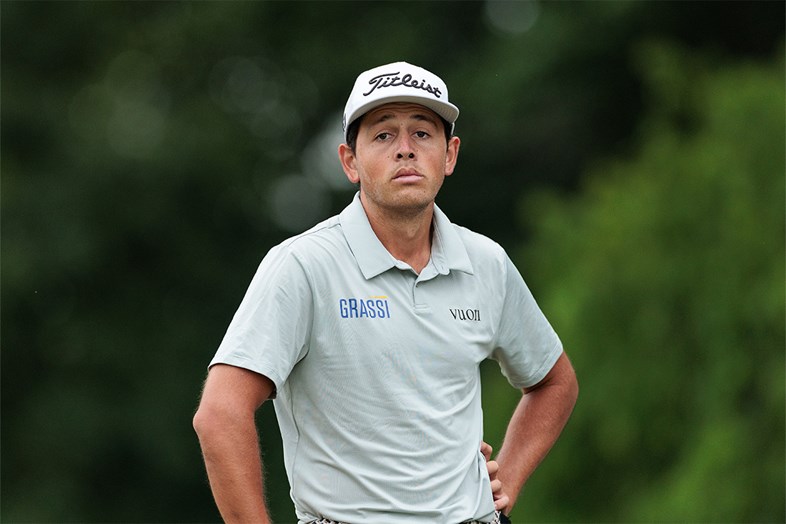
The PGA Tour’s feeder circuit has become the first major professional tour to publish players’ pace-of-play data, with officials hoping greater transparency will help tackle slow play.
The Korn Ferry Tour has become the first major professional golf circuit to publicly publish pace-of-play data for every player in a bid to tackle one of the game’s biggest frustrations: slow play.
The PGA Tour’s feeder circuit has been recording how long players take over every shot throughout the season, breaking the figures down into five categories: overall pace, off the tee, approach shots, around the green, and putting.
By making those numbers public, officials hope greater transparency will improve accountability while giving fans a clearer picture of who really plays quickly – and, crucially, who doesn’t.
One player sitting comfortably at the top of those rankings is Dylan Menante.
The American leads four of the five pace-of-play categories and ranks second in the other, making him the quickest player on the Korn Ferry Tour this season.
Menante says that his pace comes from simplifying the decision-making process rather than rushing through shots.
“Whether you play good or bad, play quick.”
Dylan Menante is No. 7 on the Points List and No. 1 in speed of play on the Korn Ferry Tour. pic.twitter.com/Zwitk7zUbD
— Korn Ferry Tour (@KornFerryTour) July 30, 2026
“I try to keep it as simple as possible. Like what side of the green am I trying to hit, what shot am I trying to hit, what number?”
He also believes golfers often waste time chasing perfection when the reality is that even the best players rarely produce exactly the shot they have in mind.
“Your routine is really important, but how many times are you actually going to hit the exact shot you desire?” he says “Like [Ben] Hogan said – two or three [times] a round. And I’m nowhere near as good as him ball-striking-wise, so maybe I’m hitting one or two, so why get so uncomfortable standing over a shot waiting when you’re only going to hit two or three perfect shots a round?”
Menante isn’t advocating rushing, but believes that taking too long can be as damaging to your performance as playing too quickly, with the key being to find a routine that allows you to commit to a shot without overthinking it.
“The dilemma [is] between trying to play fast yet trying to play good, because sometimes you play too fast, you don’t look at the stuff, you make careless mistakes. But then if you play too slow, it’s anxious and you only think about the bad things that can happen. So it’s trying to find a balance between playing good and playing fast.”
Ultimately, though, he believes golf is simply more enjoyable when it’s played at a better pace.
“It’s obviously awesome to play well and to play quick. I think it’s just nice to play quick. Whether you play good or bad, play quick.”
His results this season suggest quicker golf doesn’t come at the expense of performance.
With a win and a runner-up finish under his belt, Menante currently sits seventh in the Korn Ferry Tour Points List, comfortably inside the top-20 players who will earn PGA Tour cards at the end of the season. He also ranks 16th in Strokes Gained: Off the Tee, 24th Around the Green, and eighth in Strokes Gained: Total.
The Korn Ferry Tour hopes publishing pace-of-play data will encourage more players to follow Menante’s example.
Players whose average stroke time is seven seconds or more slower than the field receive an “Average Stroke Time” violation. After five violations the Tour steps in with a warning, while players who continue to ignore the policy eventually face financial penalties.
Those fines begin at $50,000 for a 10th violation, followed by $5,000 for each of the next four violations, before increasing to $10,000 for every subsequent offence.
If it succeeds in changing the habits of even a small number of slower players, the initiative could become a blueprint for the PGA Tour, where slow play remains one of the game’s most persistent talking points.