
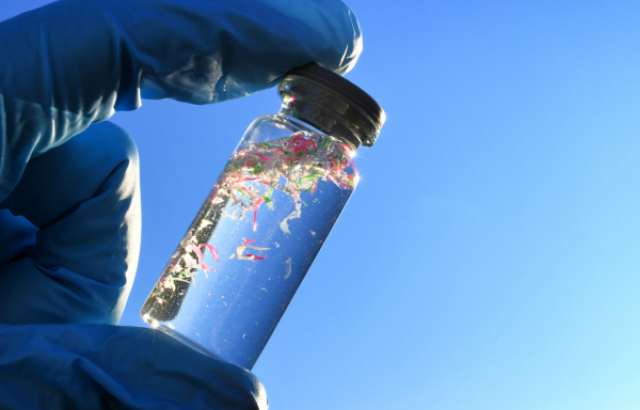
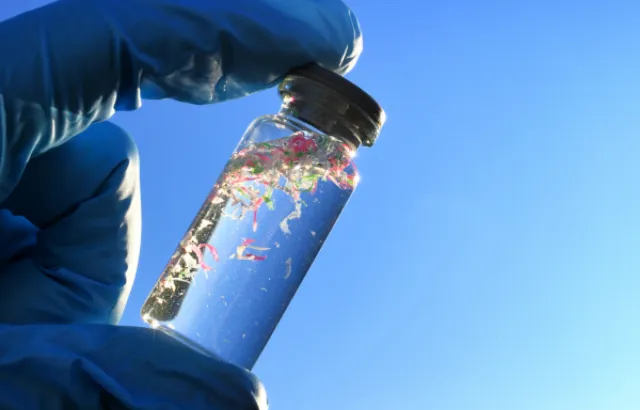
Gloved hand holding a small bottle containing microplastics
The award – announced today (3 August 2026) – will fund the establishment of a Health and Pollution Research Hub at Queen Mary.
The Health and Pollution Research Hub, conceived by Dr Vahitha Abdul Salam and co-led with Dr Abish Stephen, will form the core infrastructure of the University’s Collaborative for Health, Impact of Pollution and Sustainability (CHiPS) initiative established by Dr Abdul Salam. CHiPS brings together clinical, environmental, and analytical experts to investigate the relationships between environmental pollution and health outcomes.
Today, environmental exposures such as air pollution and microplastics are increasingly well documented. However, we do not yet understand how these exposures impact biological pathways and in turn, how they damage people’s health.
This first-of-its-kind hub in the UK will help overcome this challenge by bringing multiple types of equipment and experts from different fields together to better understand the biological mechanisms and pathways impacted by environmental pollution, and how this harms people’s health. In doing so, the Hub will create a step-change in our understanding of pollution and health, which in turn will directly inform prevention, diagnosis, treatment and policy in relation to environmental pollution.
As a university, Queen Mary is uniquely placed to carry out this type of research. Across East London, hundreds of thousands of people suffer from chronic conditions including heart, kidney and respiratory diseases, which are all linked to exposure to environmental pollutants.
Through its strong ties to NHS organisations in East London, Queen Mary can integrate this research within a clinically relevant framework, meaning researchers can more easily link their lab-based findings with real health data. This work will build on and tie in with the University’s existing, world-leading research into the impact of environmental pollution on health – research that includes studying the relationship between air pollution and the introduction of ULEZ on children’s growth and development and how historic landfills are impacting our health.
Professor Colin Bailey, CBE, President and Principal of Queen Mary said: “Environmental pollution is one of the most significant, yet least understood, drivers of human disease. This funding from the Wolfson Foundation, which we are proud to receive, will provide Queen Mary with the tools needed to better understand how things like microplastics and air pollution actually damage our health.
“In doing so, and by building on our existing portfolio of world-leading research in this area, we will find new ways to prevent, diagnose and treat conditions caused by environmental pollution, which will improve the health of our local communities and people across the world.”
Paul Ramsbottom, Chief Executive of the Wolfson Foundation, said: “All of us come into contact with nanoplastics and highly persistent chemicals daily. How these accumulate over time in the natural environment and in our bodies is rightly a source of growing public concern. We are delighted to support Queen Mary to set up the Health and Pollution Research Hub, enabling new discoveries about our exposure to pollutants, and their impact on our health.”
Specifically, this new funding will support a laser direct infrared chemical imaging system, a pyrolysis gas chromatography mass spectrometer, and a 2D-gas chromatography, time-of-flight mass spectrometer. These machines will combine spatial particle analysis, polymer characterisation and high-resolution exposome profiling. This means that complex physical and chemical exposures such as microplastics, nanoplastics, per- and poly-fluoroalkyls and complex environmental mixtures can, for the first time, be comprehensively characterised and, due to integration within a clinically integrated research framework, their impact on biological pathways better understood.
Read more: