

Credit: Far Out / Album Cover
Wed 5 August 2026 0:00, UK
The year 1967 is cemented in history as one of the most groundbreaking for a number of reasons.
With music and popular culture, the year birthed the ‘Summer of Love’, starting with the first Human Be-In that January, bands like The Jimi Hendrix Experience, The Doors and Big Brother and the Holding Company debuted to the world, and psychedelia became mainstream, through rock music and mind-altering substances alike.
The United States saw the rise of San Francisco as the breeding ground for the counterculture, never to be the same again, while on the opposite coast, New York was beginning to rattle with the vibrant chaos of Andy Warhol’s world and The Velvet Underground’s debut, the start of a new generation of rock ‘n’ roll primed to take over. Meanwhile, the fictional quartet-turned-real-life pop-rock band, The Monkees, who had formed mid-decade, after a casting call for a television series called for “insane boys, age 17–21”, were at the top of their game.
The producers started with Davy Jones as the sole member, and found Michael Nesmith, Peter Tork and Micky Dolenz among the 437 applicants for the series. The newly-formed Monkees got to work and debuted with their first single, ‘Last Train to Clarksville’, in August 1966, while their eponymous television series premiered on September 12th, 1966; the single topped the Billboard Hot 100 on their first shot, and The Monkees were an immediate sensation.
Their self-titled debut album, released that November, had the same chart-topping success, and to follow in its footsteps was a formidable but not impossible feat, as, after all, The Monkees were in line with Beatlemania when it came to the fanaticism that surrounded them, and subsequent chart-topping releases. As progenitors of the modern boy band, they appealed directly to the American youth culture that had latched on to the Fab Four, albeit from a distance, so The Monkees were the American answer to pop-rock stardom, new pop stars for a new age of music culture, entirely.
 Credit: Far Out / The Monkees
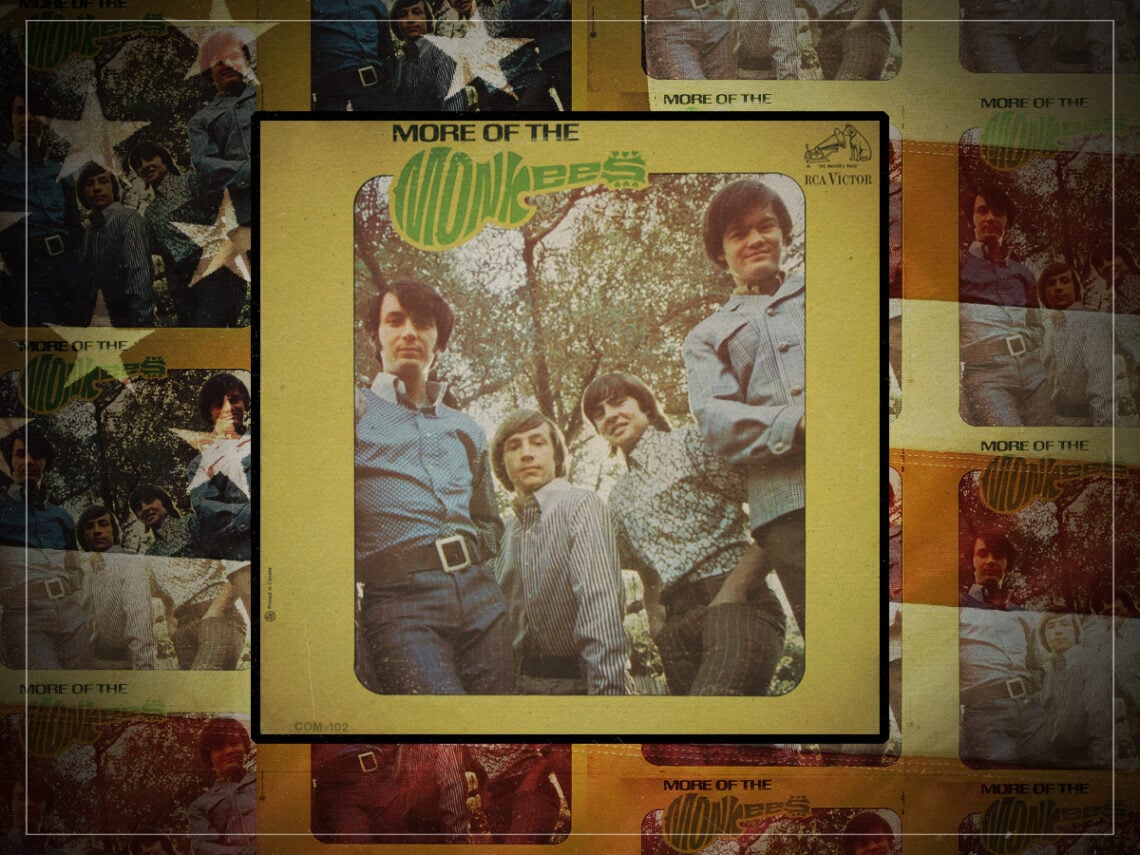
For their sophomore album, the apt title of More of the Monkees was chosen, released on January 9th, 1967, and as expected, it shot to the number one spot on the Billboard 200 chart beginning on the week of February 11th, where it remained for a staggering 18 weeks. The album featured two of The Monkees’ defining tunes: the lead single, ‘I’m a Believer’, with ‘(I’m Not Your) Steppin’ Stone’ as its B-side, rose to number one, and the latter reached number 20 on the charts.
In 2016, Mickey Dolenz recalled to Rolling Stone that Neil Diamond-penned ‘I’m a Believer’ as “my signature Monkees tune. I can’t explain why it’s proven to be so popular. You can’t reduce art like that, especially collaborative stuff”. Meanwhile, ‘Mary, Mary’, written by Nesmith, became a fan favourite, first recorded by the Paul Butterfield Blues Band the year prior, before The Monkees had their turn.
“This was an early song,” Nesmith recalled about the track to Rolling Stone, “I hadn’t been writing long, but I was interested in finding a place that was between country and blues”.
But, for all of More of the Monkees triumphs, it was also one underlying with tensions that would peak after its release. For one, the album’s creation was rushed to capitalise on The Monkees’ success, even being released without any of the members’ knowledge.
Recorded using session musicians, The Monkees were reduced to only their vocals being included on record, with limited instrumentals of their own sparsely sprinkled throughout. The band disapproved of the album cover, which pieced together images taken for a JCPenney clothing campaign, and they were not even given copies of the album of their own; instead, they had to purchase them from the record store.
The Monkees brought their concerns to Don Kirschner, who oversaw their production and implemented a rule that the four Monkees were only allowed to provide vocals on his productions (Nesmith-produced sessions, on the other hand, saw Peter Tork contribute his guitars). Nesmith campaigned for the band to play their own instruments on their next record, telling the Saturday Evening Post on January 28th, 1967, “Do you know how debilitating it is to sit up and have to duplicate somebody else’s records? Tell the world we don’t record our own music.”
On January 16th, exactly a week after More of the Monkees was released, the band held their first recording session as an independent outfit. More of the Monkees may not have been the album that the band had hoped for (Nesmith even went on to regard it, to Melody Maker, as “probably the worst album in the history of the world”), but the album did cause a sensation, in its own right, and proved that the fanfare surrounding The Monkees had only just begun.
