
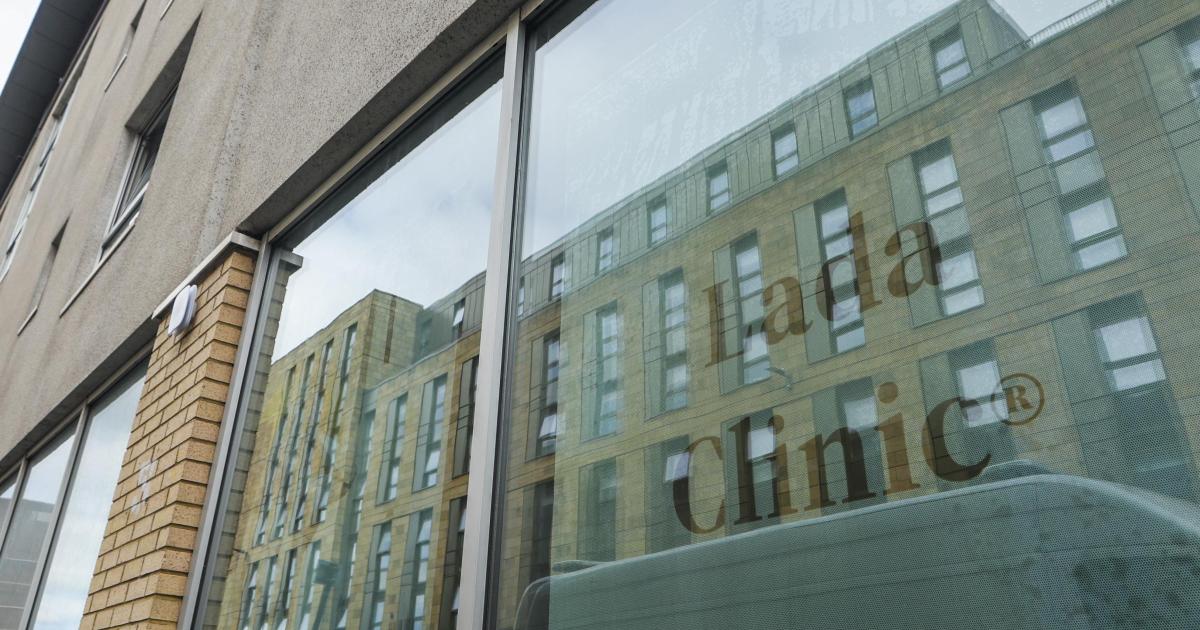
The clinic sees just one client at a time. Its menu moves between Botox, skin lasers and EMFemme 360 alongside menopause consultations, pelvic-floor assessments and investigations into pain or prolapse.
“I wanted to offer time for clients or patients to express how they feel,” Dr Revicky says; his tone is gentle and measured. “I wanted them to understand that this is the place where we will listen.”
The consultant gynaecologist with NHS Greater Glasgow and Clyde wanted to open a space where women could detail what they were going through, and in turn, Dr Revicky could go through options, ensure they understand their own health, and give them confidence. “We provide them a safe, discreet environment,” he says.
Vladinir Revicky of Glagsow’s Lada Clinic. (Image: GordonTerris/Herald&Times)
Revicky calls it “a consultant-led women’s health, aesthetics, and longevity clinic”, created to bring together “medical expertise, time, and a calm environment where women can feel properly listened to”.
More women than ever are flocking to private healthcare. Not as a first choice, but often because it feels like the only option. In November 2025, there were 64,535 people waiting for a gynaecology appointment or procedure in Scotland, according to the Scottish Government’s own Women’s Health Plan. In Glasgow alone, NHS Greater Glasgow and Clyde had 5,650 people waiting for planned gynaecology procedures at the end of March 2025. The median wait was 45 weeks, one of the longest among the mainland health boards published in the table.
Calm, spa‑like waiting area where women finally have time to talk (Image: GordonTerris/Herald&Times)
Female admissions to private hospitals funded by insurance rose from 10,375 in 2021 to 14,980 in 2025, while self‑pay admissions increased from 9,697 to 13,701 over the same period – an extra 8,600 women going private in just one five‑year span. Within that, obstetrics and gynaecology stand out: insured admissions in these specialities grew by around 17% a year and self‑pay by 13%, with gynaecology alone seeing annual increases of 14% (insured) and 8% (self‑funded).
“Analysis of private hospital admissions among female patients in Scotland shows sustained growth between 2021 and 2025,” says Dr Chris Smith‑Brown, clinical adviser at the Private Healthcare Information Network. “Admissions increased for both insured and self‑pay patients, with particularly strong growth in obstetrics and gynaecology.”
Growth, however, was not limited to women’s health services, with specialities such as ENT, trauma, orthopaedics, and ophthalmology also recording substantial increases, he added.
“Long NHS waiting times are certainly a factor in why some women choose to access care privately,” says Melanie Tipples, vice president at The Royal College of Obstetricians and Gynaecologists. “Women deserve timely, personalised gynaecological care close to home, and true choice in how they access it – this relies on NHS care being equally accessible.”
The figures sit within wider service problems (in March 2025, 59% of NHS outpatients in Scotland had waited more than 12 weeks for an appointment, up from just 25% in March 2019), but the burden of the delays stands out even more starkly in women’s health. Symptoms can be chronic, intimate, and misunderstood, even by people living with them.
For endometriosis, a chronic and painful condition, the average time from first GP visit to diagnosis in the UK is now nine years and four months. In Scotland, it’s worse still: 10 years and two months, the highest average of any UK nation. Thirty-nine per cent of respondents to Endometriosis UK’s recent survey said they had seen a GP at least 10 times before endometriosis was suspected. For ethnically diverse communities, the average diagnosis time reaches 11 years.
Vladimir Revicky of Glagsow’s Lada Clinic. (Image: GordonTerris/Herald&Times)
Scotland’s Women’s Health Plan Phase Two, published in January, promises to transform gynaecology services through a national plan, but the policy commitment has yet to make a difference on the ground.
Emily Turner, whose name has been changed to protect her privacy, has just left her GP’s office when we speak. Her painful periods are becoming more and more unbearable, so she reluctantly made an appointment to see the doctor about endometriosis. Her female GP suggested hormonal contraception, a commonly prescribed treatment, but the side effects have ruled it out as an option for Turner. She was prescribed a strong painkiller instead, and told it would take at least a year to be seen by a gynaecologist for a first examination, then about four years after that before she could expect an endometriosis diagnosis.
The 26-year-old oscillates between waves of anger and defeat. “So, it’s technically five years, which is insane,” she says, pausing to gather her thoughts. “If I want anything done with it, I’m going to need to go private. With the cost of living, my wage doesn’t stretch far – I don’t have much left at the end of the month. Even if I get a payment plan, it’s going to skin me.”
It’s left her weighing up what is worse for her overall health: pain that stretches across a never-ending week each month or the stress of trying to do something about it. Her GP suggested going private if she could. “In her words, she doesn’t know why the NHS is like this, why it takes so long,” she says. “My long-term partner has been to the doctor for his health, and has never come across a five-year waiting list for something.”
Bouclé sofas and soft light, not plastic floors and harsh strip bulbs (Image: GordonTerris/Herald&Times)
Turner explains feeling increasingly abandoned by a system she has contributed to during her working life. “Why am I contributing to that if I’m essentially being forced to go private anyway?” she says. “I’m not getting basic healthcare. I don’t know how that’s going to affect me in the future.”
Fiona Campbell, whose name has also been changed, went for a routine smear test. The results came back around six weeks later and her heart sank: they were abnormal. She was invited for a colposcopy examination to establish whether the abnormal cells might need treatment, then told the wait would be around 56 weeks.
“I paid for the colposcopy because the wait time was over a year,” the 29-year-old says. She had anxiously called the helpline on her leaflet in search of answers, some sort of explanation about what she was waiting for. “They told me the only alternative would be to exercise private healthcare routes; that was the only alternative. They didn’t say anything else.”
For peace of mind, she paid just over £1,000 for a private colposcopy. She has a good job, she says, but the calculation was not really financial. “If I was waiting a year and a bit, I would have just been really, really anxious.”
Only afterwards did she learn, through friends and healthcare contacts, that colposcopy waits are triaged according to the degree of abnormality. Her smear result was apparently at the less urgent end of the scale; the year-long estimate was not necessarily the wait she would have faced. But no one had explained that distinction when she called. If they had given her reassurance, she says, she would not have spent the money, she says.
Charlotte McCann, 27, spent most of her teens and early twenties in a quest for a diagnosis. After seven years of appointments, blood tests, ultrasounds, and contraception, she still had yet to make it onto an NHS waiting list and opted to pay for surgery herself to find an answer to the pain that regularly had her vomiting at night, convinced she had appendicitis. “I had to go private for that surgery because I’d been seeking advice for about seven years, and I hadn’t even got as far as getting on a waitlist,” she says. “They’d done blood tests and ultrasounds, and changed my contraception, but never even considered endometriosis.”
Vladinir Revicky of Glagsow’s Lada Clinic. (Image: GordonTerris/Herald&Times)
The private operation found stage‑three endometriosis. “I spent seven years chasing answers and being told nothing’s wrong,” she says. “Even though being told, ‘It’s incurable, and there’s not a lot of treatment,’ at least you’re believed. You know there is something wrong.”
Five years later, she’s in Aberdeenshire, back in the system, and the disease has progressed: her bladder and uterus are now tethered together; the ligaments between her pelvis and lower back are “completely covered” in endometriosis. She walks with a stick, has handrails around the house and is “just exhausted and in pain all the time”. “I used to work in a school, I used to do corporate finance,” she says. “Now I can’t be sat up for eight hours, and I can’t be well on a schedule because I just don’t know when I’m not going to be well enough.”
This time, she isn’t in a financial position to go private. Because of a separate condition, most hormonal treatments clash with her medication; the pain clinic has a wait of more than a year; the gynae wait in Aberdeenshire is “two years plus”. An MRI has now pushed her case to a multidisciplinary team, after “multiple organ involvement” was spotted (likely stage four endometriosis) but she’s been told not to expect a call until the end of the year.
“It’s like you’re asking me to pick whether to be in debilitated pain or to be so suicidal that I might not be alive,” she says softly. “They’re trying to make me pick which bad I would prefer, when really you want less bad.”
In the meantime, she spends a lot of time “sitting in the dark”, chasing professionals just to find out if she is still on a list, what the list is for, and how long it might be. “If they can’t make the reality of the wait times better right now, they could make the communication better,” she says. “If they can’t fix the waiting times, they could at least fix the information you’re given.”
Dr Nóra Murray-Cavanagh, deputy chair of BMA Scottish council, says the boom in private providers, including women’s‑only clinics, is a symptom of an NHS that can’t keep up with demand. More and more Scots, she argues, are “forced” towards private care because they can’t get what they need on the NHS – a shift that only people with money can make, and one that inevitably widens health inequalities.
She warns that Scotland has “drifted” into a two‑tier system, where those who can pay are far more likely to get timely care. That, she says, undermines the founding promise of an NHS free at the point of need and deepens existing inequalities. Patients value being able to see the same doctor, and evidence shows that continuity improves care and reduces emergency use, but, she insists, the NHS can only deliver that if it’s properly resourced.
Catherine Murphy, executive director of Engender, says that a tiered system is already a reality for Scottish women. Those in the most deprived communities, she notes, can expect around 25 fewer years of good health than women in the most affluent parts of the country.
“Gender discrimination and medical misogyny are deeply ingrained within Scotland’s healthcare systems,” she says. “Women wait longer for diagnosis and treatment than men and are more likely to have health concerns dismissed by doctors. Specific groups of women are at higher risk of harm from these biases, including women living in poverty, women of colour, LGBTI+ women and disabled women.”
Murphy says it’s no surprise that more women are turning to private providers to plug gaps in care, but warns that this “risks making inequality worse”. Women are already less financially secure than men, she points out, so paying out of pocket for treatment piles extra strain on those who can afford it and leaves women who can’t pay at even greater risk of harm.
She criticises the Scottish Government’s recent decision to downgrade the Minister for Women’s Health role, noting that more than 35 organisations have challenged the move. What’s needed now, she argues, is a renewed focus on women’s health, backed by ring‑fenced funding aimed specifically at the needs of women who are already marginalised.
Pelvic‑floor tech and skincare devices in a warm, timber‑lined space (Image: GordonTerris/Herald&Times)
Dr Revicky is a consultant gynaecologist and consultant subspecialist urogynaecologist at NHS Greater Glasgow and Clyde alongside his private clinic work. In essence, he works on both sides of the divide. He is careful in his definition of what Lada Clinic is, and what it is not. “This is not a replacement for the NHS,” he says. “This is just an addition for people who feel they would like to have private care.”
And there is a distinction. Lada cannot refer a patient directly to NHS treatment. With the patient’s consent, Dr Revicky sends consultation notes and recommendations to their GP, who can then make an NHS referral or discuss the next steps with them. Patients can use the clinic for advice, an examination or a scan, then choose whether to continue privately or return to the NHS pathway. Dr Revicky says prices are discussed before any test or treatment, and that pursuing NHS care remains an option.
Amid the muted colours and organic furniture shapes of the clinic is a collection of high-tech devices, a smorgasbord of the latest technology in health and aesthetics. There’s the EMSELLA, an electromagnetic chair marketed for urinary incontinence and pelvic-floor weakness (common after childbirth and around menopause). Dr Revicky explains that clients sit on the chair for about 30 minutes, fully clothed, and can see results after half a dozen sessions.
Vladinir Revicky of Glagsow’s Lada Clinic. (Image: GordonTerris/Herald&Times)
Bouclé sofas and soft light, not plastic floors and harsh strip bulbs (Image: GordonTerris/Herald&Times)
EXOMIND, a branded TMS treatment, uses magnetic pulses to stimulate areas of the brain linked to mood and cognition. Other devices use radio frequency and ultrasound to improve skin firmness and texture, or to target “stubborn fat”.
In his two-plus-decades in the NHS, Dr Revicky says he has watched how tightly women’s health, confidence, and quality of life are braided together – and how rarely problems occur in isolation. Pelvic floor issues bleed into bladder problems, skin changes, brain fog, disrupted sleep. “They can feel like they don’t feel themselves,” he says.
He makes clear that opening Lada was not intended to be a slight on the NHS. “I’m respectful and grateful for the NHS; it is not a criticism of the NHS,” he says. Clinicians, nurses, and doctors work under “extreme pressures”, he adds, and time constraints mean explanations are not always detailed, which leaves women feeling ignored.
What strikes him, he says, is how often women feel better before anything medical happens. “Even without any major treatments, they feel actually better because they were able to express what they’re worried about,” he says. Simply naming what hurts is “healing”, and he describes his job, quite simply, as “to make people feel better.”
Thinking back to the opening night –at Lada, when the room briefly turned into an impromptu group therapy session, he says it underlined the simplest need: “People should have time and space and a safe environment to talk about the problems,” he says. “Nobody should feel dismissed. Nobody should feel that, ‘Oh, I have to just live with it.’”
What the clinic is really about, he says, is taking women’s health in the round. “It’s never just one condition,” he says. “Women’s health is a complex issue. It should be addressed as a complex, not just a piece of diagnosis or one treatment.”
Lada, in his mind, exists to look at health, confidence and quality of life together. And to make it “absolutely normal” to talk about the worries that come with that.
Marissa MacWhirter is a columnist and feature writer at The Herald and editor of The Glasgow Wrap – a free daily newsletter curating the best of Glasgow’s local news, delivered each morning without ads, clickbait, or digital clutter. She can be found on Instagram, X, and Bluesky.