
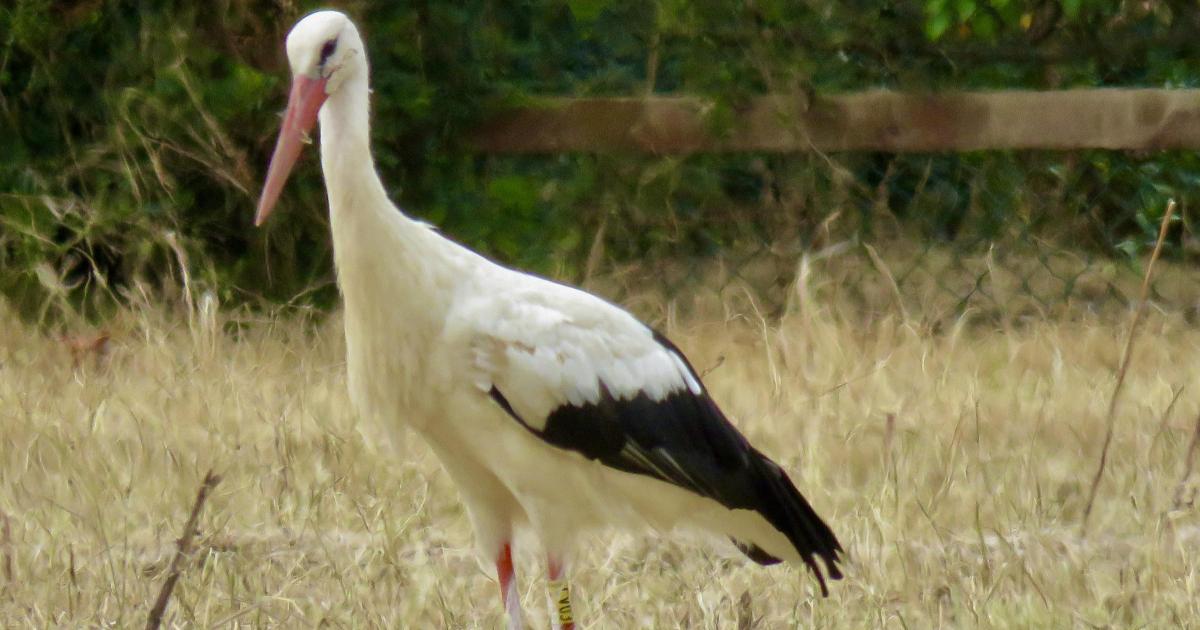
Cumnor Hill man Peter Scatchard spotted a white stork on a field between Norreys Road and Chawley Lane, on the edge of Oxford.
The white stork hasn’t been a regular native breeder in the UK for centuries.
Large numbers typically breed in Poland, Spain, Germany, central and eastern Europe as well as north west Africa and parts of the Middle East.
White stork spotted at Cumnor Hill, near Oxford (Image: Peter Scatchard)
In the winter, they migrate down to the Sahara and southern Africa – but are not often seen in the UK.
However, a reintroduction programme in West Sussex has released captive‑bred and rehabilitated white storks since the late 2010s.
READ MORE: Utility faces £60k fee over ‘unauthorised’ Oxford slip road closure
In 2020, a pair bred successfully in the UK for the first time in roughly 600 years, at Knepp.
Mr Scatchard said: “Was anyone on Norreys Road expecting a ‘delivery’ (sic) these past few days? And who says Global Warming is an issue?
“A very rare sight anywhere in the UK, even more so in Oxfordshire.
“This [was spotted] after the field was mown and baled on Sunday, August 2, and our stork took advantage of the feast of insects and animals killed and injured during the mowing.”
He reported the sighting to the RSPB and White Stork Project.
The British Trust for Ornithology now describes the white stork as having a “small breeding population in southern England, the result of a reintroduction attempt,” with numbers and sightings increasing.
Rewilding Britain reports that over 250 white storks have been released across southern England (Surrey, West Sussex, East Sussex) as part of the White Stork Project.
White storks prefer open landscapes such as wetlands, floodplains, grasslands, meadows, pastures and agricultural fields, usually with shallow standing water nearby.
They are an opportunistic carnivore/omnivore feeding on insects, earthworms, frogs, fish, reptiles, small mammals, and occasionally eggs or chicks of ground‑nesting birds.
The latest rare find comes after another unlikely spot in the form of a long-tailed shrike in late July.
Twitchers from afar rushed to the Oxfordshire Cotswolds’ border with Gloucestershire to see the Asian-native bird.
It represented only the third British record of long-tailed shrike, with the first sighting only being in the Outer Hebrides in November 2000.
Birdwatchers were able to locate the shrike on July 19 and it has remained on view ever since, attracting hundreds of people to flock.
Josh Jones of BirdGuides said: “This is a truly extraordinary inland occurrence of what is an extremely rare visitor to Europe from Asia.
“There have only been about 15 European records ever.”