
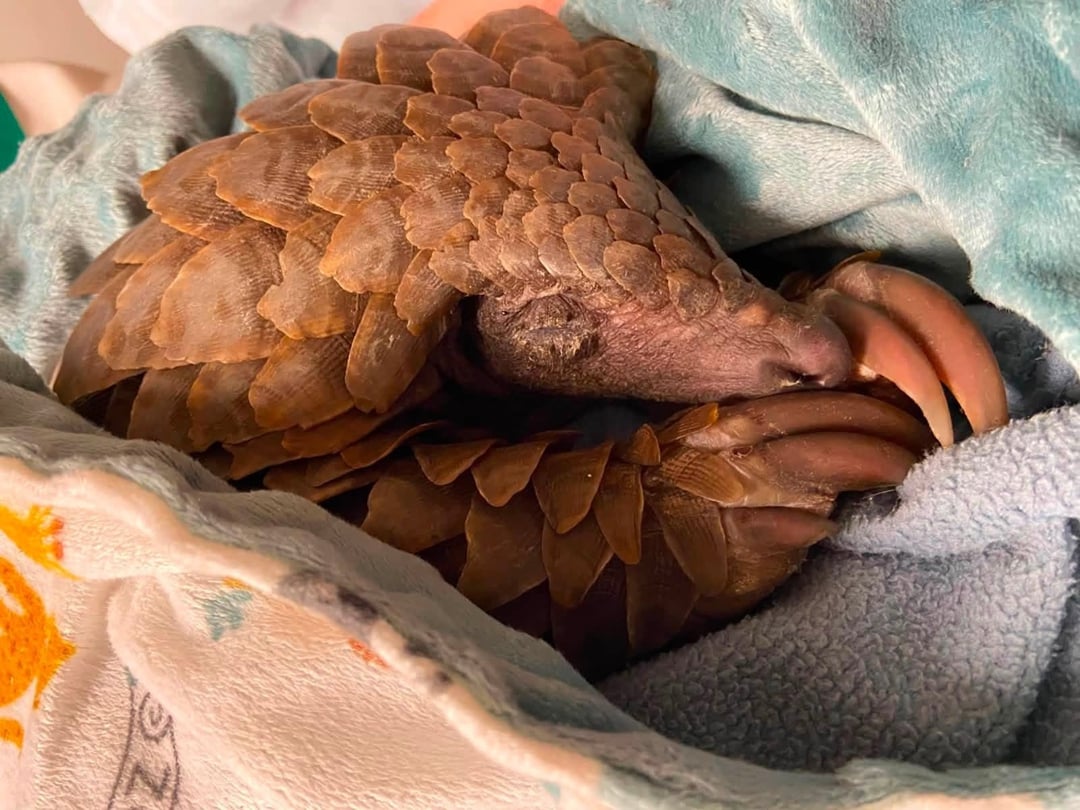
A starving Temminck’s pangolin named Percival was rescued from the boot of a car during a sting operation in the Western Cape, and five poachers were arrested. Despite round-the-clock care from veterinarians across two provinces, Percy remains in critical condition with a long, costly recovery ahead. Pangolins are the most trafficked mammals on Earth, poached every five minutes for their scales, meat, and blood.
A sting operation by the Malmesbury Stock Theft Unit in the Swartland Local Municipality found and rescued a male Temminck’s pangolin. Percival, found starving in a drum in the boot of a car, was immediately given over to Asgar Vahed for a chance at survival.
Vahed, a Cape Nature Environmental Management inspector, was on leave at the time. But he sprang into action. The sub-adult male pangolin (a young pangolin that has weaned but is not fully adult) went to several veterinary practices, but none felt equipped to help the pangolin, which is extremely sensitive to stress, until Dr Lynne Klug at the Malmesbury Animal Hospital was willing to attempt to stabilise Percy.
Dr Klug was guided by the team at the Johannesburg Wildlife Veterinary Hospital, which is one of the very few organisations that have successfully rehabilitated poached pangolins.
Speaking to News24, Wendy Willson, co-director of the Johannesburg Wildlife Veterinary Hospital, said it took 12 hours for Percy to stabilise. And in that time, none of the parties involved got any sleep. But Percy wasn’t getting any better, and the decision was made to send him to a secret location in Gauteng where the Johannesburg Wildlife Vets could try to help him.
Never leaving Percy’s side, Vahed accompanied Percy on an Airlink flight to get him the necessary care he needed.
But while he is getting the best care, Percy is still in critical condition, and Willson said he had a long road ahead to recovery.She predicted he could have been with the poachers for several weeks because the animal is not found in the Western Cape, so the poachers would have caught him in the north of the country and travelled down with him.
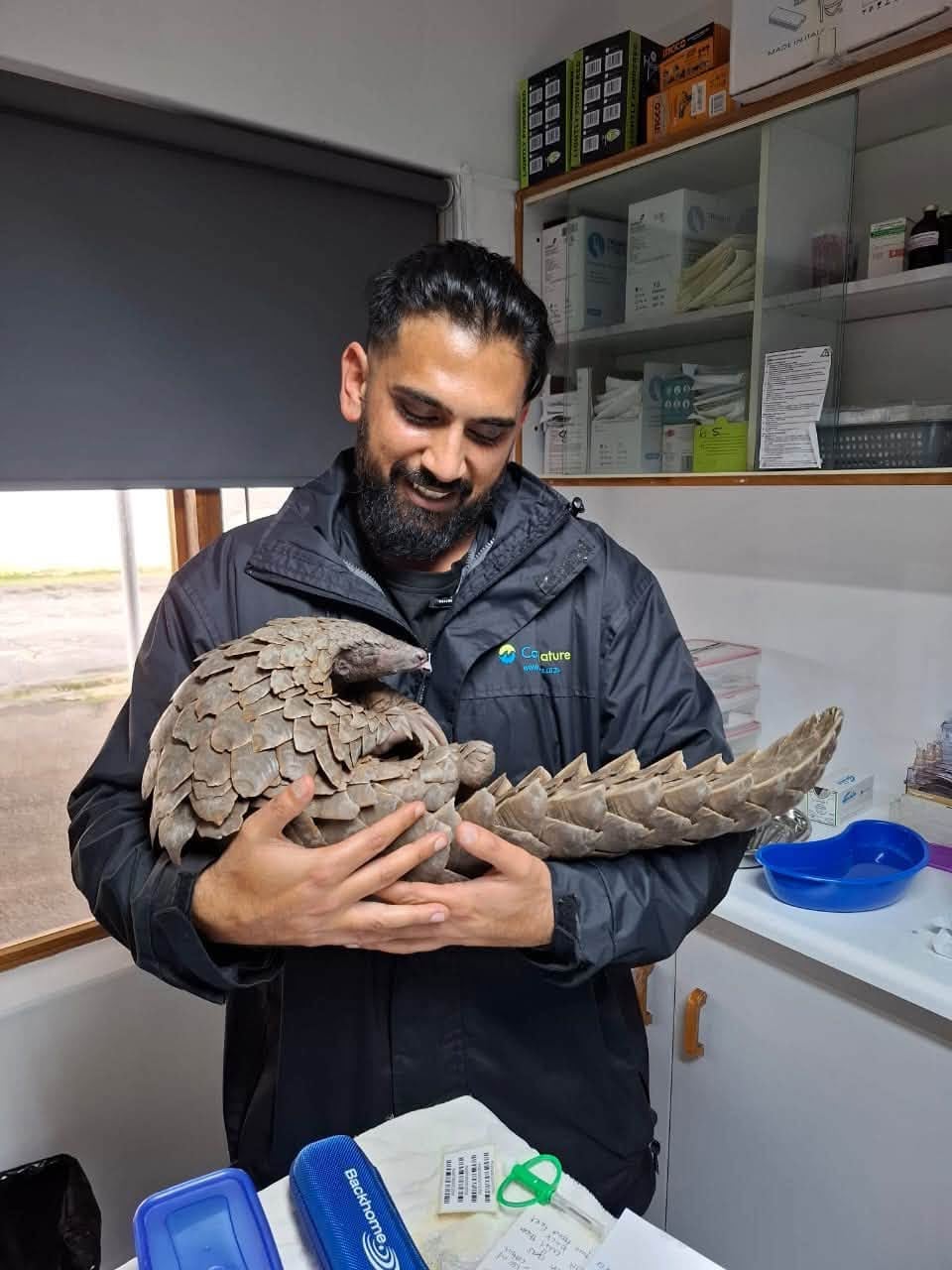
Asgar Vahed, a Cape Nature Environmental Management inspector, with Percy.
Johannesburg Wildlife Veterinary Hospital/Facebook
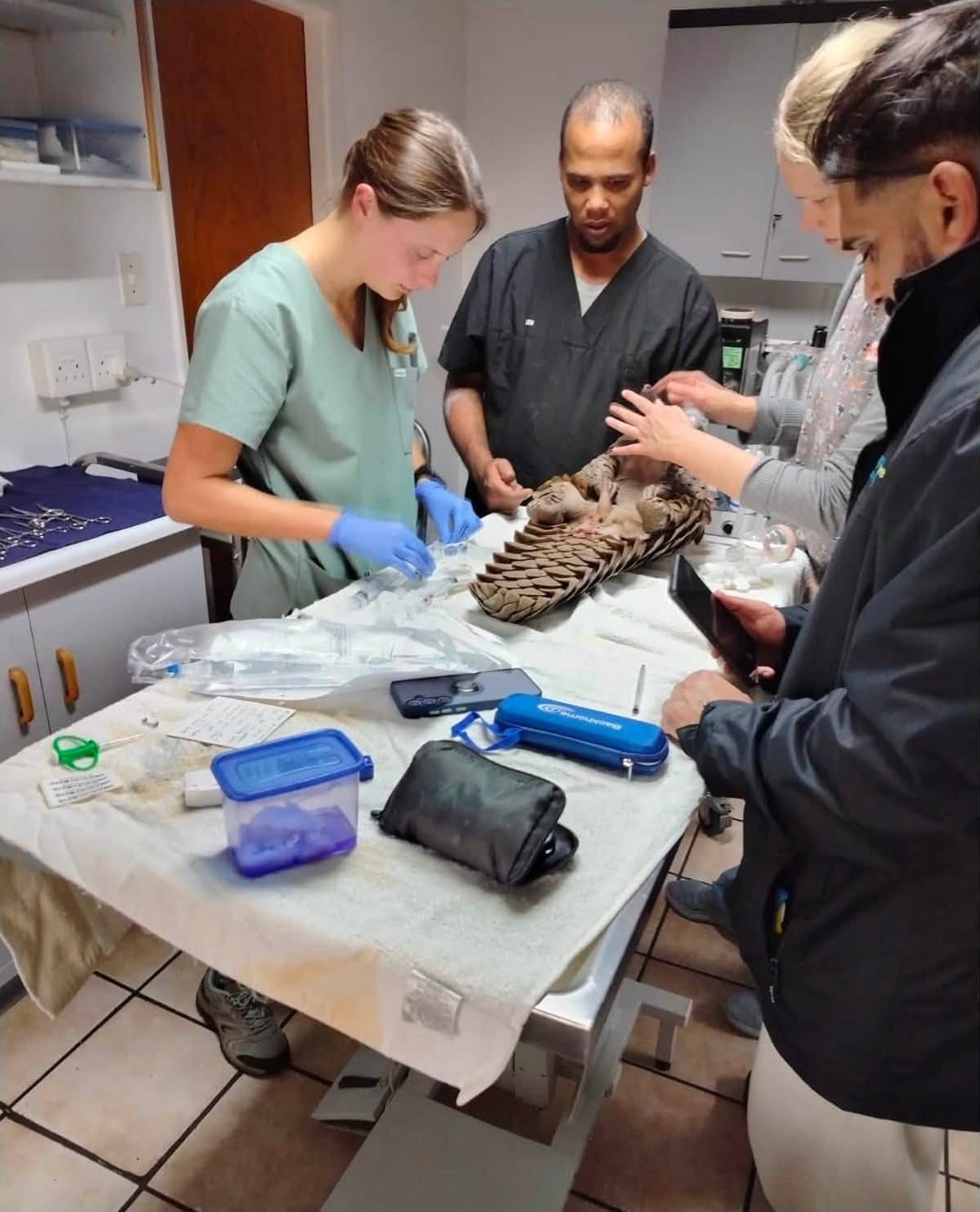
Percival’s condition is still critical.
Johannesburg Wildlife Veterinary Hospital/Facebook
“He would have been moved around. [Poachers] often put them in sacks where they are not fed.
“The trauma is both physical and mental,” she said.
Percy is the 217th pangolin the Wildlife Vets have received. Because the creature is so highly valued, it cannot be housed at the centre and must be hidden in a secret location.
Willson said that it is not known exactly how many pangolin are left in the wild because they are such a secretive species. She said there had been an increase in pangolin poaching since 2019, with poachers moving further down into southern Africa as the animals’ numbers declined.
While this is one of the most poached animals in the country, she said the poaching we discovered was “just the tip of the iceberg.”
READ | Shumi the pangolin’s incredible journey from poaching victim to wildlife freedom
To make things worse, they are very difficult to rehabilitate. Especially the Temminck’s pangolin, which won’t eat ants from a bowl, “they need to walk for kilometres to feed. There is no plan B” for them.
Willson said that Percy had to be placed on IV fluids and had X-rays and sonar scans when he came to the vets, but she said that while he has good and bad days, “many [health issues] can manifest over the days to come.”
She said the pangolins treated at the facility take weeks and even months to recover from their ordeal, as each individual responds differently and has a different personality. She said it costs the facility R25 000 a day while the animal is in hospital.
Five people were arrested for poaching Percy. A police statement released at the time said the men were arrested on Friday, 17 July, following a tip-off about a planned pangolin sale at a petrol station on the N7 in Malmesbury.
It said that when they spotted the maroon VW Polo parked at the back of the petrol station, they made their move, searching the vehicle and finding Percy in the boot, inside a white drum. Five people aged between 28 and 53 were arrested for possession of an endangered species.
Willson said the different teams working together were the reason the arrest was successful. She said joint initiatives with multiple agencies would make pangolin crime less attractive.
“Even if people have no empathy for a poached animal, they should realise that no crime happens in a vacuum. People may not worry about a pangolin, but they should worry about other crimes,” she said, adding that the routes taken by poachers are usually the same routes taken by criminals trafficking drugs and even human traffickers.
ALSO READ | Conservationists boosted by report finding ‘major disruption’ in pangolin trade
Willson said that once Percy is healed, he will have a “monitored release,” during which environmentalists will ensure he settles into his new environment.
Willson said there were eight species of pangolin in the world. Four in Asia, the Indian pangolin, Philippine pangolin, Sunda pangolin, and Chinese pangolin, and four found in Africa, including the giant ground pangolin, Temminck’s ground pangolin, the black-bellied pangolin, and the white-bellied pangolin.
The pangolin found in South Africa is the Temminck’s ground pangolin, which occurs in the northern part of the country, according to Willson.
According to Pangolin.Africa, a South African NPO, the African pangolin is “the most highly trafficked wildlife species on Earth”. It claims that, statistically, a pangolin is poached every five minutes.
The NGO states on its website:
The situation facing the African pangolin has reached a tipping point. If we don’t act now, this animal could disappear in our lifetime.
They are poached mainly for their scales, which are used in traditional medicine; their meat is considered a high-end delicacy in China and Vietnam; and their blood is considered to be a healing tonic in eastern medicine. Besides poaching, they are also threatened by habitat loss and electric fences.
Pangolins consume around 70 million ants and termites each, keeping ant populations in check and ensuring the health of vegetation.
According to the African Pangolin Working Group NPO, the Temminck’s pangolin is found in southern Africa, eastern Africa, southern Sudan and southern Chad. It is the second-largest of the species, with individuals weighing around 7-12kg and reaching 1.2 metres in length.
They are classified as vulnerable on the IUCN Red List, and their population is believed to be decreasing.