
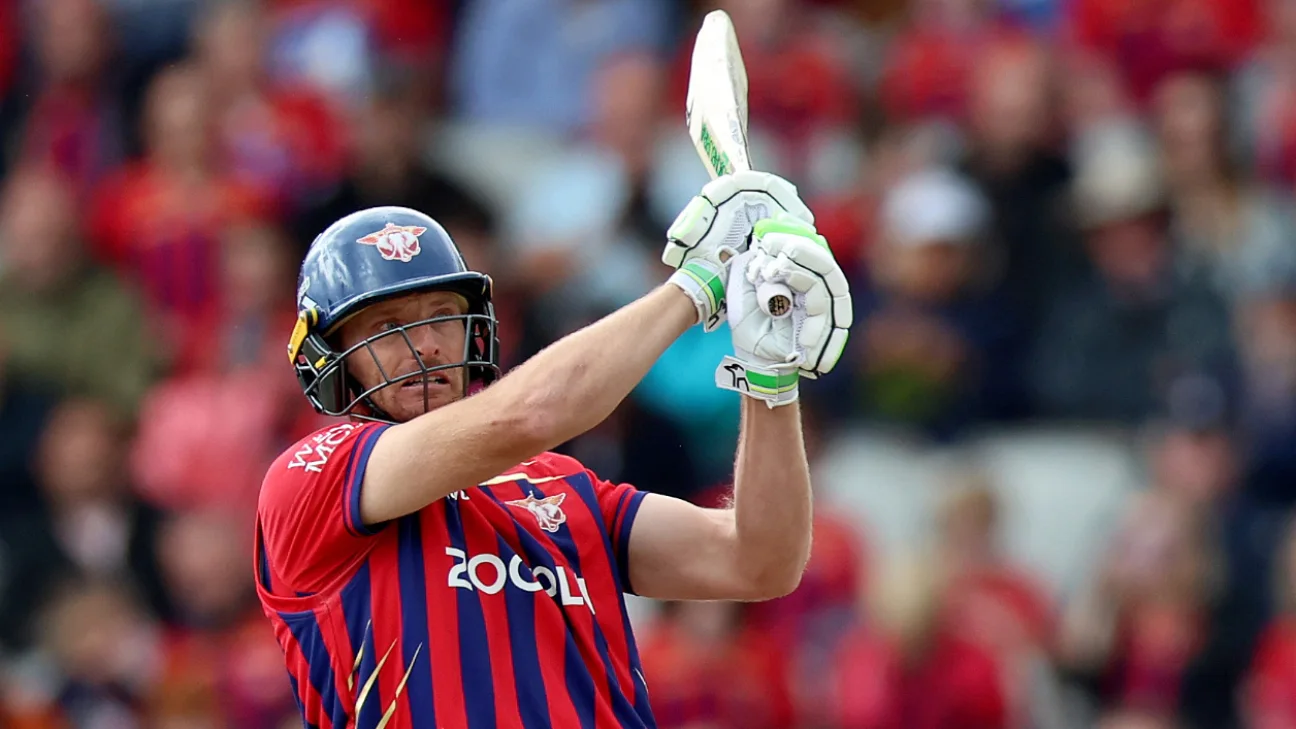
Chris Gayle, who spent 12 years as T20 cricket’s leading run-scorer until he was surpassed by Pollard earlier this year, asked the same question. “Hundred stats added to T20 stats?” he replied to a Cricinfo post on Instagram, with a shrugging emoji.
This is nothing new: statistics in the Hundred – both men’s and women’s – have always counted towards players’ T20 records since the tournament’s first season in 2021.
Why? The most straightforward explanation is that while the format is slightly different – teams bowl consecutive overs from the same end, for example, and the same bowler can bowl two overs in a row – it is also played across 20 overs per side, only with five balls per over instead of six.

Chris Gayle’s reply to Cricinfo’s post•Jiostar India Pvt Ltd
The ICC’s classification of ‘official cricket’ makes clear that ‘List A Twenty 20’ status – commonly referred to as T20 – can be granted to “any limited overs match scheduled for one day’s duration and of one innings per side with a limit of 20 overs per side”, along with certain other parameters around standard.
Appendix B of the same document also specifies that both the men’s and women’s Hundred count among the ‘List A Twenty20’ tournaments played in England and Wales.
David Kendix, the president of the Association of Cricket Statisticians and Historians (ACS), said that the decision to include statistics from the Hundred within players’ T20 records suited all parties.
“When The Hundred was being created, ECB sought ICC agreement that the matches would still be classified as official cricket,” Kendix, who also sits on the ICC’s cricket committee, told Cricinfo.
“They didn’t want an event where the statistics ‘didn’t count’. ICC clearly wasn’t going to create a fourth official format of the game when it is played in only one tournament in one country, but nor was it going to say that it wasn’t official cricket because it’s 20 balls shorter than a T20.
“Wearing my various hats, I suggested including Hundred matches within the T20 category. After all, it comprises 20 overs, just each of five balls. This suited ICC, ECB and the ACS.”
Kendix added that the Hundred counting as T20 cricket was no different to ‘List A’ one-day cricket including matches of various durations and with wildly different playing conditions. The same is true of ‘first-class’ status, which has been conferred on matches lasting three, four, five, or more days, and with overs lasting anything from four to eight balls.
“From a historical perspective, this was hardly a great stretch,” Kendix said. “We already have List A limited overs matches of various durations (historically 55, 60 and 65; and still less than 50 when weather affected). So having matches of 20 6-ball overs, 20 5-ball overs plus weather reduced matches all under the T20 banner is equally pragmatic.
“Of course, if people want to split out Hundred stats from the rest, they are free to do so,” he added, “much as you can split out performances in any other competitions.”
Discounting Hundred runs from overall T20 records would mean Gayle was still the format’s leading run-scorer. He would be 29 runs ahead of Pollard, who scored 270 runs across his two seasons as a player in the Hundred, and 921 ahead of Buttler. However, these figures all include runs from rain-shortened T20 matches.
Matt Roller is a senior correspondent at Cricinfo. @mroller98