
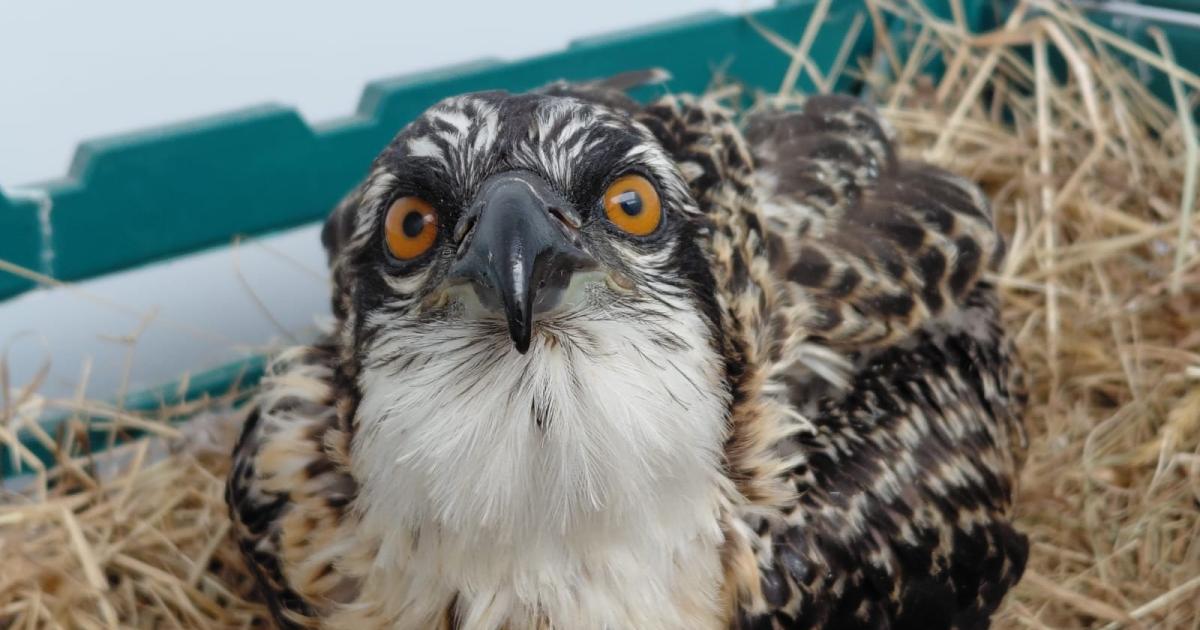
This little family had been doing so well since the chicks had hatched but it became noticeable that food was becoming scarce.
The situation turned bad very quickly with the female FS2 erratically leaving the nest for very long periods, leaving the chicks alone and Eli their dad nowhere to be seen either.
The chicks father Eli eventually brought food, but only the larger chick ate as it bullied and pecked the smaller sibling away from the fish (Image: Tweed Valley Osprey)
When Eli did return with fish, FS2 was not there to feed the chicks, so he began to try to feed them but that is when the biggest chick then turned on the smallest chick and began to attack it, pecking the back of its neck and trying to push it from the nest.
This set a pattern then, at each mealtime with the larger chick preventing the small chick from coming near for food and it just shut down, head tucked in, hunkered and trying to keep from getting attacked.
The biggest chick began to attack the smaller sibling, pecking the back of its neck and trying to push it from the nest (Image: Tweed Valley Osprey)
It started to become weak. Things did not improve even when FS2 returned because the biggest chick would attack the smaller one and it had no food for at least 50 hours; it was weak and becoming dehydrated and so the decision was taken to intervene.
We did not think that it would survive another 24 hours on the nest. So far since it is out of the nest it has picked up, gained in strength and is eating.
Eventually a pattern was set, with each mealtime leading to the smaller chick shutting down, with its head tucked in, hunkered and trying to not get attacked (Image: Tweed Valley Osprey)
We are continuing to monitor the nest closely to see how food supplies are faring. It is too early to predict any kind of outcome yet for any further decisions to be made regarding the reintroduction of the chick but for now it is safe, gaining weight and is standing up again.
The biggest chick began to attack the smaller sibling, pecking the back of its neck and trying to push it from the nest (Image: Tweed Valley Osprey)
At another of the Tweed Valley nest sites visited for ringing it was discovered that there had been a change of adults which had taken over the nest.
The un-ringed female was noticeably different in her behaviour being calm unlike her predecessor that was quite an aggressive bird. On getting a closer look and capturing a photo of the male bird it was discovered that he has a Darvic ring on his right leg and the number 433.
433 Emblehope Kielder (Image: Stuart Blaik)
This is a Kielder bird called Emblehope that came from a brood of three. His sister has also been spotted in Wales but has not bred successfully yet.
So, it is encouraging that Emblehope and his partner are parents to two fine chicks this season in Tweed Valley and they have been ringed 1X8 and 1X9 and both have successfully fledged.
We have heard that Tweed Valley osprey 731 was spotted in Northumberland on August 1 with another osprey flying overhead. He is from a brood of three males in 2023 in the Tweed Valley area.
1X8and 1X9 (Image: Tony Lightley)
There have been no sightings of his brothers since fledging but 731 was seen last year on his first migration return at Wakefield and Kielder, then he was spotted again in April on this year’s return.
It seems he likes the Northumberland area, so hopefully we may hear news of him perhaps settling there next season.