
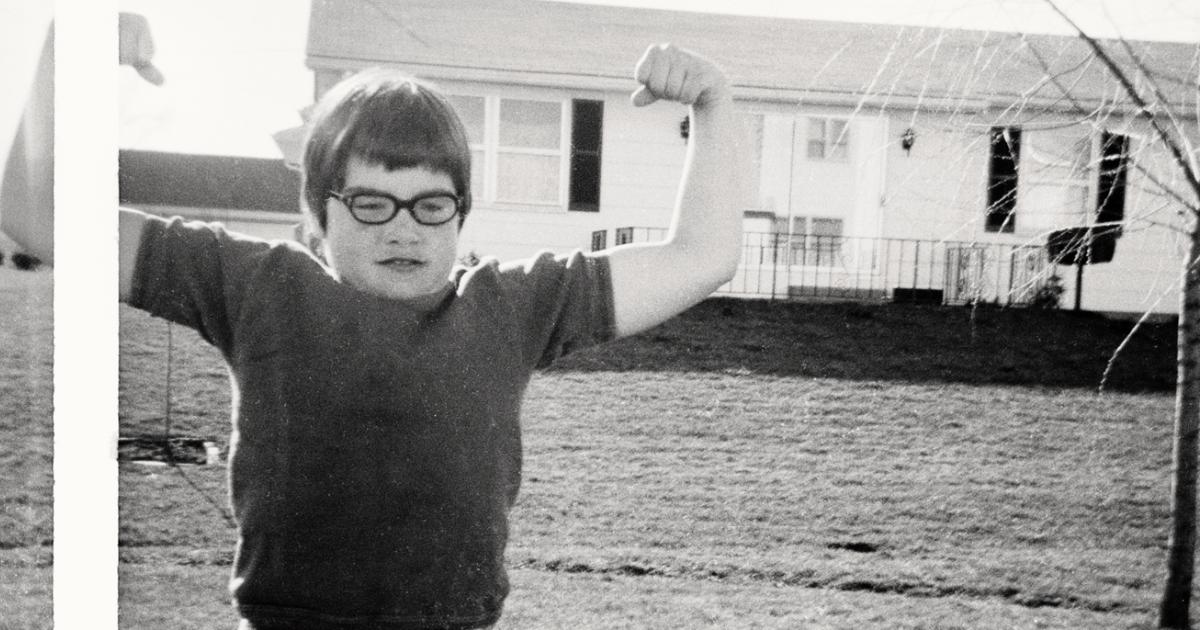
The first three frames Opie shot on her first ever roll of film were of her family. The fourth was a self-portrait: a black and white image revealing a girl in thick-framed spectacles, black t-shirt and floral print trousers making a determined muscleman pose.
“I decided to show myself to me,” she would say later. “I wanted myself represented that way, as a strong little girl.”
It isn’t the largest or most eye-catching image in this expansive retrospective, opening in Edinburgh after a three-month run at London’s National Portrait Gallery. But in many ways it’s one of the most significant.
Catherine Opie, Self Portrait, 1970 (Image: Catherine Opie)
Artist Catherine Opie photographed at her National Galleries of Scotland exhibition (Image: National Galleries of Scotland)
As the exhibition title demonstrates and as Opie herself stresses during a press tour of the Royal Scottish Academy’s vast halls – her actual words: “Without representation there is no visibility” – she has spent her career making herself seen and, importantly, the wider Queer community of which she is a part.
Accordingly the large rooms are peppered with portraits of Opie’s friends and acquaintances, mostly from Los Angeles, where she has lived since the late 1980s. People such as the boundary-pushing performance artist Ron Athey. Or the fearless Steak House, who had the word ‘Dyke’ tattooed on the back of her neck in the sort of Old English font more familiar from Death Metal band t-shirts. Opie photographed her naked torso from behind in 1993, the backdrop a rich blue damask wallpaper such as you might find in those carpeted art mausoleums in which Old Masters hang.
Or how about her good friend Pig Pen, a regular subject? They are seen in the black and white Girlfriends series, in 1991’s Being And Having series (a study of Opie’s friends in what’s described as the ‘West Coast leather dyke scene’) and once more in a larger colour studio print, wearing a white vest and cut-offs, and with a Hallowe’en pumpkin tattoo on each knee.
Read more Barry Didcock
That image is paired with one of American conceptual artist Justin Bond and is part of a series made in the peak years of the AIDS crisis in the mid-1990s. Bond died from an AIDS-related illness in 1999, aged just 33. The Being And Having series, meanwhile, also features Opie as the moustache-wearing Bo, a persona she created and who features elsewhere.
Intriguingly, Opie has collaborated with curators in Edinburgh and London to pair many of her own works with paintings from the respective national collections. So as well as championing visibility, she invites reflection and dialogue. And so you have a 2004 self-portrait showing her naked from the waist up as she breast feeds her baby son, Oliver, alongside Madonna And Child In A Garden, an anonymous Dutch work from around 1500.
You have Picasso’s 1902 work Mother And Child placed next to a domestic scene of a Queer couple in a leafy North Carolina garden. You have Sir John Baptiste de Medina’s huge, collage-like 1695 group portrait of the family of the 1st Marquess of Tweeddale facing 12 grouped, multi-generational portraits of the family of Katy Barkan, a frequent collaborator who also designed this exhibition.
There’s juxtaposition of a different sort in a series of four documentary works in which Opie contrasts images from Barack Obama’s 2009 inauguration with a 2010 rally by the right wing Tea Party, the ideological forerunner of Donald Trump’s MAGA movement.
Catherine Opie’s Chloe from 1993 (Image: Catherine Opie)
Catherine Opie, Pig Pen, 1993 (Image: Catherine Opie)
Also in the pairing of an image of attentive Boy Scouts listening to a speech at a jamboree with a shot titled Butches Are My Hope For The Planet, taken at a women only music festival in Michigan. Meanwhile in the examples from her High School Football series and an abstract landscape of the Dover cliffs you can see her investigating more general ideas about physicality and how we use space.
Opie uses a range of cameras for her portraits, working mostly with medium and large formats. It results in images of incredible detail, even when they themselves are huge.
The backdrops, meanwhile, are generally coloured. Red is a favourite, but there are also yellows, greens, purples and blues. The gallery walls have been painted accordingly. But for one of the most striking collections of images, the Portraits And Landscapes series begun in 2012, Opie uses a black velvet backdrop and dramatic spot lighting instead. It means her subjects – among them the film-maker Isaac Julien, novelist Jonathan Franzen, a now much older Oliver (with his pet mouse Mrs Nibbles) and sexagenarian long-distance swimmer Diana Nyad – emerge out of the darkness, almost as if in a painting by Caravaggio.
But if the rest of the 80 or so images lack that sense of the theatrical, they’re no less powerful or engaging because of it. Rigorously academic but also playful, emotional and open, Catherine Opie’s work shines a light on large and important social and political themes – but it never loses sight of its human components.
Barry Didcock is an Edinburgh-based Herald writer and freelance journalist specialising in arts, culture and media. He can be found on X at @BarryDidcock