
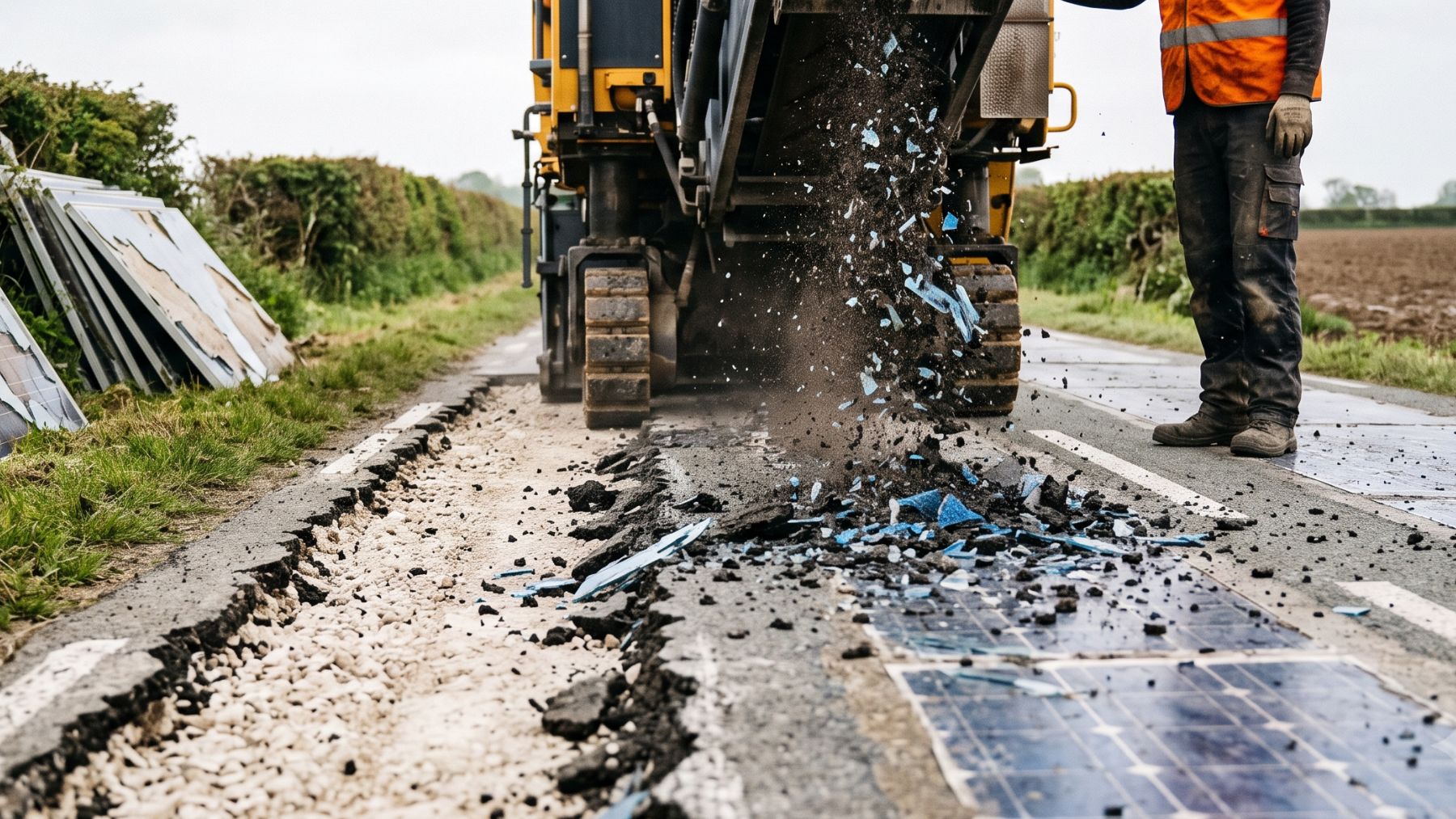
A milling machine went down a rural lane in Normandy in late May and started chewing the road surface out.
Underneath it were photovoltaic panels, bolted flat into the carriageway eight years earlier.
The council had voted in February to take the whole thing out, and the work took about two weeks.
The interesting part of the solar road is not that the experiment ended.
It is that every reason it ended was known in advance, and printed, before the first panel went down.
Two weeks with a grinder
The municipal council of Tourouvre au Perche voted in February of 2024 to have the surface removed.
The reasons given were constant repairs and the way the failing sections were getting in the way of local access.
Demolition started on the twenty seventh of May and was scheduled through the seventh of June.
By then the installation was already a patchwork, because sections had been pulled out and replaced twice, once in 2020 and again in 2021.
Those replacements covered only a few hundred feet of the original run.
The Wattway director called the experiment a success anyway, saying the surface laid in 2020 went on to be sold at fifty sites, and that this road type is not suited to fast traffic.
What it was built to do
The opening was a national event on the twenty second of December in 2016, with the environment minister on site.
The specification was tidy. About 30,000 square feet of panel, laid over two thirds of a mile of an ordinary rural road.
Related
The bill came to just over 5 million dollars, paid out of state funds, for a stretch you can walk in twelve minutes.
The stated target was 790 kilowatt hours a day, which is enough to run the street lighting of a town of roughly 3,400 people.
It was designed to carry about 2,000 vehicles a day, which is the detail most retellings drop.
This was never a sealed test track. It was a working lane in farm country, and being driven on was the entire point of it.
Three things went wrong at once
The panels came loose first. Joints cracked, laminate peeled back, and roughly 300 feet of the surface had to be destroyed and carted off as early as 2018.
Farm traffic was part of it, because a loaded tractor flexes a road surface in a way a car does not, and glass laminate does not like being flexed.
The second problem was sound. The resin coating rattled loudly enough that the speed limit was cut to 43 miles an hour.
Then the production figures came in. The first year produced around 150,000 kilowatt hours against a projection near 288,000.
The next full year came in at about 78,000, and the first half of the year after that at roughly 38,000.
Revenue followed the same curve down, from an expected 11,000 dollars a year to about 3,300 in practice.
Why flat is the worst angle there is
None of this comes as a surprise if you start from the physics rather than from the pitch.
A panel wants a tilt, because tilt is what points it at the sun and what lets rain rinse it clean.
Related
A road panel gets neither. It faces straight up, it sits in its own dirt, and it has no air underneath to shed heat.
Then add shade from every passing vehicle, leaf litter through autumn, road grit year round, and the load of everything that drives over it.
The comparison that settles it sits in the United States. A drive over lane in Georgia makes around 1,300 kilowatt hours a year, while an array beside a highway in Oregon makes about 128,000.
Same panels, same sun, a hundredfold difference, and the only variable is whether cars drive on them.
What the road left behind
The plan this project belonged to was much larger than one lane.
The minister had announced an intention to build 621 miles of solar road across the country within five years, as the target was set out at the time.
None of that network was built, and the company moved instead to small panel modules sized for yards, parking areas and bike paths.
Which is roughly where the technology had always worked, next to the traffic rather than beneath it, the same way an offshore array or a fenced solar site earns its keep by being left alone.
Normandy gets around 44 days of strong sunshine in a year, which was in every almanac before the contract was signed.
The lane is ordinary asphalt again, and it carries the same traffic it always did, over nothing at all.