
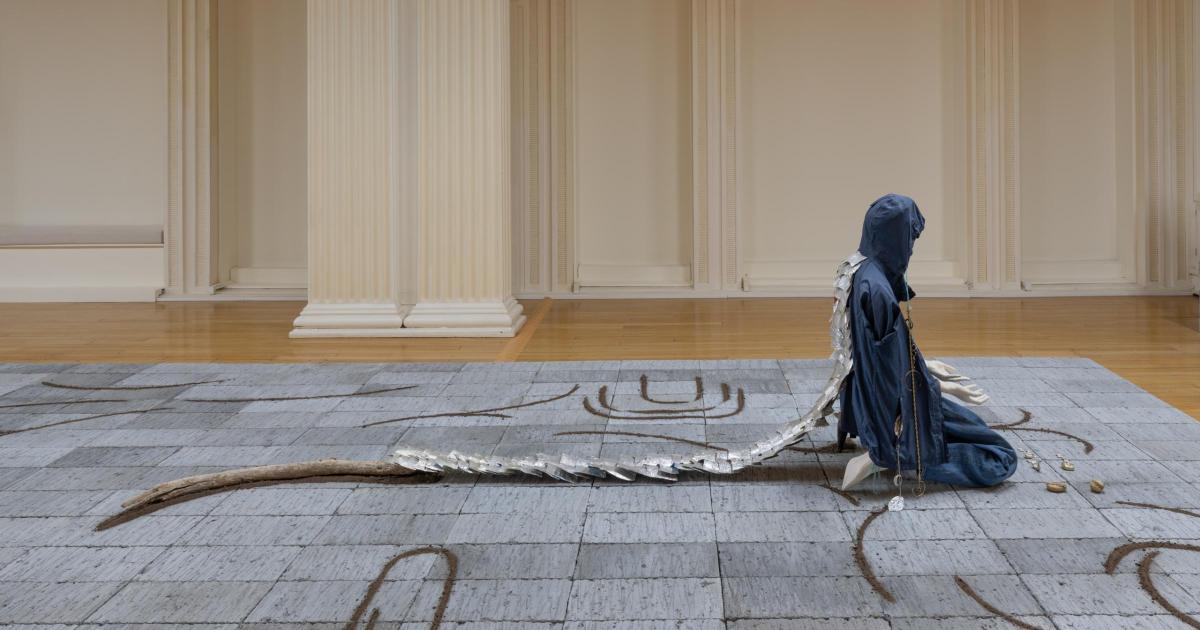
What those lights illuminate is a long, low expanse of breeze blocks which could be a road, a platform or a causeway. Sited on it at either end are sculptural figures made from material such as welded steel and cast pewter, but also found objects and items of the artist’s own clothing.
At the far end from the entrance, with her (his?) back to us, is Being (Interloper), shrouded in a hooded blue garment and kneeling with hands upright as if in supplication. He (she?) has a long silver train trailing behind like a tail. At the other end are two more sculptural figures, also eerie. One, titled Being Warrior), is constructed partly from blue plastic moped casing – the sort of thing you might find by the road after a minor collision.
Anne Hardy – Feelings – 2026 – Talbot Rice Gallery (Image: Talbot Rice Gallery)
This kind of detritus is like gold to Hardy, who lists the found materials she employs in wonderfully descriptive terms throughout. For instance a smaller sculptural piece sited on the balcony running round the room is made from (in her words) “abandoned concrete from transient zone, organised chaos, hunted objects, wild cast bronze”.
That last material features a many of the smaller sculptures, “wild” being Hardy’s description of the non-traditional method she uses. Punk casting might be another description. You’ll often find aerials embedded in them, too, though whether to receive or transmit is up to the viewer to decide. We already know there’s data firing the lights, so what else is buzzing in the air around us?
Read more Barry Didcock
Another material Hardy uses is just as elemental as air or the fire she uses to cast her bronze shapes. It is earth. The artist has sourced some of the good old common or garden Edinburgh variety and made a series of what she calls Earth Energy Drawings in situ. They look like the gestural mark-making of prehistoric cave dwellers, or perhaps abstracted hieroglyphs. Again, their meaning is shrouded in ambiguity.
A key concept in Hardy’s practice is the idea of scenography – the act of creating a sensory space in which to present work. So as well as treating the gallery itself as a sort of found object, she imposes a sense of theatricality on it. Accordingly Feelings does not exist in silence. On breeze block piles in each corner of the main room sit speakers playing an audio work, Flux, in quadraphonic audio. We hear the sounds of the natural world, but in contact with the human one – rain on concrete, for example. Or is it a tin roof?
Pleasingly unsettling, Hardy’s dramatic intervention in the gallery’s august surrounds is an aural and visual tour-de-force.
Until September 27