

The ocean is home to animals so enormous that some can outweigh entire groups of elephants, while others stretch farther than a city block. But deciding which one is the largest sea creature is not as simple as arranging them from biggest to smallest.
Should size be measured by weight, length, or the dimensions of a single body—and should colonies count as one animal? To resolve that problem, this list focuses only on creatures alive today and gives each one a different, scientifically defensible record.
1. Blue whale

The blue whale is the heaviest animal known to have lived, reaching around 30 meters (98 feet) and, in exceptional cases, an estimated 190 tonnes (209 US tons). Antarctic blue whales can also grow to approximately 33.5 meters (110 feet), although verified measurements vary between individuals.
Despite their extraordinary bulk, blue whales survive primarily on krill. Their immense mouths expand during feeding, allowing them to engulf water and strain the tiny crustaceans through baleen plates.
Their size surpasses every known dinosaur, making the biggest sea creature in the world also the largest animal in Earth’s history.
2. Giant siphonophore
A giant siphonophore recorded off Western Australia in 2020 was estimated to measure approximately 45 meters (148 feet), making it possibly the longest marine animal colony directly observed.
Researchers encountered it while exploring the Cape Range Canyon using a remotely operated vehicle.
However, a siphonophore is not one animal in the conventional sense. It is a colony formed from numerous specialized units called zooids.
Each performs a particular function, such as feeding, movement or reproduction, but cannot survive independently. That unusual biology complicates its claim to being the longest animal in the world.
3. Lion’s mane jellyfish
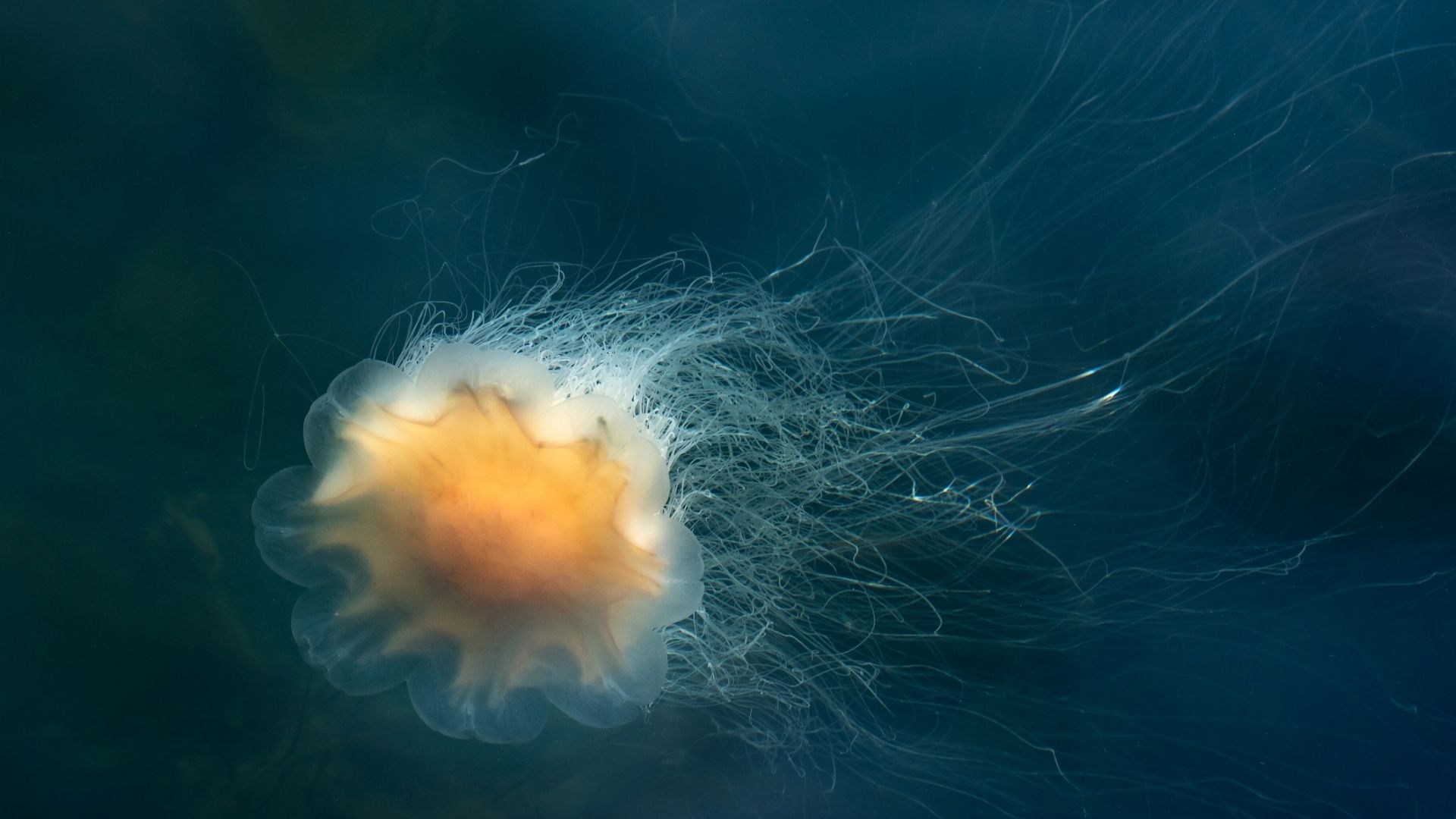
The largest reported lion’s mane jellyfish stretched approximately 36.5 meters (120 feet) from the top of its bell to the ends of its tentacles. Its bell reportedly measured more than 2 meters (6.6 feet) across.
That measurement should be treated cautiously because it comes from a poorly documented historical account. Smithsonian notes that more representative large specimens have bells approaching 1.8 meters (5.9 feet) and tentacles exceeding 15 meters (49 feet).
The jellyfish uses its long, toxin-bearing tentacles to capture fish, plankton and other jellyfish in cold northern waters.
4. Whale shark

The whale shark is the world’s largest living fish and can reportedly reach approximately 18 meters. However, most mature individuals are considerably smaller than that exceptional upper estimate.
Despite being a shark, it is a filter-feeder rather than an active hunter of large prey. It swims with its mouth open, collecting plankton, fish eggs, and small marine animals. Its spotted skin pattern is unique to each individual, allowing researchers to identify and monitor particular sharks.
5. Colossal squid
The colossal squid is estimated to grow up to 7 meters (23 feet) long and weigh as much as 500 kilograms, making it the heaviest known invertebrate.
Remarkably, scientists did not obtain confirmed footage of one alive in its natural habitat until March 9, 2025. The animal filmed near the South Sandwich Islands was a 30-centimeter (12-inch) juvenile swimming at a depth of 600 meters (1,969 feet).
The sighting occurred exactly 100 years after the species was formally named. Before then, scientists mainly studied specimens caught accidentally or remains discovered inside whales, seabirds and fish.
6. Sperm whale
Male sperm whales can reach approximately 15.8 meters (52 feet) and weigh around 45 tonnes (50 US tons), making the species the largest toothed animal alive. They also possess the largest brain of any living animal.
Unlike the filter-feeding blue whale, the sperm whale is an active deep-sea hunter. It uses powerful echolocation clicks to locate squid and fish in dark water, sometimes diving deeper than 3,000 meters (9,842 feet) and remaining submerged for over an hour.
7. Bump-head sunfish

The heaviest bony fish ever recorded was a bump-head sunfish found off Faial Island in the Azores on December 9, 2021. It weighed 2,744 kilograms (6,051 pounds), measured 3.25 meters (10.7 feet) long, and spanned 3.6 meters (11.8 feet) between its fin tips.
Its flattened body and enormous fins make the sunfish appear almost unfinished. Yet this unusual design supports one of the ocean’s most distinctive giants.
Water supports body mass more effectively than air, helping marine animals grow beyond the limits faced by land-dwelling creatures.
Even so, the ocean continues to conceal its extremes. If the colossal squid could evade observation in its natural habitat for a century, other record-breaking animals may still be waiting in the depths.
Conclusion
Water supports immense bodies in a way that air cannot, allowing marine animals to grow far larger than most creatures on land. From the blue whale’s unmatched weight to the siphonophore’s extraordinary length, these ocean giants show that size can take remarkably different forms.
Yet the most exciting possibility is that the list may not be complete. If the colossal squid remained unfilmed in its natural habitat for a century, other record-breaking creatures could still be moving through parts of the ocean humans have barely explored.