
In 2014, a team of Dutch scientists set out to conduct an unusual experiment.
They placed a hamster wheel in the wild to see whether mice would use it as they do in captivity. Not only did wild mice take to the wheel, but rats, shrews, frogs, and even slugs also interacted with it. The experiment showed that wheel running isn’t simply something captivity creates: given the chance, wild mice will voluntarily hop on and run too.

Build It and They Will Run
For decades, biologists assumed that captive mice ran on wheels simply because they were bored, stressed, or “crazed” by their cramped cages. But Johanna Meijer and Yuri Robbers from Leiden University suspected there was more to the story. They took the wheels out of the lab and into the wild to see if free-roaming animals would ignore them—or hop on for a spin.
“If wheel running is indeed caused by captive housing, wild mice are not expected to use a running wheel in nature. This, however, to our knowledge, has never been tested. Here, we show that when running wheels are placed in nature, they are frequently used by wild mice,” the researchers explained in the study.
The scientists set up a 24-centimeter running wheel in a green urban area and installed a night-vision camera and motion sensors to record how animals responded. The wheel sat inside a small, open structure that animals up to the size of a rat could freely enter and leave. Food was initially placed nearby to attract mice. To attract wildlife, they initially placed food near the wheel, but they later removed it to see if animals would still use it.
The results were delightful. Mice were by far the most enthusiastic users, accounting for 88% of recorded wheel-running events, but shrews, rats, and frogs also set the wheel spinning. Frogs sometimes hopped back and forth, while slugs and snails produced rather less athletic wheel movements. Birds occasionally visited the setup but apparently declined to join in.
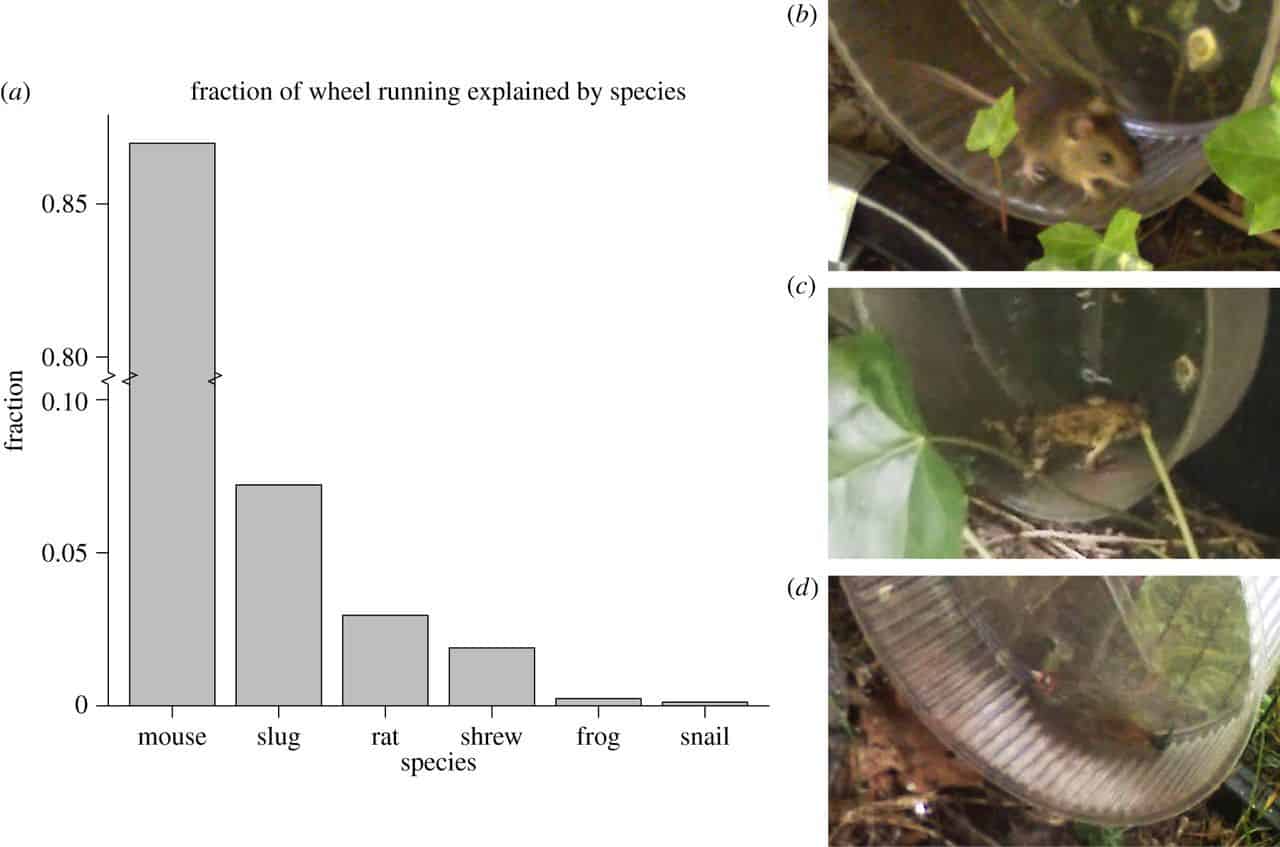 Various animals use the running wheels, though mice are by far the most common. Image credits: Meijer and Robbers.
The results were intriguing enough that the researchers installed another wheel in a nearby dune area that was closed to the public. The two experiments ultimately ran for more than three years.
Remarkably, the animals kept gathering at the wheel. Over a span of three years, the team recorded over 200,000 animal visits and analyzed more than 12,000 video clips of animals interacting with the wheels. Some individuals showed remarkably consistent behavior—one mouse ran for an astonishing 18 minutes!
×
Thank you! One more thing…
Please check your inbox and confirm your subscription.
When the food was taken away from the wheel, the number of visits dropped significantly but still didn’t decrease to zero. Also, some mice using the wheel were observed to be too young to have known that there was ever a food reward; in other words, they were just using the wheel for the sake of it.
This begs an obvious question
Why Do Mice Run on Wheels When There’s No Reward?
Researchers propose one idea that could be linked to the metabolic reward system: it’s a motor response to hunger or other stimuli related to foraging. It could also satisfy the animals’ curiosity or desire to play. This idea is backed by the fact that when the food was taken away from the wheel, fewer animals showed up — but those that did show up were more likely to use it.
“Our results indicate that while the number of visits to the recording site decreased when no food was present, the fraction of visits including wheel running increased. This implies that wheel running can be experienced as rewarding even without an associated food reward,” the researchers write.

This experiment opens up a major question: why do animals engage in wheel running when there’s no clear reward?
One theory suggests that it may be linked to a metabolic reward system, where movement provides a natural stimulus related to foraging or hunger. Another possibility is that it satisfies a fundamental instinct to play or explore new objects in their environment.
Interestingly, the study also found seasonal variations in wheel use. Mice were more likely to run during the warmer months, with peaks in late spring and summer. This coincides with the time when young mice are most active, possibly indicating that juveniles are more curious or energetic.
In 2016, animal-behavior researchers Georgia Mason and Hanno Würbel pointed out that a behavior occurring naturally in wild animals doesn’t necessarily mean that an exaggerated version of the same behavior cannot become abnormal in captivity. Pacing, for instance, can grow out of perfectly normal locomotion. Wild mice choosing to use a wheel therefore showed that wheel running itself isn’t purely an artifact of cages.
Later research has nevertheless strengthened the idea that rodents can be genuinely motivated to run and play.
A 2019 review described wheel running as a rewarding, initially goal-directed behavior that can become habitual with repeated access. And in 2025, researchers studying male mice identified part of the neural circuitry involved.
Studies have documented both solitary and social play in mice, including running, pouncing, energetic jumping, chasing, climbing over one another, and rudimentary play fighting. Researchers have even observed tame mice chasing human hands in interactions interpreted as play.
So the quirky 2014 experiment has held up rather well,
It’s likely that there’s more than just one motivation at play, but whatever the case may be, one thing is for sure: mice don’t just use the wheel in captivity, they also use it in the wild. So this is feeding a natural desire for them, not creating an artificial need. This could have implications both for people keeping mice as pets, and for researchers using lab mice.
Journal Reference: Wheel running in the wild, Published 21 May 2014 DOI: 10.1098/rspb.2014.0210
This article was originally published in January 2023 and has been since reedited to add more information.