

The Southern Trust has been challenged to explain a dramatic rise in secluding mental health patients seven years on from an investigation into over-use in one of its units of the practise deemed by health authorities as a “last resort”.
It has emerged that 65 percent of all mental health patient seclusion incidents in Northern Ireland last year occurred within the Southern Trust.
The data has once again turned the spotlight on a Co Armagh care facility run by the trust that has previously faced controversy regarding claims of over-use of seclusion and mistreatment of vulnerable patients.
Figures released by Stormont’s health minister Mike Nesbitt show that out of 162 total incidents where mental health patients were secluded in 2025, 106 occurred in the Southern Trust.
The trust’s total for last year was more than its previous four years combined.
In 2024 there were just 13 incidents in its facilities, 15 in 2023, 32 in 2022 and 27 in 2021.
The statistics were released in response to a written question from Upper Bann DUP MLA Diane Dodds, who has said the seclusion incidents occurred in the Bluestone Unit at Craigavon Area Hospital.
In 2019 it was revealed Bluestone was the focus of an independent investigation, sparked after a whistleblower raised allegations of the over-use of seclusion regarding vulnerable adult patients.
Reported incidents at the time included an elderly dementia patient being locked in their room with a chair against the door.
It was also claimed that the restraining of patients was being used too often, and without the necessary de-briefs afterwards, meaning “key learning” was lost.
Other claims included a lack of “compassionate leadership” a culture of cronyism, and the bullying of some staff.
The probe was carried out by the Royal College of Psychiatrists, and the trust said that while “no safeguarding issues” were identified, recommendations for improvement had been implemented.
The £12m Bluestone unit was opened in 2008, and other issues in recent years facing the facility include a 2021 Regulation and Quality Improvement Authority inspection that found mental health patients being cared for in reclining chairs due to a lack of beds.
Meanwhile, in July of this year, care worker Ciara Corvan was sentenced after taking degrading pictures of dementia patients at Bluestone and sharing them on social media.
The 28-year-old was handed a probation order and ordered to serve 100 hours of community service after pleading guilty to seven counts of ill treatment of patients under the Mental Health Order (NI) 1986.
The images Corvan shared on Snapchat included a vulnerable elderly patient in a bath.
Earlier this month, the Irish News revealed the Southern Trust was facing over 150 reports of alleged abuse of patients by staff at its mental health and learning disability facilities.
Speaking of the latest data on seclusion incidents, Diane Dodds told the Irish News: “I meet and am in contact with the Southern Trust leadership on a regular basis and will be raising with them why more than 65% of incidences of seclusion in mental health facilities in Northern Ireland last year occurred at the Bluestone Unit.
“I am interested to know if there were specific factors such as a particularly challenging patient, the approach of individual clinicians or differing staffing or bed pressures, which have had a marked effect on the overall statistics last year.”
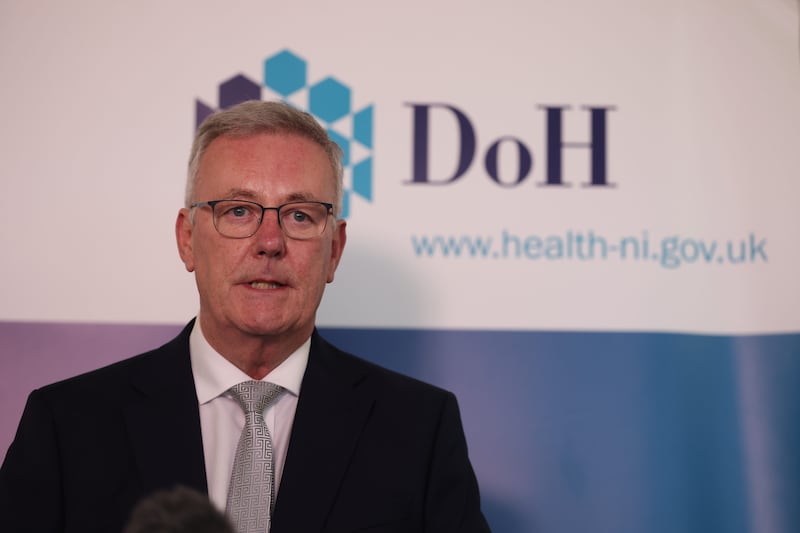 Health minister Mike Nesbitt PICTURE: PA (Liam McBurney/PA)
In his written response to Ms Dodds, Minister Nesbitt said trusts have “robust arrangements in place for the safe, lawful and appropriate use of seclusion, including clinical governance, monitoring and oversight”.
“Seclusion is a restrictive intervention that may only be used as a last resort where there is an immediate and unmanageable risk of harm to others and less restrictive interventions have been deemed insufficient,” the minister said.
He also confirmed that seclusion is not used at all within the Western Health Trust.
A Southern Trust spokesperson told the Irish News the figures can be “significantly influenced by a small number of individuals presenting with acute, severe mental illness and exceptionally high levels of risk”.
“Due to the relatively low overall number of patients requiring seclusion, a small number of complex cases can have a disproportionate impact on reported figures and may not be representative of routine clinical practice across the service as a whole,” they said.
“The Trust continually monitors seclusion data and trends through its governance structures and uses this information to identify learning opportunities, strengthen practice and reduce reliance on restrictive interventions wherever possible. We also welcome the open and transparent incident reporting culture among our staff, which enables us to learn and continually improve the quality and safety of our services.”
A Department of Health spokesperson said seclusion “is considered only as a last resort”, adding: “The Department’s Regional Policy on the use of Restrictive Practices in Health and Social Care Settings sets out standards on the use of seclusion.”